Mediterranean paradiso
Benvenuti a Plaza Delfino!
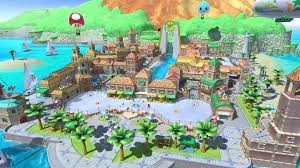
Where Mario will finally get the chance to reconnect with his Italian ancestry. Perhaps they even decided to visit some relative or Mario wants to show Princess Peach where he comes from; the important part is that we are no longer in the Mushroom Kingdom or its surrounding wacky worlds. We are now in the era where both Mario and Link are attuned to expansive bodies of water and the period where both Mario brothers decided to expand their body moveset with specialized devices attached to their backs (developed by the same inventor as it happens).
Like all things Mario everything begins with a functional gameplay idea and then a locale and story are fitted to it. This time around, for the awaited successor to Super Mario 64—which took a whopping 6 years to come out proving this series is not as milked as it could be—the best way they found to expand upon the fluidity of movement from the first 3D entry was in the figure of the Flash Liquidizer Ultra Dousing Device, better known as FLUDD, an specialized multipurpose water hose and pump that Mario uses as a backpack; the brand new shoulder buttons of the GameCube controller that allowed precise gradation inspired the developers to create a water pistol where you could control the flux of water. From there the water motif inspired the concept of summer and then developers decided to create a town with various buildings and roofs for players to experiment with their water device; and since water is now the protagonist what better than to change the setting to an island out in the sea. This is Isle Delfino, a mediterranean tropical paradise that brings Mario to his most realistic and cohesive setting yet—at least before the ridiculously realistic New Donk City literally appeared on the map—The entire game is a single location with the vacation theme where you can see every world on the horizon. The water and paradise concept makes it so that the enemy this time around is their opposite concept: pollution. There aren’t any goombas or Koopas around. Here you can use water to pretty much interact with anything and clean graffitis and goop (the shoulder buttons of the GameCube are also the reason behind Luigi’s precise control of his vacuum cleaner).
The realistic setting means we find ourselves now at the southern coast of Italy, with Isle Delfino having Italian names for its various locations and Italian signs coexisting with the strange dialect of the local Piantas (naturally, Italian for plant); the place where Mario and all of our musical terms come from. The dolphin shaped island is based around the Il Gallo Lungo island at the western part of the Amalfi Coast, whose main town directly inspired the architecture of Delfino Plaza.

If this was The Legend of Zelda then composer Koji Kondo would already have the work laid out for him, just use an Italian tarantella or any other popular folk dance from the region since the music from Zelda is based around location and environment; but Mario music is all about movement so a pleasant gondola tune won’t do—perhaps only in an alternate reality where Mario’s vacation is not ruined—Instead, Kondo uses the typical melodic phrases and Italian folk instruments like acoustic guitars, mandolins and accordion (or organetto which is the Italian equivalent) as starting points; and since Yoshi is also here we get his drums. These the composer decides to combine with and once again capture the frenetic Mario movements with the fast paced rhythms of gypsy jazz, the preeminent European jazz music that serves as foil to the Latin jazz heard all across the Mushroom Kingdom and its surroundings, just like the rhythmic style was used for the main theme of Super Mario World, a callback to Yoshi and Mario first ever ruined vacation in a tropical island. Even though back in the SNES era Koji Kondo wanted game music to be completely original and did so by pairing instruments you would not normally see together in a real world example, by the time the GameCube came along with more realistic samples and the realistic setting of Super Mario Sunshine he now decided to use instruments you would hear on a real Italian ensemble; still, his originality ambitions for game music still remain by using the instruments to play the gypsy jazz style.
Musical Analysis
The GameCube had now the potential for a big instrument set and much more recorded music. Despite this, Koji Kondo did not change his approach, going for the simplicity of a small sequenced ensemble. He focuses more on the dynamics of the samples and manipulate volume and vibrato to create realistic articulation for his instruments. The Italian organetto phrases and guitar lick chorus are laid on top of the fast paced staccato guitar and possibly a mandolin accompaniment straight from the gypsy jazz of Django Reinhardt, a Romani musician that established the genre conventions in part due to an accident where he lost the movement of two of his fretting fingers, forcing him to develop a workaround for this and the result was coming up with a style with certain chord shapes and melodic lines where chromatic movements, chord that are close together and diminished shapes are king. Another aspect of the style is based on the chord shapes Reinhardt was forced to use due to his injury. Standard barre chords are not as common in gypsy jazz. Major and minor chords are almost never played, and are replaced by often broken major 7th chords, major 6th chords, and 6/9 chords implied by just three notes. Gypsy jazz groups generally consisted of a lead guitar, violin, two rhythm guitars and bass. The rhythm guitars supply the percussive rhythm called la pompe, which, in conjunction with strongly syncopated bass lines, makes a percussion section redundant. Unlike American jazz that features prominently the horns, gypsy jazz is based around guitar, making it sound more acoustic and folkloric.
Koji Kondo captures this rhythm playing and harmony in the way he sequences the piece, with two different guitars strumming in slightly different fashion to create the effect that there are two actual rhythm guitarists. Adding to this authenticity are the three note chords with open voiced notes as they would sound in a real life plucked string instruments. The main progression is based around the voice leading of chromatically descending notes that are part of the chord progression A – Gdim – D6 – Ddim9 which contain inside the note line: E, G, F#, F which give it the chromatic flavor that propels the harmony. The bass player also finds his own chromatic line on those chords: A, Bb, B , E. It is chromaticism all the way down. The piece only needs a single bar to establish its full progression. Technically there is a quick C#m chord at the beginning but in the context they are just muted strings, an imitation of the chucka chucka percussive sound you produce when you strum it with no particular strings pressed.
Like all Mario main themes the piece starts with an intro hook that never returns for the loop (the main theme of the series being the one exception that Koji never pulled off again (Yoshi’s Island one does not really have a hook intro but the more traditional vamp intro). This pre-intro immediately puts us on the Italian setting with the notes of the accordion phrase bringing the chromatic flavor and establishing the A key with the dominant chord E7.
Like its spiritual predecessor, the Super Mario World theme the piece then goes into the harmony-establishing Intro (the other Mario main themes go straight to the melody). The lead guitar plays the choruses of the composition based around a motif that repeats itself three times, the first two exactly the same question-answer block that fit within the 1-bar progression and then the last repetition the same question with a longer tail answer that closes the phrase and leaves its last note, the tonic, for an extra bar. The guitar melody is plucked with bravado and with more dynamics, as if Django is using his plectrum to play it with force.
For the B section many themes go to the IV chord. For Delfino Plaza this is D, kickstarting the vamp between D and tonic A; this is similar to the B Section of the main theme of the series. As part of its duties as a contrasting section the melody is now taken over by the organetto, playing chromatic passing notes with longer question-answer blocks. Each chord is now sustained for a full bar. Once again the melody are two almost equal question-answer blocks followed by a third with the tail answer; balance between variety and repetition is achieved with the second question-answer block of the melody ending on the tonic as opposed to the first time. However, on this occasion there is a fourth question-answer block since the third one ended up on the dissonant and inconclusive Bb, where the harmonic profile of the piece changes since the chord used here is F#7 in place of the expected F#m of the A Ionian/Major profile. The fourth question-answer block is over the F chord which is borrowed from the parallel A Aeolian/Minor scale, adding chromaticism straight into the chord changes with the full progression being:
D – A – D – A
D – A – E – F#7 – F – E
The bass player has fun with walking bass lines that foreshadow the changing of the harmonic profile. In typical Super Mario fashion, unlike the A Section which in Mario music most of the time ends up resolving to the tonic, this one ends with the cliffhanger of the dominant (only Yoshi’s Island, Super Mario 64 and Super Mario Bros 2 themes end their B sections on the I).
Apparently both the Delfino Plaza theme and the music for the Motel 6 commercial have the same musical kernel in these jazz influences since they sound very similar:
Unlike the other Mario themes with C sections, this one goes back to its A section as the main hook and chorus of this rondo form piece. This second time there is just one instance of the melodic period as opposed to two, the next section coming up in less time.
For the C Section the harmony profile of the piece changes one again, the bass player stays on the pedal note A while the rhythm guitars go between A and G, a vamp that always screams Mixolydian profile. The accompaniment is then transposed to the C Mixolydian profile going back and forth between C and Bb. The organetto plays a chordal melody following the underlying harmony. The phrases are still based on question-answer blocks; first one ends up on a lower A then the second on the upper A. The piece returns to the A key based profile and the chords change with a faster pace each two beats even though the melody profile is the same. The jazzier progression being:
A6 – B7 – E –
E6 – F#7 – Bm – E7
The B major chord coming courtesy the A Lydian profile.
The V chord prepares us for another repetition of the A Section. Once again just one instance of the melody. The track appears to loop at this point, repeating the intro vamp. But no, there is one last section that uses the same progression from A Section, with the accordion playing its more Italian melody yet. Since the piece needs balance, another question-answer block based section would not be as interesting so this one uses a long phrase based melody that sounds as if the accordionist is improvising one last lick as an outro that ends its lines on the note E. Ever since the original Super Mario Bros. Overworld there has not been a D section on a Mario main theme. The piece loops directly to the A section, omitting the Intro establishing progression.
Imported from the India smuggled in some gypsy caravan is Yoshi along with his tabla, which this time around are not the traditional bongoes from Super Mario Word meant to convey the horse quality of this dinosaur. The tabla is slightly detuned to G which is outside the A Ionian/Major scale,
Following the trend that started on Super Mario World and continued on Super Mario 64—although there the hub world was not the main theme—Koji Kondo decided to create a main theme and then rearrange it for various levels since he feels this kind of repetition makes the world feel more cohesive and makes the music more memorable, something that he believes modernity brings down since there is so much more music written for a project than in the early days, so tunes don’t tend to stick as easily. The worlds closer to the plaza like Ricco Harbor, Gelato Beach and Bianco Hill are based on this composition, along many other smaller cues; the further you go from the plaza the further the music goes from it. Unlike the other Mario games, this main theme is played on the hub world of the game.
This is the first Mario where every world has its own unique music. There is so much music that this is the era where projects often need multiple composers in order to be completed successfully; on this one, Kondo gets the help of composer Shinobu Tanaka—now Shinobu Nagata since it is suspected she married fellow Nintendo composer Kenta Nagata—who provides pretty much all the non-Defino Plaza based compositions. Even though the locale is based around the European mediterranean coast, there are still Latin influences on the soundtrack, with some calypso, ska and samba infused tunes that color this brand new locale for Princess Peach and her cohort of now colored and with more personality Toads. Some classic Mario melodies also turn up—like the underground music from Super Mario Bros, newly arranged here as Shadow Mario’s theme, the acapella Super Mario Bros. series theme which is found on the special levels that served as the inspiration for the free form Super Mario Galaxy worlds. This was also the first try of the Mario series at voice acting, which Shigeru Miyamoto requested to remove on later entries since he felt voices made Super Mario seem closer to a children property than the more universal language of silence and mumbles from the early days.
In contrast with The Legend of Zelda series, composer Koji Kondo has been continually more involved with the Mario series which is closer to heart due to the Latin jazz influences. From the original Super Mario Bros down to the more recent entries like Super Mario Odyssey and Super Mario Wonder, Koji Kondo remains the driving force for the tone of each main Mario game.

Help to keep the rites going around here by supporting the shrine:

Media Files, requests and support for more interactive content

Thou shall donate since this is a cult and you are now a sheep

Help staying awake analyzing game tracks and writing posts or else everything will end up being written by A.I
- Inside The Score – The Legend of Zeda: A Link to the Past – End Credits / Staff Roll
 The land rests As the last few minutes of this extensive journey that has now come to an end fly by, the nostalgia and reflective mood kicks in. Because such a massive enterprise as a Zelda game or a Lord of the Rings movie require multiple endings to convey everything… Read More »Inside The Score – The Legend of Zeda: A Link to the Past – End Credits / Staff Roll
 - Inside The Score – The Legend of Zelda: A Link to the Past – Ending / Epilogue ~ Beautiful HyruleFinal of the fantasy The Triforce has been touched. A wish has been granted. For the occasion, the newly undeceased king of Hyrule has commissioned a march in honor of the legendary hero to the Hylian Sousa, who might as well be composer Nobuo Uematsu since this piece is very… Read More »Inside The Score – The Legend of Zelda: A Link to the Past – Ending / Epilogue ~ Beautiful Hyrule
- Inside The Score – The Legend of Zelda: A Link to the Past – Triforce Chamber / Power of the GodsTake your boots off your feet And thus the Triforce spoke to men. And it became present in history. And you better treasure and contemplate this moment seldom witnessed in the course of the series. The elusive opportunity to interact and touch the most important artifact. You are now in… Read More »Inside The Score – The Legend of Zelda: A Link to the Past – Triforce Chamber / Power of the Gods
- Inside The Score – The Legend of Zelda: A Link to the Past – Ganon Battle / Prince of DarknessProgressive evil En Garde! And you better be prepared since you are about to duel the iconic enemy of the series at perhaps his canonically most powerful incarnation. Right after having touched the sacred Triforce which allowed him to conquer all of the Golden Land and whose evil and darkness… Read More »Inside The Score – The Legend of Zelda: A Link to the Past – Ganon Battle / Prince of Darkness
- Inside The Score – The Legend of Zelda: A Link to the Past – Boss Battle / Anger of the GuardiansQuick mayhem Ah, the simpler times when boss battles where not a multi epic orchestral suite but just an ostinato more basic that even what became the music for standard battle encounters out there. We are a long way from each boss having his own personalized track. And this early… Read More »Inside The Score – The Legend of Zelda: A Link to the Past – Boss Battle / Anger of the Guardians
- Inside The Score – The Legend of Zelda: A Link to the Past – Dark World Dungeon / Dungeon of ShadowsMemento mori We are getting closer to Ganondorf (or at least the wizard Agahnim who ultimately fulfills the same human side of evil role in this game) and that means getting closer to the profiles and motifs of his own theme song (which naturally was the theme of Agahnim at… Read More »Inside The Score – The Legend of Zelda: A Link to the Past – Dark World Dungeon / Dungeon of Shadows