Nuts ‘n’ Bolts
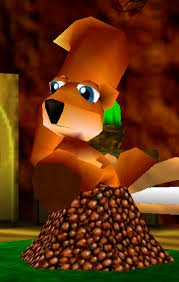
Nabnut’s Theme serves as a little time capsule of how Banjo-Kazooie sounded originally; innocent, earnest cartoon music appropriate for cute anthropomorphic animals, as if the squirrel is skipping, moving about in short, twitching movements without a care in the world through lush woods saying hello to all his animal friends (although in reality he has some cares). It remains in the game due to the developers at Rare finding it very catchy and addictive, one of their favorites, which surprises Grant Kirkhope since it was an easy song to write. The composition complies with the small children music most basic guideline standards: simple, repetitive melodies that are easy to remember and are structured in a very symmetric and delineated question-answer blocks on top of exclusively and unambiguously major tonalities, a far cry from the zany, slightly darker tone the music acquired mid development. Yet, the use of chromatic trills and a minor chord as opposed to the expected I IV V scheme chords adds an air of melancholy to the melody that gives it more character. Additionally, the piece is not in C major like many other tracks in the game; whenever this is the case, we know we probably are in an F tonality. It is also a bit of an anomaly in that it does not have an intro.
This is all very much in line with the cartoon influences of Nabnut, the squirrell, who is preparing to receive his girlfriend—of course pink colored— for the winter hibernation and needs the help of Banjo and Kazooie through the various seasons to collect food for storage. Animals are a staple of children media and stories, going back to Mickey, the mouse when it comes to cartoons or even Aesop fables in literature, since they posses reliable features and personalities that are easy to distinguish at a glance, sometimes even codified in the species they are supposed to represent—like wolf and snakes are usually not good guys, predators and poisonous creatures are just evil—They’re animals who think, talk and act mostly like human beings. The Funny Animal has almost all the mannerisms of people. Sometimes, only their appearance distinguishes them from the hairless primates who draw them. The world of the bear and the bird is a world of funny animals just like many of the golden age of animation; even though both Banjo and Nabnut live in houses and conditions that share similarities with human beings, Banjo belongs to the dressed animal cartoon category while Nabnut doesn’t.
Musical Analysis
Structure: {ABA’ – O }
Tempo: 130
Melodic and Harmonic Profiles: F Ionian/Major
The music takes the motif and harmony previously heard on the cue ‘Bottles’ puzzle Challenge’ and runs with it—even though this was likely composed first and is the original source of the motif and harmony—It relies on the same question motif and only altering slightly the answering phrases in order to create repetition, changing only the pitches to adapt to the underlying harmony. It still retains the bouncyness and effervescence of the Banjo-Kazooie style; the oom-pah rhythm is there, just more delicate courtesy of the pizzicatos sounding like the skipping steps of a light animal. There are basically just two melodies and then small variations and permutations of the A melody.
The basic harmony for the A section is
F – C7 – Gm – C7 – F
The contrasting B section naturally goes to the subdominant or fourth degree of the scale, in this case Bb, generating a descending voice leading based progression:
Bb – F – C7 – F
Bb – F – G7 – C
Or alternatively, just like the pizzicatos play it, the C7 can be seen as an Edim chord, and G7 as a Cdim one. Functionally they are the same thing, serving as leading chords to the tonic and to the dominant respectively (the key of becoming leading is the economy of movement to the root of the next score, just a half step).
The most spicy chord is the G since it does not belong to the F major scale, serving as a small bridge and pseudo-dominant to the chord C. After that, Grant just plays around with the A Section to create new sections, one with the melody harmonized with a voice on top in thirds, sounding to the ear like a new melody since the ear tends to favor the tune in the higher voice. Another is changing the instruments that play the melody and then finishing off with repeating exclusively the answer phrases iteratively, as if to drill it more into the ear.
Just how much Rare likes the tune? A lot apparently since it was one of only two tracks to receive a special treatment in an official soundtrack release of Banjo-Kazooie, where it was remixed and rearranged with better sounding samples (the other one was the cinematic overture).
Nabnut is not the only animal friend of this animated fable. There are many more animals not represented in the sound effects found on these woods. Woodpeckers are not the only construction workers in animal land after all.

Help to keep the rites going around here by supporting the shrine:

Media Files, requests and support for more interactive content

Thou shall donate since this is a cult and you are now a sheep

Help staying awake analyzing game tracks and writing posts or else everything will end up being written by A.I
- Inside The Score – Super Mario All-Stars – Ending Theme (SMB)
 Wedding bells Romance is in the air. Before credit themes were introduced into the series we had this little hymn for Princess Toadstool of the Mushroom Kingdom. A wedding march for when the plumber and the princess tie the knot at the end of the series—so never, since Peach works… Read More »Inside The Score – Super Mario All-Stars – Ending Theme (SMB)
 - Inside The Score – Super Mario All-Stars – Bowser Final Battle (SMB)Last show down The companion piece to the previous track in which composer Soyo Oko goes beyond the call of duty to musicalize the final battle of the original game even if it is not that much different from the other encounters with king Koopa (which technically are minions disguised… Read More »Inside The Score – Super Mario All-Stars – Bowser Final Battle (SMB)
- Inside The Score – Super Mario All-Stars – Bowser Battle (SMB)Latin fire Here is composer Soyo Oka bringing us yet another heavy metal subgenre from the millions that sprout each week—since even adding a cello to a song is apparently a new subgenre—in the form of Cuban metal. So try and enjoy this dance instead of killing king Koopa right… Read More »Inside The Score – Super Mario All-Stars – Bowser Battle (SMB)
- Inside The Score – Super Mario All-Stars – Castle (SMB)Inferno The musical equivalent of two walls closing in to crush you. The serpentine track written for the Koopa castle is the pinnacle of claustrophobia, taking the dissonance of the Underground theme to its extreme in this diminutive cue that keeps going and going stressing you out throughout the castle… Read More »Inside The Score – Super Mario All-Stars – Castle (SMB)
- Inside The Score – Super Mario All-Stars – Underwater (SMB)Floating in three steps A waltz that today is not only a famous video game track but a piece of music worth of being cultural heritage of a classical repertoire even if it has a diminutive length. Because this tune is as recognizable in pop culture as other famous waltzes… Read More »Inside The Score – Super Mario All-Stars – Underwater (SMB)
- Inside The Score – Super Mario All-Stars – Underground (SMB)Obscure influences The environment where the Mario brothers thrive and where we first encountered them both having fights with turtles; the reason why we even have pipes in the first place. This is the underworld, which is meant to be a juxtaposition with the colorful world above in all senses… Read More »Inside The Score – Super Mario All-Stars – Underground (SMB)