Underwater bliss
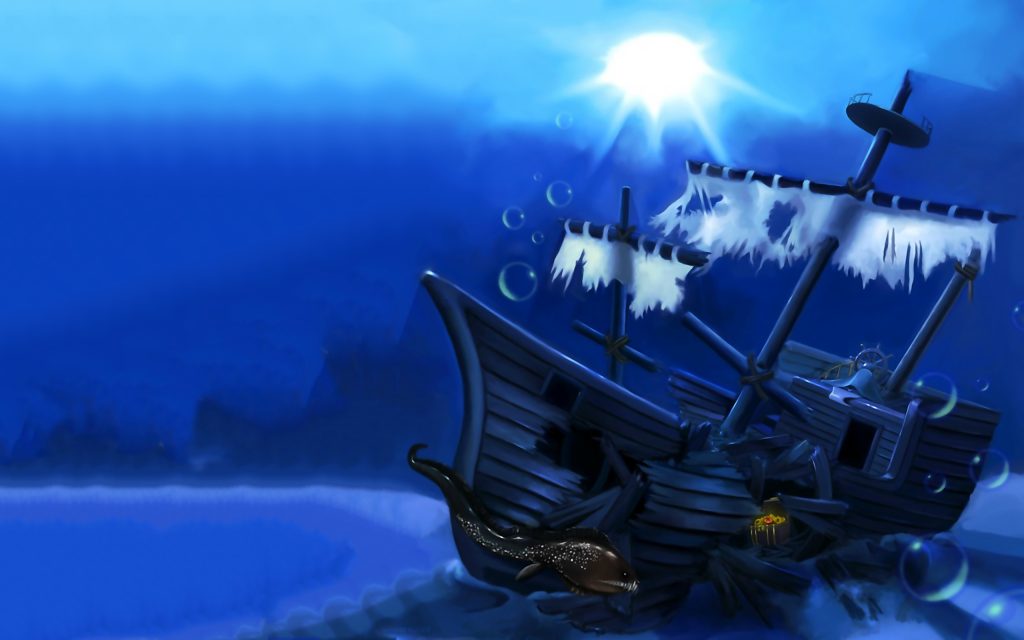
The only track that can give Aquatic Ambience a run for its money in the battle for the most iconic aquatic ambient theme in video game music. Even so, while the song from Donkey Kong Country was a technical marvel with each sound painstakingly crafted to convey its atmosphere, for the Super Mario 64 one composer Koji Kondo just selected the most generic patches and samples of the 80s and 90s floating around and called it a day. Miraculously, it all ends of working out by sheer force of melody, harmony and proper context. Still, there is some tech behind the way that the score responds to the environment; we are entering the era of truly interactive game music.
In less expert hands the overuse of the classic electric piano sound of all manner of melodramatic RnB ballads of the time would deem a piece too sappy or cheesy. The key was not going for a key, instead Kondo goes for his traditional modal mixture and stays away from being perceived as strictly major or minor for the most part.
Unlike the other main series that Koji Kondo scores, The Legend of Zelda, Mario music was all about movement first, environment second. Kondo is very particular that the music should capture the rhythms of Mario’s actions. The brand new 3D world Mario found himself in now allowed for more realistic movements in water environments, slower and less bouncy than in previous entries; this allowed the composer to stray from the path of the waltz rhythms that traditionally accompanied the water levels from the Super Mario series till that point and insert a more atmospheric track that now captures both the movements and environments. Its shimmering sounds even mix quite nicely with the coin and life meter sound effects from the game (in fact, it is also the same instrument used in the ‘Star appears’ cue).
Musical Analysis
Koji Kondo crafted a soothing sound out of the classic electric piano patch that originated in the Yamaha DX7 synthesizer. When you think of 80s ballad music some of the sounds that come to mind are precisely these sparkly electric pianos, pure sounding basses and cheesy orchestral elements. Many of these sounds came from one synthesizer: the Yamaha DX7. Dire, Dire Docks has them all but it never sounds like a ballad, just a true water environment experience, as if you are just floating around reflecting about life. The DX’s most famous sound: the E.Piano 1 preset, which is factory preset 11 not only appears in countless Whitney Houston songs but was also popular in soundtracks like the TV show Twin Peaks; in fact, Koji was already beaten to the punch in using these sounds in a water setting by the Disney film The Little Mermaid, which features heavily this patch throughout the score. So it was a possible inspiration or composers just gravitate to it because it somehow sounds watery and delicate.
Because of the popularity of the patch in the 80s, virtually every digital synth that came after the DX7 featured some sparkling electric piano preset that emulates this famous sound. The one specifically that was used for Super Mario 64 is found on the Roland JD-990, which is an updated version of the Roland JD-800 synthesizer in the form of a module with expanded capabilities. The patch is named I-63 Crystal Rhodes 1 and was sampled at the G5 key for the Nintendo 64; the composer added chorus effect in the final version of the track. Yes, by the way there was an early version which was featured on the beta version of Super Mario 64 in which the patch sounds way more dry and the piece lacked all of its other layers. It could be heard in the versions played during early showcases of the game. This is what it sounded like:
Because of course one of the greatest features of the theme is that it was one of the first Nintendo experiments with music that dynamically shifts depending of what happens in the level, a technique that would be employed to great effect in The Legend of Zelda: Ocarina of Time which was developed at the same time that Super Mario 64. The Dire, Dire Docks theme as originally heard in the game employs some nicely deceptive techniques in order for its loop to appear longer than it really is, with the Intro serving double duty and roleplaying as a new musical section later on; this is all possible thanks to the dynamic music possibilities offered by sequencing music in the Nintendo 64 as opposed to just pre recording the music. For starters, in Jolly Roger Bay the piece will only add strings whenever the player enters the water. This allows the intro to always sound without the strings since the player will always start on land. When the song loops and the player is presumably now underwater the string melody somehow makes the pensive intro feel not only as a new section but now even as the climax to the composition. Later on, when the player arrives at a cave the drum kit and bass are added and the song acquires a faster feeling since the player is now running around dodging enemies and hazards inside it, the music now trying to capture these movements since Mario music is all about the actions. The other Water Level—the one actually called Dire, Dire Docks—uses it in similar fashion, although the strings don’t enter until the player is at a certain underwater tunnel while the drums appear whenever one reaches the submarine terrains.
For the Super Mario 64 score Koji Kondo decided to employ once again the technique from Super Mario World where the idea was to take a main theme and repurpose it throughout the game for the different environments and actions the player found themselves in. Even so, Dire, Dire Docks is one of the few tracks that are not based around the main theme from Super Mario 64.
For the final version the patch was now heavily modified to have more of an underwater feel, with lots of chorus and reverb effect thrown in and then sampled for the N64. Musically, the pedal arpeggio that kickstarts the piece now sounds as if water bubbles are slowly coming up and then exploding each time the D4 interval is sounded. The composition is mostly based around G major but borrowing chords from other parallel modes like the F major chord and the Eb major chord; they are the reason why this piece is salvaged from sounding like any other ballad from the time period and instead bring with them a more epic feel straight from..Zelda? Of course we are talking about the classic major Andalusian progression or the Zelda cadence, or the inverse Mario cadence if you prefer. Which is playing with the I – bVII – bVI sound that composer Koji Kondo favors for that heroic, mythical feel.
Structurally, even though the piece feels longer thanks to the dynamic instruments that enter in and leave depending of what happens in-game, the loop itself only has 4 sections; the Intro (aka also section D)-A-B-A-C.
The harmony of the piece begins with the G to F progression before taking us down to the bVI (Eb) and then coming back to the bVII (F).
Section A continues playing with this progression G – F – Eb
As it is standard for contrasting sections, the next one goes to the IV chord, C in this case. Now we are unambiguously on the Ionian/Major profile, a lifting change of pace. The full harmony is:
C – G – Am – G
C – G – Gdim – Am – D
The Bb present in the diminished chords getting us out of the major key comfort zone.
Melodically, both A and B sections have clearly defined question-answer blocks with section A repeating the same question-answer block twice although the question and answer each has very different melodic profiles in rhythm and notes. In contrast, Section B has two different question-answer blocks but with similar melodic profiles between question and answer (except for the last answer which is a cadence back to the A section). All is balanced and symmetrical.
After another A section we go to the last one. C section doesn’t have much of a melody but instead it serves as a kind of pre-chorus for the climax of the revamped Intro, anticipating the strings that will likely be in the track by this point. The harmony for this part goes something like F – Eb – D – Ebmaj7 – D.
Koji then writes a climatic string melody that works with the same chords for the Intro in order to make appear the track deceptively longer.
Throughout the piece there is tasteful piano playing that feels organic and not sequenced, with little notes here and there and also slight rhythm changes in the left hand. The wavelike arpeggios fall naturally thanks to well placed voice leading that is melodic in nature. Song does not care at all about drum kit accurate playing since these drum parts are not possible to play by a real drummer (you would need like four hands).
There is also the clean bass sound of the fretless bass sample used. A fretless bass is an electric bass guitar whose neck and sound are both smooth like traditional string instruments since it has that legato quality between notes that compliments the synth sounds of the piece. As a matter of fact, the track has what we could unambiguously call a mistake or oversight from the part of the composer. During the first time we hear the A Section where the harmony is going down G – F – Eb, the bass player completely forgets to change to the F, playing a G note which clashes against the F and really has no musical contribution; we can safely say it is an error that ended up in the final game and soundtrack since the other times this progression repeats now the bass note goes to the F. The bass is fortunately low in the mix and always sounds alongside the drum kit so in is not that noticeable.
The soundtrack version released on CD has a different mix with more reverb and of course since it cannot show the dynamic nature of the track it just mixes in the instruments in a way that makes musical sense. Here is a possible mix that could be found in the game. also, for listening pleasure purposes the tempo on the soundtrack version was also sped up from 133 in-game to roughly 138 bpm.
As a bit of trivia Jolly Roger Bay is dark and foggy the very first time you enter it, then bright and sunny afterwards for the rest of that save file, even if you go back to the first star.

Help to keep the rites going around here by supporting the shrine:

Media Files, requests and support for more interactive content

Thou shall donate since this is a cult and you are now a sheep

Help staying awake analyzing game tracks and writing posts or else everything will end up being written by A.I
- Inside The Score – Super Mario All-Stars – Ending Theme (SMB)
 Wedding bells Romance is in the air. Before credit themes were introduced into the series we had this little hymn for Princess Toadstool of the Mushroom Kingdom. A wedding march for when the plumber and the princess tie the knot at the end of the series—so never, since Peach works… Read More »Inside The Score – Super Mario All-Stars – Ending Theme (SMB)
 - Inside The Score – Super Mario All-Stars – Bowser Final Battle (SMB)Last show down The companion piece to the previous track in which composer Soyo Oko goes beyond the call of duty to musicalize the final battle of the original game even if it is not that much different from the other encounters with king Koopa (which technically are minions disguised… Read More »Inside The Score – Super Mario All-Stars – Bowser Final Battle (SMB)
- Inside The Score – Super Mario All-Stars – Bowser Battle (SMB)Latin fire Here is composer Soyo Oka bringing us yet another heavy metal subgenre from the millions that sprout each week—since even adding a cello to a song is apparently a new subgenre—in the form of Cuban metal. So try and enjoy this dance instead of killing king Koopa right… Read More »Inside The Score – Super Mario All-Stars – Bowser Battle (SMB)
- Inside The Score – Super Mario All-Stars – Castle (SMB)Inferno The musical equivalent of two walls closing in to crush you. The serpentine track written for the Koopa castle is the pinnacle of claustrophobia, taking the dissonance of the Underground theme to its extreme in this diminutive cue that keeps going and going stressing you out throughout the castle… Read More »Inside The Score – Super Mario All-Stars – Castle (SMB)
- Inside The Score – Super Mario All-Stars – Underwater (SMB)Floating in three steps A waltz that today is not only a famous video game track but a piece of music worth of being cultural heritage of a classical repertoire even if it has a diminutive length. Because this tune is as recognizable in pop culture as other famous waltzes… Read More »Inside The Score – Super Mario All-Stars – Underwater (SMB)
- Inside The Score – Super Mario All-Stars – Underground (SMB)Obscure influences The environment where the Mario brothers thrive and where we first encountered them both having fights with turtles; the reason why we even have pipes in the first place. This is the underworld, which is meant to be a juxtaposition with the colorful world above in all senses… Read More »Inside The Score – Super Mario All-Stars – Underground (SMB)