Follow the leader
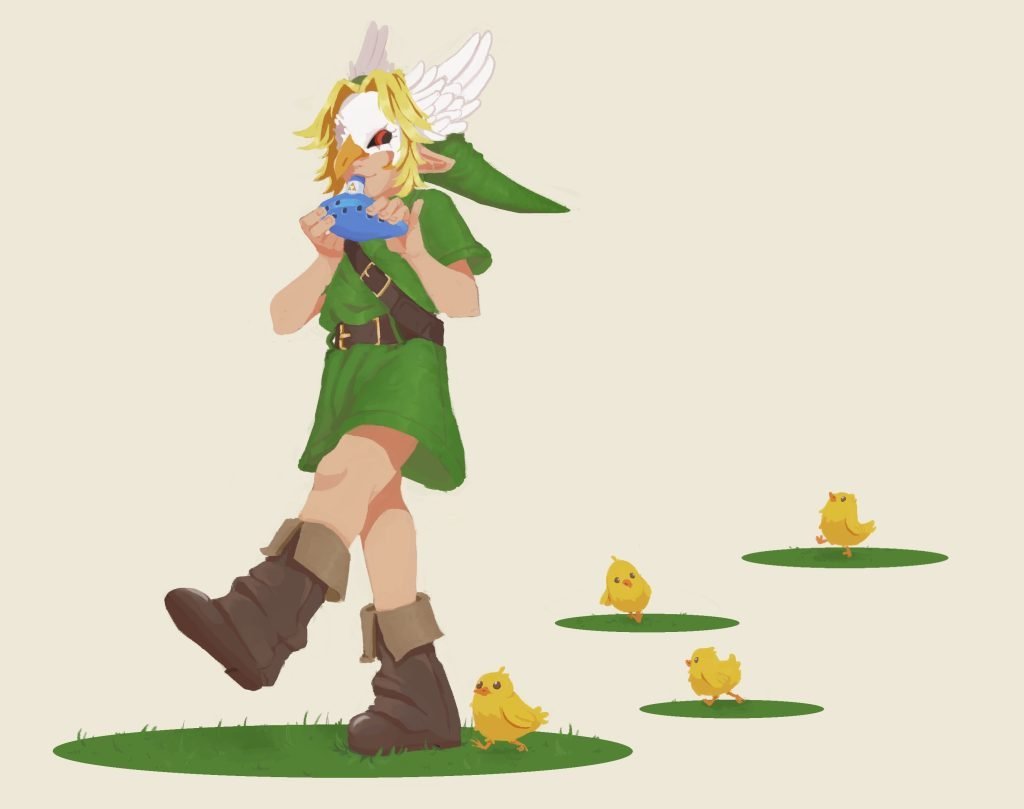
We reach one of the Majora’s Mask niche genres for the first time with this little fun track attached to the Bremen mask. The war music genre, or martial music, which will be used on three tracks in the score for the game, the later two instances in a more serious setting and context.
The Bremen Mask has one of the most bizarre origin stories; ultimately, it’s all about Link learning the qualities of being a good leader. Yet, it originally belonged to a dog who was leader of an animal troupe (that included a man since, as he tells it, a human is also an animal). The organ grinder, who belonged to this troupe, stole the mask from the dog because he claims that the human should be the leader of all animals; he wants to unburden his guilt with someone and Link is there, ready to give an ear to his story. Who came out with this scenario? Is this some kind of meta commentary about something? Environment? Countries? Politics? Whatever the case, this little story together with the name of the mask seems to be referencing the German folk story known as the “Town Musicians of Bremen” about a group of animals who decide to run away and form their own musical troupe.
Since with this mask Link becomes the leader of any animal troupe he encounters, the music is appropriately a march to lead his troops. Military music is a specific genre of music intended for use in war or training settings, performed by professional soldiers called field musicians. This music comes straight from World War II cartoons (like the ones made by the Disney company in order to survive financially) and all of the numerous patriotic statements and propaganda made; it could certainly fit in one of those educational videos about the military were not for the childish connotations of an ocarina and playground connotations of the melody. The mask also seems to be based on a bald eagle—which ends up being the lead of a group of chickens— the national animal of the United States of America; so who knows, maybe there are some kinds of connections they were trying to make between the USA, patriotism and military leadership, as the country has these qualities as one of its tenets.
Another possibility is that the theme is meant to bring the image of a second fairy tale, The Pied Piper of Hamelin, another classic German story often referenced in popular culture; The story is often brought in connection with charismatic leadership. a story describing a piper, dressed in multicolored clothing, who was a rat catcher hired by the town to lure rats away with his magical music; he ends up using his instrument’s magical power on the village’s children, leading them away as he had done with the rats. So yeah, perhaps the whole concept was pertaining fairy tales and fables, where animals are protagonists.
Musical Analysis
Structure: Section 0 / Section 1 / Section 2
Time Signature: 2/4
Tempo: 120
Melodic and Harmonic Profiles: F Ionian/Major
A standard march tune with steady tempo in F major, made more interesting by using the flat fifth and flat sixth note from time to time; it is a single melody line accompanied by your standard percussion from a military institution, the snare having all the responsibility of giving dynamism to the piece by accentuating certain points. The use of the ocarina is obviously meant to be diegetic, as the player can watch Link marching and playing along with his own instrument. There is a simple melody with the clearly defined structure of two main question-answer blocks (the first three phrases have the same exact rhythmic profile, a staple of easily remembered children tunes…or motivational phrases for soldiers) in which the last phrase predictably ends on the tonic. It sounds both patriotic for the troops and innocent for the fact that our troops are usually cute animals (it also works to control the not so cute troops of Ikana though). All in all, a playful game of kids playing soldier. The low timpani is meant to be and big ol military bass drum.
Many themes of this style have been made, with one of the most iconic being the music from the film The Great Escape (1963)—about World War II of course, the go-to war for Hollywood movies— where the main title’s patriotic march has since become very popular in Britain. It has similarities to the Bremen march in structure and cadences.
Well, it was nice to spend some extra time in Clock Town helping other fellow humans. But the hero has to embark once again outside of his land and onto the land of the second imprisoned giant, another mountain where the Goron tribe once again lives, paralleling the same adventure he had in Hyrule; this time however, the Goron are literally out of their element since as it is always the case with Termina, everything is twisted and reversed.
As a fun fact, guru-guru is the Japanese sound effect word for turning round and round.

Help to keep the rites going around here by supporting the shrine:

Media Files, requests and support for more interactive content

Thou shall donate since this is a cult and you are now a sheep

Help staying awake analyzing game tracks and writing posts or else everything will end up being written by A.I
- Inside The Score – Super Mario All-Stars – Ending Theme (SMB)
 Wedding bells Romance is in the air. Before credit themes were introduced into the series we had this little hymn for Princess Toadstool of the Mushroom Kingdom. A wedding march for when the plumber and the princess tie the knot at the end of the series—so never, since Peach works… Read More »Inside The Score – Super Mario All-Stars – Ending Theme (SMB)
 - Inside The Score – Super Mario All-Stars – Bowser Final Battle (SMB)Last show down The companion piece to the previous track in which composer Soyo Oko goes beyond the call of duty to musicalize the final battle of the original game even if it is not that much different from the other encounters with king Koopa (which technically are minions disguised… Read More »Inside The Score – Super Mario All-Stars – Bowser Final Battle (SMB)
- Inside The Score – Super Mario All-Stars – Bowser Battle (SMB)Latin fire Here is composer Soyo Oka bringing us yet another heavy metal subgenre from the millions that sprout each week—since even adding a cello to a song is apparently a new subgenre—in the form of Cuban metal. So try and enjoy this dance instead of killing king Koopa right… Read More »Inside The Score – Super Mario All-Stars – Bowser Battle (SMB)
- Inside The Score – Super Mario All-Stars – Castle (SMB)Inferno The musical equivalent of two walls closing in to crush you. The serpentine track written for the Koopa castle is the pinnacle of claustrophobia, taking the dissonance of the Underground theme to its extreme in this diminutive cue that keeps going and going stressing you out throughout the castle… Read More »Inside The Score – Super Mario All-Stars – Castle (SMB)
- Inside The Score – Super Mario All-Stars – Underwater (SMB)Floating in three steps A waltz that today is not only a famous video game track but a piece of music worth of being cultural heritage of a classical repertoire even if it has a diminutive length. Because this tune is as recognizable in pop culture as other famous waltzes… Read More »Inside The Score – Super Mario All-Stars – Underwater (SMB)
- Inside The Score – Super Mario All-Stars – Underground (SMB)Obscure influences The environment where the Mario brothers thrive and where we first encountered them both having fights with turtles; the reason why we even have pipes in the first place. This is the underworld, which is meant to be a juxtaposition with the colorful world above in all senses… Read More »Inside The Score – Super Mario All-Stars – Underground (SMB)