Cursed clowns
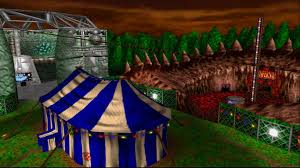
We are entering a Banjo-Kazooie spree. It seems that the respective safety authorities have been bribed since now we get to enter the famous park operated by the witch Gruntilda, who truly appears to be a tycoon outside her fairy tail home at Spiral Mountain.
This is the level where Banjo, Kazooie and their music were always meant to be; they feel at home now. In fact, this was a world planned for the first game originally. Because only a decayed amusement park of doom where a bear and a bird can do multiple acrobatics is able to capture the fun yet slightly twisted and sinister vibe of the series. So pretty much all elements are present here. And this particular park also allows for it to be kind of a mini hub world where various kinds of environments are able to coexist.
So enjoy it at your own peril and remember that only those that survive the attractions are able to become part of the members’ club. Current members: 0.
Musical Analysis
The music of the series always sounded like drunk, evil clowns bouncing alongside the playfully sinister tracks and dark cabaret tunes inspired by the work of Danny Elfman. So here is where it feels at home the most. A park whose central landmark is a huge circus. As always, just like the park, music theory breaks down whenever Grant Kirkhope is at the helm; he breaks all possible music theory rules by following his zany method of just looking for the odd chord and then trying to force a melody into them, the tunes serving as the connective tissue that ultimately make the pieces make sense. Therefore, as one of the definitive statements of the Banjo series tone, it has almost all of the usual suspects except for the frantic rhythm that will be reserved for the benefit of Mr. Patch. Here the park sounds at a more sinister pace and completely mechanical (there is not one iota of swing in the oom-pah rhythms here) since the cartoon orchestra is mimicking the sounds that are often produced on the calliope which is the ultimate carnival and park instrument since it could use the steam already produced at the parks—like in carousels—to keep operating forever. This means the pan flute is not meant to sound tribal here but like a steam powered whistle on a calliope. For real calliopes, since the pitch of each note is largely affected by the temperature of the steam, accurate tuning is nearly impossible; however, the off-pitch notes, particularly in the upper register, have become something of a trademark of the steam calliope. This characteristic is not mimicked here.
Here you can hear a version with only the harmony. Banjo Tooie seems to have more minor based songs than its predecessor. The closest profile to the piece would be the Melodic Minor in the key of A—or whatever scale that has a minor tetrachord as its head and a major tetrachord as its tail, creating this uncanny balance between happy and sad apt for this level; Grant always prefers to have as the base the white note scales on the piano so either C major of A minor, and then play around with multiple borrowed chords. Later the piece is transposed one tone down to G. The track also has an emphasis on dominant seventh chords to spice things up. The full harmony section by section would be:
Intro
Am – Am/Ab – Am/G – Am/Gb – F7 – E7 – Am
Here we got the basic chords of the piece. The first thing you notice is that popular compositional device of using a pedal chord and then move the bass line chromatically down also heard in popular tracks like Michelle from The Beatles. The main chords of the piece will be the i, the VI and the V, a new progression for the series.
Section A
Am – F7 – Am – E7
Am – Bb – B – E7
As always the melody follows the profiles of their respective chords. The blusier notes of the seventh chords enhance the sinister vibe. The endings of phrases often use those vaudeville and showbiz devices of running through a scale to reach the tonic. The section repeats and ends with the pedal chord device of the intro.
Section B
Am – F7 – Am – F7 – E7
Am – F7 – Am – E7 – F7 – E7 –
The back and forth section where vamps between chords are created and the trombone melody rises and falls down alongside them. The pipe organ enters here to introduce the haunted park feeling to the proceedings. The coda of Section A follows. This would be the tightrope walker section. This part was inspired by the track Chase from Project Dream:
Section C
D7 – G – E7 – Am
Eb – B – F – D7 – Gm
Lots of Kirkhopisms here. Contrasting sections often go to the fourth chord, here in major form. We also get his tritone chord movement from Am to Eb and B to F, and then the flat sixth chord movement from Eb to B, all preparing the piece to reach its new G minor profile via its V7.
Section D
Gm – Eb – Gm – D7
Gm – Eb7 – D7
The most carnival sounding section thanks to the pan flute melody. We play around with the same chords but in the G profile.
The last part is just Section B but a whole step down. it forces its way back to the original key in preparation for the loop which includes the full song with the intro just like a calliope would.
You are truly on a carousel of death here and both level and music are a perfect realization of the tone of the series as a whole.
Speaking of The Beatles chord progressions, they had also played with this sinister circus style on one of their songs, which might have inspired this track altogether.

Help to keep the rites going around here by supporting the shrine:

Media Files, requests and support for more interactive content

Thou shall donate since this is a cult and you are now a sheep

Help staying awake analyzing game tracks and writing posts or else everything will end up being written by A.I
- Inside The Score – The Legend of Zeda: A Link to the Past – End Credits / Staff Roll
 The land rests As the last few minutes of this extensive journey that has now come to an end fly by, the nostalgia and reflective mood kicks in. Because such a massive enterprise as a Zelda game or a Lord of the Rings movie require multiple endings to convey everything… Read More »Inside The Score – The Legend of Zeda: A Link to the Past – End Credits / Staff Roll
 - Inside The Score – The Legend of Zelda: A Link to the Past – Ending / Epilogue ~ Beautiful HyruleFinal of the fantasy The Triforce has been touched. A wish has been granted. For the occasion, the newly undeceased king of Hyrule has commissioned a march in honor of the legendary hero to the Hylian Sousa, who might as well be composer Nobuo Uematsu since this piece is very… Read More »Inside The Score – The Legend of Zelda: A Link to the Past – Ending / Epilogue ~ Beautiful Hyrule
- Inside The Score – The Legend of Zelda: A Link to the Past – Triforce Chamber / Power of the GodsTake your boots off your feet And thus the Triforce spoke to men. And it became present in history. And you better treasure and contemplate this moment seldom witnessed in the course of the series. The elusive opportunity to interact and touch the most important artifact. You are now in… Read More »Inside The Score – The Legend of Zelda: A Link to the Past – Triforce Chamber / Power of the Gods
- Inside The Score – The Legend of Zelda: A Link to the Past – Ganon Battle / Prince of DarknessProgressive evil En Garde! And you better be prepared since you are about to duel the iconic enemy of the series at perhaps his canonically most powerful incarnation. Right after having touched the sacred Triforce which allowed him to conquer all of the Golden Land and whose evil and darkness… Read More »Inside The Score – The Legend of Zelda: A Link to the Past – Ganon Battle / Prince of Darkness
- Inside The Score – The Legend of Zelda: A Link to the Past – Boss Battle / Anger of the GuardiansQuick mayhem Ah, the simpler times when boss battles where not a multi epic orchestral suite but just an ostinato more basic that even what became the music for standard battle encounters out there. We are a long way from each boss having his own personalized track. And this early… Read More »Inside The Score – The Legend of Zelda: A Link to the Past – Boss Battle / Anger of the Guardians
- Inside The Score – The Legend of Zelda: A Link to the Past – Dark World Dungeon / Dungeon of ShadowsMemento mori We are getting closer to Ganondorf (or at least the wizard Agahnim who ultimately fulfills the same human side of evil role in this game) and that means getting closer to the profiles and motifs of his own theme song (which naturally was the theme of Agahnim at… Read More »Inside The Score – The Legend of Zelda: A Link to the Past – Dark World Dungeon / Dungeon of Shadows