Duality of bear
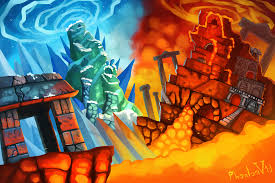
The duality of man, or rather of bear and bird. Because a series based around the contrasting personalities of its main characters sooner or later had to tackle such a level; the true twin peaks.
Because why waste two levels with the generic lava and ice biomes when you can get a clever and more original concept by combining the two and have them interact in diverse ways? Seeing as these elements are opposites the developers can play directly with their respective tropes. Hailfire Peaks was another level that was originally planned for the first game but ended up on the sequel, two volcanoes with some Greco-Roman architecture sprinkled in which two twin dragons live; so it seems the lava side is the main inspiration overall. Banjo-Kazooie gave us four levels in one but now Banjo-Tooie makes the two levels in one more differentiated, serving as a huge world that can be seen as an island surrounded by sea above from the clouds. Now this kind of environment is one that can only exist within cartoon logic so don’t think too hard about how this ecosystem is sustained (although some volcanoes can actually appear at the earth’s poles such as Mount Erebious in Antartica).
Musical Analysis
As for the music, the lava side also seems to be the main theme from which the other one is a rearrangement. This is due to the fact that the theme has a passing resemblance to typical Middle Eastern fire levels found in countless video games. It has some differences from standard Banjo-Kazooie fare; for starters, Grant Kirkhope gets a lot of mileage from just a single chord by putting it against a catchy main melody that is repeated constantly and serves as the basis for the melodic variations heard on the third section. The track also just pretty much has three sections with the different sections repeating the same melodic material but giving them to different instruments as if they are taking turns to play the tunes. We also get some different instruments, with an emphasis on brass instruments, usually reserved for battles, and the monks from the Jigggywiggy Temple joining in to give it a sense of ancientness to this Roman world. The bass saxophone shows that Grant is not afraid to go even lower when it comes to this characteristic raspy tone from the Banjo series. There is also sound design going on via lava bubbles, an underground ambience and unatural sounding orchestral cymbals played at such low pitch that they become sound effects characteristic of volcanic activity rather than musical instruments.
The main instrument here are the horns played at their most aggressive articulation that capture the fiery volcano. They are the first to tackle the main melody which is played against a C harmony made with just octaves, all contributing to the monolithic sound. Making use of just a C note as the entire harmony functions as a kind of droning sound apt for ancient cultures. There is also a not so often heard emphasis on the major seventh interval as a core identity of the melody, this note alongside the Phrygian tetrachord as the tail of the scale also makes the piece stand out from the other tracks in the game. it could be a snake charmer melody if you were to play it with a more nasal sounding instrument.
The B Section does not go to the fourth this time around but to the bII, making the piece more Phrygian sounding and thus more Middle Eastern and thus more ancient. The harmony for this part can also be thought of as the Kirkhope cadence which uses the tritone chord of the dominant degree, so Db – G. The guitar plays only during this part obviously meant to sound like one of those Middle Eastern lutes like the oud. It is not as cartoony as other tracks because of the specific instruments chosen—although the saxophones will always sound chunkily comedic and quirky in the series.
After this, the main melody repeats a single time with additional accompaniment and then onto its variations with the zany and convoluted chord changes we are used to in the Banjo world. As always, the melody adapts to each underlying chord. For Section C the piece goes to the bVI chord, a favorite move in the series and then to endearingly awkward chords such as the tritone chord of that bVI until it manages to stumble back to the C tonic chord as it always does no matter how far it travels via the Kirkhope cadence [bII – V – I]. The full run would be:
Ab – F – Ab – D
B – Ab – B – F
Bb – Ab – Db – G
The anchor point is the Ab chord which serves as the basis of the vamps found within the multiple key changes that occur by just looking for odd chords (minors not permitted entrance).
After this the main theme repeats and then a single run of the B Section before the loop; Banjo themes often get D sections so this is one of the less complex. The instruments serve both melodic and accompaniment roles throughout the piece.

Help to keep the rites going around here by supporting the shrine:

Media Files, requests and support for more interactive content

Thou shall donate since this is a cult and you are now a sheep

Help staying awake analyzing game tracks and writing posts or else everything will end up being written by A.I
- Inside The Score – The Legend of Zeda: A Link to the Past – End Credits / Staff Roll
 The land rests As the last few minutes of this extensive journey that has now come to an end fly by, the nostalgia and reflective mood kicks in. Because such a massive enterprise as a Zelda game or a Lord of the Rings movie require multiple endings to convey everything… Read More »Inside The Score – The Legend of Zeda: A Link to the Past – End Credits / Staff Roll
 - Inside The Score – The Legend of Zelda: A Link to the Past – Ending / Epilogue ~ Beautiful HyruleFinal of the fantasy The Triforce has been touched. A wish has been granted. For the occasion, the newly undeceased king of Hyrule has commissioned a march in honor of the legendary hero to the Hylian Sousa, who might as well be composer Nobuo Uematsu since this piece is very… Read More »Inside The Score – The Legend of Zelda: A Link to the Past – Ending / Epilogue ~ Beautiful Hyrule
- Inside The Score – The Legend of Zelda: A Link to the Past – Triforce Chamber / Power of the GodsTake your boots off your feet And thus the Triforce spoke to men. And it became present in history. And you better treasure and contemplate this moment seldom witnessed in the course of the series. The elusive opportunity to interact and touch the most important artifact. You are now in… Read More »Inside The Score – The Legend of Zelda: A Link to the Past – Triforce Chamber / Power of the Gods
- Inside The Score – The Legend of Zelda: A Link to the Past – Ganon Battle / Prince of DarknessProgressive evil En Garde! And you better be prepared since you are about to duel the iconic enemy of the series at perhaps his canonically most powerful incarnation. Right after having touched the sacred Triforce which allowed him to conquer all of the Golden Land and whose evil and darkness… Read More »Inside The Score – The Legend of Zelda: A Link to the Past – Ganon Battle / Prince of Darkness
- Inside The Score – The Legend of Zelda: A Link to the Past – Boss Battle / Anger of the GuardiansQuick mayhem Ah, the simpler times when boss battles where not a multi epic orchestral suite but just an ostinato more basic that even what became the music for standard battle encounters out there. We are a long way from each boss having his own personalized track. And this early… Read More »Inside The Score – The Legend of Zelda: A Link to the Past – Boss Battle / Anger of the Guardians
- Inside The Score – The Legend of Zelda: A Link to the Past – Dark World Dungeon / Dungeon of ShadowsMemento mori We are getting closer to Ganondorf (or at least the wizard Agahnim who ultimately fulfills the same human side of evil role in this game) and that means getting closer to the profiles and motifs of his own theme song (which naturally was the theme of Agahnim at… Read More »Inside The Score – The Legend of Zelda: A Link to the Past – Dark World Dungeon / Dungeon of Shadows