False parade
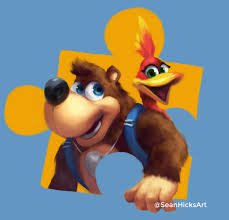
Here we are, tackling “the end” credits of the game. That does not amount to much when we are dealing with a game that likes to subvert expectations. Is a game show trivia contest truly the culmination of the quest? Well, we already know Rare has a penchant for misleading staff rolls as seen in the first Donkey Kong Country; nonetheless, while that was a quick gag, here it appears very convincing, the bear and the bird receiving a royal parade in celebration of their return to home. The credits for Banjo-Kazooie are also different in the sense that the characters themselves present the names of the developers in their particular chopped voice style.
Musical Analysis
Structure: {I – ABC – A’B’C’ – D – EFG}
Tempo: 120
Melodic and Harmonic Profiles: C Ionian/Major; F Ionian/Major; G Ionian/Major; C Aeolian/minor
Both the heroes and the developers are celebrated with a threefold procession mixing elements of regal fanfares, military marches and cartoon music in the same composition. We see the similar descending accompaniment figure previously heard in the bass for the Gnawty’s Theme cue, eliminating the “pah” part of the oom-pah rhythm in order to make it more elegant; there is also the snare used to keep the pace for marching soldiers all across the world alongside the brass section playing in ceremonial, royal fashion.
The composition is yet another variation of the main theme of the series; something anticipated. A theme that by this point will be already very familiar to the player since they would have heard its multiple versions spread throughout the game, like in the file select, pause menu, Banjo’s house, furnace fun among other multiple nods to it; the nyah nyah nyah chant has never sounded this regal. The first thing to notice about the melody is that the theme loses its characteristic tritone note, as if evil has finally been dispelled from the world. This is in line with the idea of making the cue sound triumphant and decorous, there is no trace of the quirkiness of the series here, there was just no place for it here; it s genuinely celebratory and victorious. Instead of the F#, the tune happily conforms itself with following the notes of the underlying Ab harmony. Just like with Grunty’s Furnace Fun, the original fiddle interjection played by Mumbo on the opening number is replaced with what the answering phrase actually is supposed to sound in pretty much all versions of the theme—just a transposition of one of the kazoo answering phrases—making the Mumbo fiddle part the anomaly. It is carried by lush strings intermingled with trumpet fanfares and percussion accentuating certain moments and transitions.
Another difference with respect to the way the melody is usually managed occurs during the section where the piece is based around the pair [G – Eb]—when the banjo instrument returns in the opening number. Here, the answer melody ascends to an upper D note instead of descending to the lower D, slightly altering the melody and allowing the piece to extend this section with another repetition of the [G – Eb] question-answer block, this time an octave higher. This gives it extra excitement and drills in the victorious sense.
Unlike, say, the pause music or Grunty’s Furnace Fun, the piece is allowed to go to the outro of the original opening number—the cue for inside Banjo’s house and the file select theme are the others that include the outro melody— not before giving another pass to the other sections, this time based around the woodwinds.
However, this version of the original outro, instead of capping it all off with the shave and a haircut type of ending, goes into a completely different path, a more Nintendo type of ending direction, with a section of new material that follows the template of making the endings feel nostalgic and yearning, with that tinge of melancholy that is brought by I – IV chord movements and ambiguity between major and minor profiles; there is a series of cascading cadences that find the piece moving counterclockwise through the circle of fifths, the harmony jumping by perfect fourths in the fashion of C – F – Bb – Eb (in principle, you could extend the journey through the circle of fifths as long as you like). The horns get mileage out of voice leading in order to extend each chord. The melody follows the micro key changes, playing notes pertaining to the C scale in the C – F pair and then following those of the parallel minor above the Bb – Eb. The accompaniment rhythm also changes to be more subdued and yearning.
After that, it gets more nostalgia inducing when the bassoon takes the melody and the strings are entrusted with an harmony focusing in the minor chords that the Banjo series shied away from for the most part, using all the minor chords belonging to the C major profile and getting even more closer to the Nintendo ending sound. The full Progression can be seen as:
Dm – G – Dm – G
Em – Am – Em – Am
F – G – F – G
And following the Nintendo type of ending it goes for the Grant Kirkhope version of the Mario cadence at the end, which brings everything to an heroic conclusion, going back and forth between the borrowed Ab and Bb chords and then ending on the dominant which is where the grand string ascension takes us back to the beginning of the loop.
The ending progression being:
Ab – Bb – Ab – Bb
Gsus4 – G
A cadence just like that of the full Tooty’s Theme.
Speaking of Tooty’s Theme, Grant is also deploying here leftovers from the compositions he originally made for Project Dream, which is the case whenever the music strays far from the Banjo-Kazooie sound. Yet, even though he had a treasure trove of unused themes that could have perfectly fit the ending or other parts of the game, like, for example, parts of the main theme of that game, later used for Viva Piñata, Grant decides to combine them with Banjo-Kazooie original melodies in order to preserve cohesiveness and give the themes more memorability. This new section is taken from literal royalty since it was originally meant for a character known as the Elvking. Grant probably realized it worked perfectly for an ending too.
Unlike other staff roll credits the piece is designed as any other gameplay piece of the game, looping as opposed to having a proper ending. In fact, both times that the cue is used it ends at arbitrary points. So it was certainly not designed to follow the visuals on screen other than to fit the royal parade of characters and acknowledgment that the game has been conquered.
Alas, this is not the case, as the party that awaits Banjo and Kazooie at home is interrupted by the intrusive thought that the player might have forgotten to deal with something before being allowed to relax.

Help to keep the rites going around here by supporting the shrine:

Media Files, requests and support for more interactive content

Thou shall donate since this is a cult and you are now a sheep

Help staying awake analyzing game tracks and writing posts or else everything will end up being written by A.I
- Inside The Score – Super Mario All-Stars – Ending Theme (SMB)
 Wedding bells Romance is in the air. Before credit themes were introduced into the series we had this little hymn for Princess Toadstool of the Mushroom Kingdom. A wedding march for when the plumber and the princess tie the knot at the end of the series—so never, since Peach works… Read More »Inside The Score – Super Mario All-Stars – Ending Theme (SMB)
 - Inside The Score – Super Mario All-Stars – Bowser Final Battle (SMB)Last show down The companion piece to the previous track in which composer Soyo Oko goes beyond the call of duty to musicalize the final battle of the original game even if it is not that much different from the other encounters with king Koopa (which technically are minions disguised… Read More »Inside The Score – Super Mario All-Stars – Bowser Final Battle (SMB)
- Inside The Score – Super Mario All-Stars – Bowser Battle (SMB)Latin fire Here is composer Soyo Oka bringing us yet another heavy metal subgenre from the millions that sprout each week—since even adding a cello to a song is apparently a new subgenre—in the form of Cuban metal. So try and enjoy this dance instead of killing king Koopa right… Read More »Inside The Score – Super Mario All-Stars – Bowser Battle (SMB)
- Inside The Score – Super Mario All-Stars – Castle (SMB)Inferno The musical equivalent of two walls closing in to crush you. The serpentine track written for the Koopa castle is the pinnacle of claustrophobia, taking the dissonance of the Underground theme to its extreme in this diminutive cue that keeps going and going stressing you out throughout the castle… Read More »Inside The Score – Super Mario All-Stars – Castle (SMB)
- Inside The Score – Super Mario All-Stars – Underwater (SMB)Floating in three steps A waltz that today is not only a famous video game track but a piece of music worth of being cultural heritage of a classical repertoire even if it has a diminutive length. Because this tune is as recognizable in pop culture as other famous waltzes… Read More »Inside The Score – Super Mario All-Stars – Underwater (SMB)
- Inside The Score – Super Mario All-Stars – Underground (SMB)Obscure influences The environment where the Mario brothers thrive and where we first encountered them both having fights with turtles; the reason why we even have pipes in the first place. This is the underworld, which is meant to be a juxtaposition with the colorful world above in all senses… Read More »Inside The Score – Super Mario All-Stars – Underground (SMB)