Damsel undistress
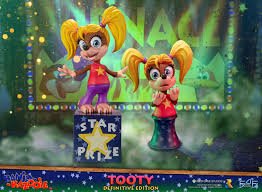
The rescue party has arrived. The heroes just had to surmount getting the star prize in a game show as opposed to slaying a dragon on top of a volcano in order to save the damsel in distress. And even though the washing machine and the Grunty plushy might be tempting for someone like Kazooie, this whole adventure was for the sake of Tooty; time to go home. Apparently the whole quest took less than a day to complete. Fable time be like that.
We get the tracks in sequence, the winning fanfare, the Grunty lose anthem and the full Tooty theme whose incomplete version was heard during the opening cinematic.
Musical Analysis
Structure: Section 1 / Section 2 {ABA} / Section 3 {ABA’}
Tempo: 160 / 50 / 135
Melodic and Harmonic Profiles: C Ionian/Major; C Harmonic minor; C Aeolian/Minor; C Mixolydian
As for being the winning contestants, they are celebrated with a royal fanfare, one tinted with Hollywood jazz harmony pertaining to the branding of the Grunty’s Furnace Fun show. This jazzyfied harmony is certainly something no king of old would have heard back when actual fanfares were performed at the castle, making this cue more akin to the famous 20th Century Fox fanfare heard in cinema, an American show biz fanfare. Even so, the instruments are the standard ones for fanfares. It is an ascending figure with the brass playing a chordal melody and the orchestral percussion reinforcing moments (naturally, the timpani also offer harmony grounding). The trumpets and horns spread a chord across the spectrum and use inversion to climb higher towards more excitement. First manipulating a C chord, then the minor chord between C and G paves the way for the Hollywoodization of the harmony that takes over the bulk of the answering phrase of the melody (the timpani by staying in C are combined with the brass minor chord [Em] to form a Cmaj7). This means adding a lot of color with the cool seventh and sixth chords.
The full harmony embedded in the melody of the fanfare can be though of as
C – Cmaj7 – C – G – C
Fm6 – C
The minor fourth degree chord does not belong to the C major scale, making it a borrowed chord. With an added pleasant sixth, this movement [iv6 to I] has served well to finish many fantasy stories in American media, giving a magical shine to the proceedings; it is basically the Hollywood cadence (IV – iv – I is also widespread). The voice leading makes it elegant due to the economy of movement (the C note stays put, the Ab and F just move a half step to their destiny). These movements are also featured in such cinematic pieces as Also Sprach Zarathustra by Richard Strauss.
The game then takes the piss out of Gruntilda by playing the most stripped, deflating version of her Lair—or more precisely, the version first hear for the beauty steal machine, which lacks the bouncier mini transposition to Eb major— mocking her defeat with a sad trombone and bored musicians doing the bare minimum to get through the piece with almost no effort. This piece will return later when Grunty is completely conquered.
As for the family reunion, we hear the complete opposite from the musicians, a faster version of the Tooty’s Theme heard in the opening cutscene with a fully open hi-hat bouncing in joy alongside more instruments, like the calliope clarinet added in to celebrate her release. We also hear the missing part from her theme, a more epic B section that uses modal profiles. Whenever these more solemn and grand profiles are heard we can infer that we are in Project Dream territory, the precursor to Banjo-Kazooie which was a more fantasy oriented setting; these classical modes feel more at home in those pirate fantasy adventures than whatever madness is the standard harmony of the Banjo sound. As previously mentioned, Tooty’s Theme began life as the music for the heroine Madeleine—just going by their names we know who is the more cartoony gal— so that makes Tooty end up with loftier music. Nonetheless Grant puts in effort and brings it to a less mythical, bouncy level by employing the cartoon orchestra, calliope like sound and the baritone sax that no fantasy game would ever possibly take seriously, fitting it more for Tooty’s needs.
The harmony is the high sounding back and forth between Gm and C, making it MIxolydian in sound. And how do epic heroic themes have to end? Of course not the wacky Kirkhope one but the Mario cadence, which borrows two chords from the parallel minor and then ends up ascending to the tonic; or sorta, the intention is there but Grant Kirkhope adds the tense dominant chord in suspended form below a thrilling flute ending before restarting the loop in the tonic after just another A Section doubled by the bassoon.
The full progression being
Gm7 – C – Gm7 – C
Ab – Bb – Gsus4 – G
The adventure is finished. The end credits and royal parade await our heroes. Sadly for the protagonists, Rare has a track record for false endings.

Help to keep the rites going around here by supporting the shrine:

Media Files, requests and support for more interactive content

Thou shall donate since this is a cult and you are now a sheep

Help staying awake analyzing game tracks and writing posts or else everything will end up being written by A.I
- Inside The Score – The Legend of Zeda: A Link to the Past – End Credits / Staff Roll
 The land rests As the last few minutes of this extensive journey that has now come to an end fly by, the nostalgia and reflective mood kicks in. Because such a massive enterprise as a Zelda game or a Lord of the Rings movie require multiple endings to convey everything… Read More »Inside The Score – The Legend of Zeda: A Link to the Past – End Credits / Staff Roll
 - Inside The Score – The Legend of Zelda: A Link to the Past – Ending / Epilogue ~ Beautiful HyruleFinal of the fantasy The Triforce has been touched. A wish has been granted. For the occasion, the newly undeceased king of Hyrule has commissioned a march in honor of the legendary hero to the Hylian Sousa, who might as well be composer Nobuo Uematsu since this piece is very… Read More »Inside The Score – The Legend of Zelda: A Link to the Past – Ending / Epilogue ~ Beautiful Hyrule
- Inside The Score – The Legend of Zelda: A Link to the Past – Triforce Chamber / Power of the GodsTake your boots off your feet And thus the Triforce spoke to men. And it became present in history. And you better treasure and contemplate this moment seldom witnessed in the course of the series. The elusive opportunity to interact and touch the most important artifact. You are now in… Read More »Inside The Score – The Legend of Zelda: A Link to the Past – Triforce Chamber / Power of the Gods
- Inside The Score – The Legend of Zelda: A Link to the Past – Ganon Battle / Prince of DarknessProgressive evil En Garde! And you better be prepared since you are about to duel the iconic enemy of the series at perhaps his canonically most powerful incarnation. Right after having touched the sacred Triforce which allowed him to conquer all of the Golden Land and whose evil and darkness… Read More »Inside The Score – The Legend of Zelda: A Link to the Past – Ganon Battle / Prince of Darkness
- Inside The Score – The Legend of Zelda: A Link to the Past – Boss Battle / Anger of the GuardiansQuick mayhem Ah, the simpler times when boss battles where not a multi epic orchestral suite but just an ostinato more basic that even what became the music for standard battle encounters out there. We are a long way from each boss having his own personalized track. And this early… Read More »Inside The Score – The Legend of Zelda: A Link to the Past – Boss Battle / Anger of the Guardians
- Inside The Score – The Legend of Zelda: A Link to the Past – Dark World Dungeon / Dungeon of ShadowsMemento mori We are getting closer to Ganondorf (or at least the wizard Agahnim who ultimately fulfills the same human side of evil role in this game) and that means getting closer to the profiles and motifs of his own theme song (which naturally was the theme of Agahnim at… Read More »Inside The Score – The Legend of Zelda: A Link to the Past – Dark World Dungeon / Dungeon of Shadows