Progressive evil
En Garde!
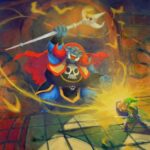
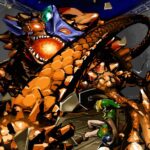
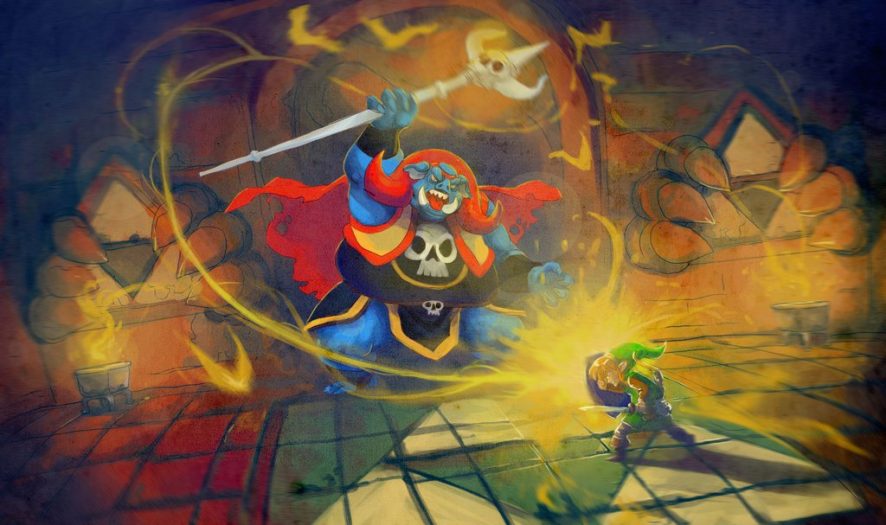
And you better be prepared since you are about to duel the iconic enemy of the series at perhaps his canonically most powerful incarnation. Right after having touched the sacred Triforce which allowed him to conquer all of the Golden Land and whose evil and darkness are pouring out into Hyrule. It is the showdown of the century even if it is not in full HD 4k but just with cute 16-bit sprites, where Ganon still looks like an almost cute demon pig with a traditional bad guy design down to the skull necklace and magic demonic trident.
This is all before the Middle Eastern associations. Just like the dragon Bowser, who was based on the Ox King from Journey to the West, the classic literature work in the East akin to something like the Iliad in the West or the Arab One thousand and One Nights, the original design of Ganon was based on that of the character Zhu Bajie which would be familiar to pretty much anyone in Japan; in the Chinese novel he is a terrible humanoid monster that’s part-human and part-pig, who often gets himself and his companions into trouble through his laziness, gluttony, and propensity for lusting after pretty women (the character of Oolong in the Dragon Ball series is also based on this figure). Other than his design and general unpleasantness, the character of Ganon as the king of evil does not have much relation with the one on the novel. Ganon is your archetypal dark overlord from fantasy that wants power, commands an army of monsters and needs to be defeated. Basically a devil figure with even an ominous cape that villains love to wear thanks to Dracula. Even his name seems so be inspired either by Sauron from Lord of the Rings or the word ‘Demon’
He is the origin of the Dark World, which is molded on his soul. In A Link to the Past we get a first approach to an origin story for his character, being an evil thief that entered the Golden Land and after getting his hands on the Triforce, the darkness of his heart transforms him into a pig that is a reflection of his inner self just like a bunny is for the hero Link (poor pigs ended up with all kinds of unpleasant associations in media due to their habits which stem from historical farming conditions that forced them into unsanitary environments, and their natural omnivorous diet, which can include scavenging). It is only in Ocarina of Time where we get to witness his transformation from man to pig in real time.
Musical Analysis
As for his very first battle theme, he seems to have a preference for odd time signatures, as this is one of the earliest examples of an odd time signature specifically for battle music in order to create chaos and destabilize the player. Even back in his Death Mountain level in the original Zelda there was some rhythm oddities seeing as how that theme could have been counted in something like 16/8 combined with 4/4. Here we get a simpler but still odd 7/8 where the feeling is always of stumbling at the end of the measure. A theme straight from the progressive rock and keyboard playing of Emerson, Lake and Palmer that keeps appearing whenever pig Ganon in ALttP multiple spiritual successors is featured. It is also the ground zero for the Ganondorf’s Battle cue from Ocarina of Time which also features weird time signatures and sustained perfect fourth intervals reminiscent of his own theme.
The 7/8 can be counted as (1 2 3) (1 2 3 4). Both the snare and the “Hammond organ” riff have accents in triplets. The timpani and the low note of the ostinato give that Zelda II clave idea that feels as if you are being attacked from above and below or from the front and the back. All in the name of chaos.
The piano often used as a bass guitar also sounds very similar to an organ. Quite the polyfacetic sample. The arpeggios it plays uses perfect fifths across the C Aeolian/Minor scale to create the rock riff C5 – Eb5 – F5 – Ab5 – G5. All in clave pattern except for the fast G5 that comes early courtesy of the 7/8 time signature. Like your typical battle theme this ostinato is then transposed to higher notes, following on the footsteps of the Boss Battle cue; it is transposed towards the tritone Gb5 and then the pattern descends chromatically each bar: F5 – E5 – .
Starting with the Eb chord we get a coda where the arpeggio pattern changes and becomes more progressive and long, like a virtuous solo line with more complex notes; it is easier to either just count here the full 7 beats of the bar instead of grouping them or maybe reverse it to (1 2 3 4) (1 2 3). Because this is a solo the percussion drops out. The harmony for each bar would be something like
[Ebm7/11 – B5 – Bb5] –
[Dm7/11 – Bb5 – A5] –
[Dbm7/♯9/11 – Ab5 – G5]
As you can see, the pattern is still based on a descending chromatic line. Only the last bar disrupts the solo pattern in order to go back to the beginning of the loop via a G note.
The seeds of the Ganondorf Battle theme are found in the way that the brass plays long notes made of perfect fourths that move in parallel chromatic fashion. Here each sus2 that originates from the three sustained notes jumps a minor third and then descends chromatically, echoing the main ostinato. It would be:
Csus2 – Ebsus2 – Dsus2 – Dbsus2 – Csus2
This figure is transposed alongside the ostinato.
For the last solo part we get the most alarming chord in existence since it is composed of the tritone, the minor second and the perfect fourth at the same time, the most sinister of the intervals. The C(b5)maj7 without the third; the chord is also moved in parallel chromatically downwards. The rhythm also gets as frantic as the harmony. Combined with the arpeggiated notes of the keyboard it is pure dissonance.
The only lead instrument is a trumpet that appears when the theme is transposed to Gb and consists of a simple short, long note pattern that either ascends or descends. It resembles the rhythms of the Dark World Dungeon melodies. For the last part it joins the piano riff to support the accompaniment.
The opening of the piece is also a standard chromatic descend that is harmonized with tritones.
This Ganon theme keeps on giving. Besides inspiring the Ganondorf Battle cue it has also been rearranged or featured some way in other Zelda games, specially those that reuse this blue Ganon design, such as Four Sword Adventures, A Link Between Worlds and the recent Echoes of Wisdom. It is also incorporated on the Phantom Ganon theme in The Wind Waker, a character that in Ocarina of Time ended up with the classic trident. Recently the character Ganondorf has been reconnecting to his demonic origins, with the latest wild era games picturing him as a true Maou, or demon king from Japanese media. On the more realistic games, the boar form of Ganon is a full beast incapable of speech unlike here. Only his minions—moblins and the like—reflect his pig origins.
Alongside the Battle cue we also get here combined a previous musical part that sounds when the alter ego transforms into the generic bat in order to escape from the tower to the pyramid. Since Ganon has fled the scene it is fitting that we get a short fugue to convey this moment of dark sorcery and the movement of the bat (fugue literally means to escape). It plays the most dissonant pentatonic scale ever since it is basically a bunch of chromatic notes [Bb B C E F]. It creates more of a musical echo than any meaningful harmony. Pretty much just a dark magic sound effect.
Feel free to share any other insights or memories pertaining this track.
Help to keep the rites going around here by supporting the shrine:

Media Files, requests and support for more interactive content

Thou shall donate since this is a cult and you are now a sheep

Help staying awake analyzing game tracks and writing posts or else everything will end up being written by A.I
- Inside The Score – The Legend of Zeda: A Link to the Past – End Credits / Staff Roll
 The land rests As the last few minutes of this extensive journey that has now come to an end fly by, the nostalgia and reflective mood kicks in. Because such a massive enterprise as a Zelda game or a Lord of the Rings movie require multiple endings to convey everything… Read More »Inside The Score – The Legend of Zeda: A Link to the Past – End Credits / Staff Roll
 - Inside The Score – The Legend of Zelda: A Link to the Past – Ending / Epilogue ~ Beautiful HyruleFinal of the fantasy The Triforce has been touched. A wish has been granted. For the occasion, the newly undeceased king of Hyrule has commissioned a march in honor of the legendary hero to the Hylian Sousa, who might as well be composer Nobuo Uematsu since this piece is very… Read More »Inside The Score – The Legend of Zelda: A Link to the Past – Ending / Epilogue ~ Beautiful Hyrule
- Inside The Score – The Legend of Zelda: A Link to the Past – Triforce Chamber / Power of the GodsTake your boots off your feet And thus the Triforce spoke to men. And it became present in history. And you better treasure and contemplate this moment seldom witnessed in the course of the series. The elusive opportunity to interact and touch the most important artifact. You are now in… Read More »Inside The Score – The Legend of Zelda: A Link to the Past – Triforce Chamber / Power of the Gods
- Inside The Score – The Legend of Zelda: A Link to the Past – Ganon Battle / Prince of DarknessProgressive evil En Garde! And you better be prepared since you are about to duel the iconic enemy of the series at perhaps his canonically most powerful incarnation. Right after having touched the sacred Triforce which allowed him to conquer all of the Golden Land and whose evil and darkness… Read More »Inside The Score – The Legend of Zelda: A Link to the Past – Ganon Battle / Prince of Darkness
- Inside The Score – The Legend of Zelda: A Link to the Past – Boss Battle / Anger of the GuardiansQuick mayhem Ah, the simpler times when boss battles where not a multi epic orchestral suite but just an ostinato more basic that even what became the music for standard battle encounters out there. We are a long way from each boss having his own personalized track. And this early… Read More »Inside The Score – The Legend of Zelda: A Link to the Past – Boss Battle / Anger of the Guardians
- Inside The Score – The Legend of Zelda: A Link to the Past – Dark World Dungeon / Dungeon of ShadowsMemento mori We are getting closer to Ganondorf (or at least the wizard Agahnim who ultimately fulfills the same human side of evil role in this game) and that means getting closer to the profiles and motifs of his own theme song (which naturally was the theme of Agahnim at… Read More »Inside The Score – The Legend of Zelda: A Link to the Past – Dark World Dungeon / Dungeon of Shadows