Quick mayhem
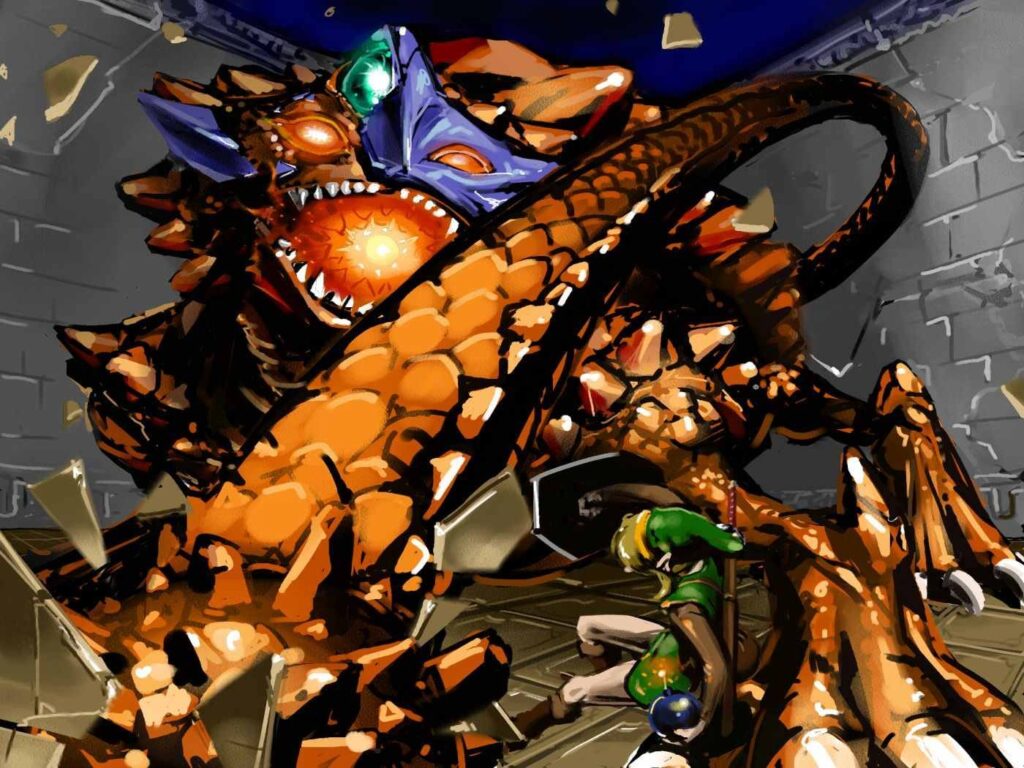
Ah, the simpler times when boss battles where not a multi epic orchestral suite but just an ostinato more basic that even what became the music for standard battle encounters out there. We are a long way from each boss having his own personalized track. And this early boss battle cue is one of the simplest battle cues in the Zelda series, closer in spirit to the battle themes from Zelda II: The Adventure of Link which was the game that introduced battle tracks to the series (before, even Ganon himself had to settle with just the dungeon theme). There aren’t any difficult rhythms or odd time signatures; and there is barely any melody here. The main upgrade with respect to Zelda II is that now they come with an intro before they loop.
Musical Analysis
Just like the boss battles of the previous Zelda game, this one consists of a basic ostinato that repeats the same question-answer block twice and then it gets transposed to a higher register and played exactly in the same way. The only difference with the Zelda II Boss Battle is that here the transposition is to a higher register where previously it was to a lower register. Maybe now it is more tension filled thanks to that; this one is not quite the characteristic half clave pattern all across Zelda II but it is close enough. For the ostinato here the question is just a movement a half step up and then answer the same half step down. In any case this track is even simpler since at least the harmony of the previous boss battle was a minor tonality. Here we get only chromaticisms and tritones and perfect intervals.
From the official title of the piece we can surmise that this one was custom made for the very firs battle against the Armos knights. And it shows in the way that the rhythms match the jumps that these statues make in order to move and the patterns of their formations often in time with the transposition. so it was a short kinetic based track that was then reused for all bosses of the game, even Agahnim.
The most complex part is the opening with dissonant chords and timpani. The trumpets play parallel chords that often move in chromatic descending fashion. The main feature of the four note chords being the tritone between the two low notes. It would be something like Abmaj7/b5 that is then moved in parallel downwards and with syncopated rhythms. Only the last two chords of this opening disrupt the expected rhythm by arriving faster (the ear would expect the last two chords to be in quarter notes), making the rhythm more interesting by being less predictable. Balance between repetition and novelty is always the key. The timpani notes change slower and descend by whole tones. The intro ends with a fast chromatic scale where most of the intervals are major thirds.
The back and forth ostinato that mimics the clockwise and counterclockwise movement of the guardian statues—or the forwards and backwards movement— is just a monolithic A5 to Bb5 and then A5 to G♯5. This same figure is then moved up to D5 where it repeats, presumably in time with the statues changing formation.
The trumpet sample is the one that fills so much sonic space by each note actually being doubled by a lower octave, making this brass section sound more powerful. We also get the traditional snare performing its militaristic accompaniment and the timpani maintain the same pace playing just a perfect fourth interval A and D. So their role is clearly more percussion than harmony; they are here just to make some noise and add to the cacophony.
The complex battle track with the strange rhythms that will characterize future bosses is reserved for our final enemy, the prince of darkness, which is at his most powerful during the events of this game.
Help to keep the rites going around here by supporting the shrine:

Media Files, requests and support for more interactive content

Thou shall donate since this is a cult and you are now a sheep

Help staying awake analyzing game tracks and writing posts or else everything will end up being written by A.I
- Inside The Score – The Legend of Zeda: A Link to the Past – End Credits / Staff Roll
 The land rests As the last few minutes of this extensive journey that has now come to an end fly by, the nostalgia and reflective mood kicks in. Because such a massive enterprise as a Zelda game or a Lord of the Rings movie require multiple endings to convey everything… Read More »Inside The Score – The Legend of Zeda: A Link to the Past – End Credits / Staff Roll
 - Inside The Score – The Legend of Zelda: A Link to the Past – Ending / Epilogue ~ Beautiful HyruleFinal of the fantasy The Triforce has been touched. A wish has been granted. For the occasion, the newly undeceased king of Hyrule has commissioned a march in honor of the legendary hero to the Hylian Sousa, who might as well be composer Nobuo Uematsu since this piece is very… Read More »Inside The Score – The Legend of Zelda: A Link to the Past – Ending / Epilogue ~ Beautiful Hyrule
- Inside The Score – The Legend of Zelda: A Link to the Past – Triforce Chamber / Power of the GodsTake your boots off your feet And thus the Triforce spoke to men. And it became present in history. And you better treasure and contemplate this moment seldom witnessed in the course of the series. The elusive opportunity to interact and touch the most important artifact. You are now in… Read More »Inside The Score – The Legend of Zelda: A Link to the Past – Triforce Chamber / Power of the Gods
- Inside The Score – The Legend of Zelda: A Link to the Past – Ganon Battle / Prince of DarknessProgressive evil En Garde! And you better be prepared since you are about to duel the iconic enemy of the series at perhaps his canonically most powerful incarnation. Right after having touched the sacred Triforce which allowed him to conquer all of the Golden Land and whose evil and darkness… Read More »Inside The Score – The Legend of Zelda: A Link to the Past – Ganon Battle / Prince of Darkness
- Inside The Score – The Legend of Zelda: A Link to the Past – Boss Battle / Anger of the GuardiansQuick mayhem Ah, the simpler times when boss battles where not a multi epic orchestral suite but just an ostinato more basic that even what became the music for standard battle encounters out there. We are a long way from each boss having his own personalized track. And this early… Read More »Inside The Score – The Legend of Zelda: A Link to the Past – Boss Battle / Anger of the Guardians
- Inside The Score – The Legend of Zelda: A Link to the Past – Dark World Dungeon / Dungeon of ShadowsMemento mori We are getting closer to Ganondorf (or at least the wizard Agahnim who ultimately fulfills the same human side of evil role in this game) and that means getting closer to the profiles and motifs of his own theme song (which naturally was the theme of Agahnim at… Read More »Inside The Score – The Legend of Zelda: A Link to the Past – Dark World Dungeon / Dungeon of Shadows