The land rests
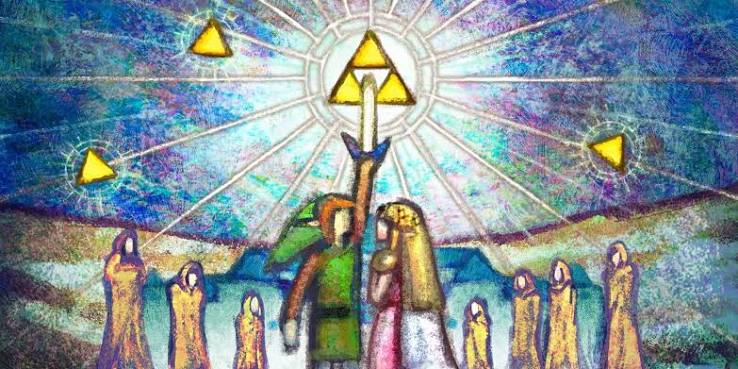
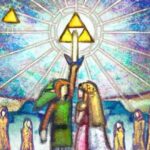
As the last few minutes of this extensive journey that has now come to an end fly by, the nostalgia and reflective mood kicks in. Because such a massive enterprise as a Zelda game or a Lord of the Rings movie require multiple endings to convey everything that the adventure represented. You sit down with controller in hand just watching the Triforce move against the autumn background, knowing that what you experienced is meant to be as special as the music makes it out to be. The hero and the game has just become legend, a painting sketched into the walls of the castle as the tale is passed down through generations.
And to convey all the emotions of a good bye the music transitions from being a triumphant parade into the proper pensive ending that ought to be remembered by players. An original track that delivers one last surprise rendition of the main theme of the series, the theme that accompanies your exploits of the kingdom of Hyrule.
Musical Analysis
As in other Nintendo endings we get the nostalgia vamp which is the I to IV, the C and F that also open Ocarina of Time. the low C note stays put while the upper notes change to form the harmony. After one round of the intro, the melody kicks in and the piece is able to explore new chords. We hear the question-answer phrases of the melody accompanied by ascending chords.
C – Em – F – G
The pure and trusted Ionian/Major profile always called to deliver the mixed emotions.
After the opening two question-answer blocks (each chord pair represents a small question-answer block, the four chords are a macro question-answer block) the melody seems to want to repeat the same phrase but an octave up when the progression repeats; but then, in order to keep the interest of the listener, it travels to a different place, a new set of question-answer blocks but now the questions posed are different between themselves unlike in the first phrase, the trick employed being that of keeping the same note rhythm but moving the second question down—The first one begins with the D to C interval and the second one opens with a lower A to E. This phrase repeats with a second string voice harmonizing; not all notes of the melody have a corresponding second voice, making the two parts semi-independent. The last question-answer block is different the second time around, ending its phrase by going up towards a new melody coda played with the aid of the woodwinds.
The piccolo based melody introduces a new rhythm to its question-answer blocks, the one that pulls the sorrowful strings. This is also aided by the harmony that is allowed to climb even higher to Am. Only the last answer with its triplet based descending motion is reminiscent of the previous phrases of the composition. The harmony for this part is:
Am – Em – F – G
The variety quota between melodies is now brought courtesy of the fact that the micro question-answer blocks here only require a single chord to develop. This structural variety is what gives a piece interest.
This progression repeats with a bonus string part arpeggiating an ascending scale. The flute seems to be repeating its melody but before you know it, over the Em chord it decides to explore notes higher up to close this section.
We go back to just strings and to the second phrase based around the ascending harmony I – iii – IV – V. This phrase and its underlying harmony plays just once, making things more asymmetrical and thus interesting and now we are on track towards the coda of the piece and the transition into the surprise. Just at the moment when the composer’s name appears on screen, the composer of the original The Legend of Zelda theme and the sole composer of the score for this entry. This coda is also the same one we find in the Title Theme from Ocarina of Time, going outside the pure Ionian/Major profile into the epic Mario Cadence used in a lot of JRPG fantasy games to give that magical finish.
You cannot beat the Ab – Bb – C for an ending. The moment we were waiting for, the return of the main overworld theme of the series at its most sublime. And it is smooth sailing from there, the elegant modal mixture nature of the theme that represents the different places you travel to still intact alongside its countermelodies and danger sections, including its snare marching effect and its brass sections.
The main difference lies on the ending, which is something this composition never had, not even on the Title Theme from the original NES game where it could. Here we get a classic Staff Roll coda minus the fanfare of cymbals and timpani, just a more muted repetition of the main motif of the series reminiscent of that original Title Theme intro, with that combination of the Ionian/Major and Aeolian/Minor profiles that characterizes the series (mostly the use of the bVI and bVII). But we get one last moment of tension by using the Gb low note while the pedal melody plays on the descending run towards the tonic. It ends with the Phrygian Major movement of C – Db – C, the Spanish roots of the theme shining through on this also epic cadence. The curtain can now close over the Triforce of the Gods, the three pieces going to different directions against the background of the kingdom.
And so we get to the end of the year by completing this Zelda game (well, not really since the more traditional cues are still missing plus some minor ones like battling against the soldiers of Kakariko; maybe sometime later for the sake of completion). It has been great exploring all kinds of music throughout the year and seeing new consumers joining in and enjoying the content and chiming in with new insights. Your satisfaction is of the utmost importance to the enterprise. I also got to work on archiving the analyses into proper blog posts here which I want to keep feeding with all kinds of new content and use as the main hub for the essays. Looking forward for what might be next. Remember you can always bring forward any suggestion or ideas about what kind of content you would like to see. Im still thinking about how to talk about more modern soundtracks; maybe with other format than visualizations but for now you can request any track or soundtrack you would like to see treated and get the MIDI files and collaborate at the Patreon or by supporting the channel. Really appreciate having you around. I will be checking on the suggestions and hopefully see how to grow the community more or explore new avenues. We will see what’s next.

Help to keep the rites going around here by supporting the shrine:

Media Files, requests and support for more interactive content

Thou shall donate since this is a cult and you are now a sheep

Help staying awake analyzing game tracks and writing posts or else everything will end up being written by A.I
- Inside The Score – The Legend of Zeda: A Link to the Past – End Credits / Staff Roll
 The land rests As the last few minutes of this extensive journey that has now come to an end fly by, the nostalgia and reflective mood kicks in. Because such a massive enterprise as a Zelda game or a Lord of the Rings movie require multiple endings to convey everything… Read More »Inside The Score – The Legend of Zeda: A Link to the Past – End Credits / Staff Roll
 - Inside The Score – The Legend of Zelda: A Link to the Past – Ending / Epilogue ~ Beautiful HyruleFinal of the fantasy The Triforce has been touched. A wish has been granted. For the occasion, the newly undeceased king of Hyrule has commissioned a march in honor of the legendary hero to the Hylian Sousa, who might as well be composer Nobuo Uematsu since this piece is very… Read More »Inside The Score – The Legend of Zelda: A Link to the Past – Ending / Epilogue ~ Beautiful Hyrule
- Inside The Score – The Legend of Zelda: A Link to the Past – Triforce Chamber / Power of the GodsTake your boots off your feet And thus the Triforce spoke to men. And it became present in history. And you better treasure and contemplate this moment seldom witnessed in the course of the series. The elusive opportunity to interact and touch the most important artifact. You are now in… Read More »Inside The Score – The Legend of Zelda: A Link to the Past – Triforce Chamber / Power of the Gods
- Inside The Score – The Legend of Zelda: A Link to the Past – Ganon Battle / Prince of DarknessProgressive evil En Garde! And you better be prepared since you are about to duel the iconic enemy of the series at perhaps his canonically most powerful incarnation. Right after having touched the sacred Triforce which allowed him to conquer all of the Golden Land and whose evil and darkness… Read More »Inside The Score – The Legend of Zelda: A Link to the Past – Ganon Battle / Prince of Darkness
- Inside The Score – The Legend of Zelda: A Link to the Past – Boss Battle / Anger of the GuardiansQuick mayhem Ah, the simpler times when boss battles where not a multi epic orchestral suite but just an ostinato more basic that even what became the music for standard battle encounters out there. We are a long way from each boss having his own personalized track. And this early… Read More »Inside The Score – The Legend of Zelda: A Link to the Past – Boss Battle / Anger of the Guardians
- Inside The Score – The Legend of Zelda: A Link to the Past – Dark World Dungeon / Dungeon of ShadowsMemento mori We are getting closer to Ganondorf (or at least the wizard Agahnim who ultimately fulfills the same human side of evil role in this game) and that means getting closer to the profiles and motifs of his own theme song (which naturally was the theme of Agahnim at… Read More »Inside The Score – The Legend of Zelda: A Link to the Past – Dark World Dungeon / Dungeon of Shadows