Heavenly Ambience
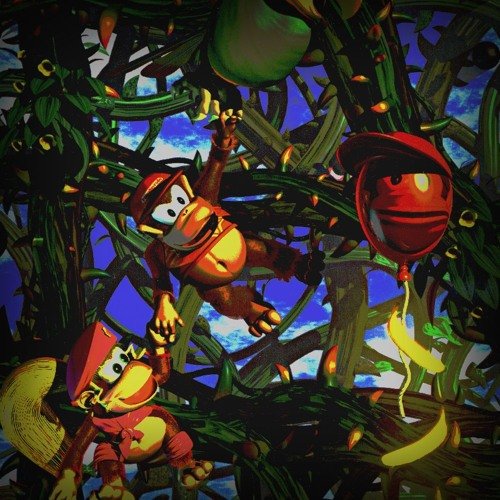
A Wise man once managed to capture the sound of water and make the Super Nintendo sing by encapsulating modern synthesizer techniques into its tiny memory; now in its spiritual and pretty much bodily successor he is aiming for the sky, and may have even gone beyond to outer space and maybe multiple dimensions in the process. This is the sequel, Heavenly Ambience.
For the Donkey Kong Country sequel Rare boldly ditched the ape right in the title in favor of his nephew and and his girlfriend who flies like an helicopter; the Diddy’s conquest, who have to come and rescue the ape in distress right at the Kremlin base which is a nastier, darker and more difficult place. The developers took the swashbuckler pirate influences present on the final boss battle and decided to go all in with the pirate theme, with K. Rool arbitrarily deciding he no longer wants to be a king but now be referred to as Kaptain K. Rool. This development was fueled by producer Gregg Myles who, being a fan of the golden age of piracy—not so much of the one for video games—, will take the company multiple times off to the seven seas, all culminating in the game Sea of Thieves.
This all means the music, now solely the vision of composer David Wise, has multiple threads to pursue. It remains stepped in the swing big band jazz of the original, mostly for bonuses and stuff related to the monkeys themselves, the sea faring shanties of the pirate themes (even rearranging the K. Rool final boss battle cue for some levels), and to capture the Kingdom of the Kremlings David Wise opted to use the darker influence of Russian composers like Prokofiev and Mussorgsky not only because of the darker sound but also for the sake of the Kremlin word pun. There are other similarities with its predecessor like the prominent and eclectic percussion, the atmospheric synth sounds and the melancholic melodies pouring in. Stickerbush Symphony, as the Aquatic Ambience sequel originally meant for an unmaterialized water level falls into those later camps; it is meant to make you float, albeit it ended on a level where you float violently through the air. Other innovations include personalized success cues for completing every level that uses instruments from the music heard on that course.
Maybe due to the easy access of world music samples, the modern games in the series have not relied that much in the electronic, synthesizer atmosphere of the SNES era.
It may be the most influential Rareware score since its tone went on to be used in future games from the company, specially its dark, low brass heavy style and technological achievements.
There were other influences due to the pirate theme like the recent movie Hook scored by composer John Williams, who is known for his romantic scores influenced by the swashbuckler, adventure films of the 40s. The Title Theme of Donkey Kong Country 2 takes its intro in 6/8 directly from the Hook cue “Flight to Neverland”:
Musical Analysis
Going the opposite direction and contrary to the Koji Kondo philosophy of platformers having to capture the rhythms of the character movements, David Wise uses atmospheric and sophisticated sounds to capture the aura of the levels, having the responsibility to match the advanced graphics with sounds that pushed the SNES to its absolute limit. A synthesizer enthusiast first and foremost, which is how the RareWare founders scouted him in the first place as the earliest audio specialist at the company, David Wise painstakingly samples a diverse array of synth sounds to create the effect of a person manipulating a dynamic, evolving sound living inside the Super Nintendo. You get filter sweeping, extreme pitch and pan manipulation, delay effects everywhere and precise volume manipulation, all stuff that a musical visualization in piano roll cannot capture since there is so much going on under the hood in order to make all this sound smooth. It is a feat of sound design and from where Rare gained its reputation for excellence in audio. However, if sound design was all that it had going on for it, it would just be an interesting footnote of technological achievement. At the end of the day David Wise knows that the musicality has to be above and he repeats the feat of having that melancholic touch from Aquatic Ambience to create a longstanding piece in the canon of the series; this is the real Bittersweet Symphony.
The landscape is painted with extended harmony all over accompanied where various long melody form solos jam to create a chill vibe; these were the lo-fi beats of 90s kids. The piece is based around an hypnotic sonar pulse pedal ostinato (remember this cue was originally meant for a scrapped water level). Three notes (B C G) that repeat and echo over each chord, gaining different meanings and morphing colors depending of the underlying harmony; there are small variations in the ostinato from time to time. The ethereal harmony is made with ethereal strings and vocal sounds (where the roles of bass and chords are reversed with respect to Aquatic Ambience, as in, the ethereal strings now provides the bass), with Wise employing the same sequence like bass line whose sound appears to evolve in real time by simulating the effect of a filter being applied to it and transitioning from opaque to brighter—which on the Super Nintendo has to be made by sampling multiple instances of the sound with the filter applied at different parameters—this gives the SNES the same sensation as if it had the capability for what is known as vector synthesis, which is a type of synthesis that provides movement in a sound by dynamically cross-fading between sound sources. It made the game sound very modern and close to famous synth based film scores from the 80s and early 90s.
Like in Aquatic Ambience there is a pseudo shepherd tone meant to be some kind of whale call (fortunately there is a common trope in media of whales soaring in the skies too since they look like blimps); this time it is made with the string sample as opposed to the vocal one from Aquatic Ambience. David Wise is able to feature multiple instruments in a single cue by changing fast between instruments on a single channel. For example the snare and hi hat sound are in the same track here, the composer just rapidly going between the instruments on the channel.
More than a piece with structure, the point is to construct an atmosphere. Yet, we can discern some patterns like an intro that begins with a vamp going from Am7 to Cmaj7 (and that here sounds just like The Simpsons’ Theme) and synth sounds with delay effects coloring around the edges, then instrumental solos and more melodies start to pop up on the painting when the arpeggiator bass line enters followed by another jam session accompanied by the drums and finally an outro where the main groove is retired.
The piece is content with focusing on the notes from the A Aeolian/Minor profile; just pure white piano keys all around with a special focus on the three notes that form the sonar ostinato (B C G). When the melodies start the harmony goes into a soothing chord progression: Fmaj7 – G – Em7 – Am7 – G6, a standard minor progression if you remove the extended harmony, which will form the basis for the rest of the piece, except for the two codas where the harmony is altered. Here is the playing field where other instruments will solo over; most notably the alto sax sample that sounds like a monkey choir and that David Wise likes to use since he was learning the saxophone during this era, a dulcimer mixed in with a similar sounding but more synthetic electronic instrument known as the clavinet; and replacing the harmonica from Aquatic Ambience is a similar sounding mute trumpet which seems to be aided by distortion. Sprinkled as ornamentation are other synthesizer sounds doing some fast notes, one is just the same one used for the bass and the other doing a chime like arpeggio that fullfills the role of the harp from its predecessor, both with the same evolving filter technique applied; this must have taken a lot of work to put together just like Aquatic Ambience took weeks to make, so it is no wonder why Wise was adamant of using it even if the original level was scrapped. Just like in Aquatic Ambience, there is an acoustic piano with lots of reverb and delay.
The instruments go back and forth between each other in call and response fashion, sometimes playing small motifs and other times going for long form melodies, special focus in the ostinato notes (B C G). There is internal repetition of the piece with the main sections separated when the percussion kicks in. The idea, just like in Aquatic Ambience, was to make the Super Nintendo sound just as the popular Korg Wavestation keyboard. The piece ends with an outro that removes the main beat and where the low strings replace the bass synthesizer. The harmony for these coda sections goes to an uplifting conclusion in Dm7 – Em(b6) – F – F6/9 – G and then to the intro vamp. For most of the piece and one of the reasons it has that relaxing sensation is that its harmony moves in very small increments, with the voice leading allowing for the notes to not make huge leaps.
More akin to an extensive deep RPG than a game about monkeys jumping around violently through the barrel motif established at the Donkey Kong arcade, the legacy of Stickerbush Symphony with with its melancholic new age groove and whose sootiness contrasts heavily with the rage inducing bramble levels—maybe its point is to actually calm players— lives on in a curious trend known as the ‘Internet Checkpoint’ where users listened to the track after it is recommended and left comments talking about nostalgia and what is going on in their lives. This collection of memories, anecdotes, shower thoughts and nostalgia managed to reach Nintendo, who after being moved to tears by the experiences of their fans decided to personally take down the video for copyright infringement. Go elsewhere for your mental health checks.
David Wise says that the reason why the theme has stuck is because of how hard these levels were and so players had to listen to it over and over again. He might be wrong about that.
Here is also David Wise himself recreating some of the techniques with a modern synth
Some samples used on this track:
Vector Synth 1 and 2 (multisampled) from Roland Alpha Juno 2
Alto Sax, Dulcimer, Drum Kit, Synth Vox and Synth String from the Korg Wavestation
Mute Trumpet from Kurzweil K2000
Clavinet from Zero-G: Funky Elements

Help to keep the rites going around here by supporting the shrine:

Media Files, requests and support for more interactive content

Thou shall donate since this is a cult and you are now a sheep

Help staying awake analyzing game tracks and writing posts or else everything will end up being written by A.I
- Inside The Score – Super Mario All-Stars – Ending Theme (SMB)
 Wedding bells Romance is in the air. Before credit themes were introduced into the series we had this little hymn for Princess Toadstool of the Mushroom Kingdom. A wedding march for when the plumber and the princess tie the knot at the end of the series—so never, since Peach works… Read More »Inside The Score – Super Mario All-Stars – Ending Theme (SMB)
 - Inside The Score – Super Mario All-Stars – Bowser Final Battle (SMB)Last show down The companion piece to the previous track in which composer Soyo Oko goes beyond the call of duty to musicalize the final battle of the original game even if it is not that much different from the other encounters with king Koopa (which technically are minions disguised… Read More »Inside The Score – Super Mario All-Stars – Bowser Final Battle (SMB)
- Inside The Score – Super Mario All-Stars – Bowser Battle (SMB)Latin fire Here is composer Soyo Oka bringing us yet another heavy metal subgenre from the millions that sprout each week—since even adding a cello to a song is apparently a new subgenre—in the form of Cuban metal. So try and enjoy this dance instead of killing king Koopa right… Read More »Inside The Score – Super Mario All-Stars – Bowser Battle (SMB)
- Inside The Score – Super Mario All-Stars – Castle (SMB)Inferno The musical equivalent of two walls closing in to crush you. The serpentine track written for the Koopa castle is the pinnacle of claustrophobia, taking the dissonance of the Underground theme to its extreme in this diminutive cue that keeps going and going stressing you out throughout the castle… Read More »Inside The Score – Super Mario All-Stars – Castle (SMB)
- Inside The Score – Super Mario All-Stars – Underwater (SMB)Floating in three steps A waltz that today is not only a famous video game track but a piece of music worth of being cultural heritage of a classical repertoire even if it has a diminutive length. Because this tune is as recognizable in pop culture as other famous waltzes… Read More »Inside The Score – Super Mario All-Stars – Underwater (SMB)
- Inside The Score – Super Mario All-Stars – Underground (SMB)Obscure influences The environment where the Mario brothers thrive and where we first encountered them both having fights with turtles; the reason why we even have pipes in the first place. This is the underworld, which is meant to be a juxtaposition with the colorful world above in all senses… Read More »Inside The Score – Super Mario All-Stars – Underground (SMB)