Synthetic nature
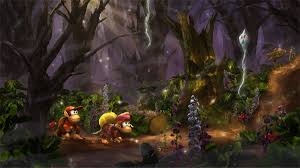
With Forest Interlude we complete a trilogy of “David Wise attempts to cram a Korg Wavestation synthesizer into the puny SNES hardware and gets away with it”. And it may be his definitive statement on the matter as he himself says it was the most involved piece to create and thus his favorite from the Donkey Kong Country 2 soundtrack where he alone was charged with the entire music direction.
Here all of the techniques learned first when making Aquatic Ambience that characterize the evolving Korg Wavestation sound are brought in to create an atmospheric sonic landscape where synthetic sounds clash against primitive organic ones such as the wooden pan flute, simple frame drums and sounds of nature sprinkled in. The result is a true ambient track that could feel at home both in some National Geographic nature documentary showing us drone images of waterfalls, birds flying, monkeys jumping, and felines running all in slow motion to capture the majesty of nature, or alternatively, the stylized synthetic sounds could bring to mind a night alone driving the car on a sophisticated urban city watching pass through the window all kinds of neon signs and cool ads not knowing where the night will take you. That is the magic result of an ambitious sound design that still does not forget about sounding musically pleasing. This one is to be dubbed ‘Nocturnal Ambience’
And it is something that David Wise, as the synth enthusiast discovered in a music store by the Rare founders (he was the first sound person at the company who literally had to build it since his very first job was actually to paint his own office), has always chased; a way to differentiate himself from the pack by pushing the limits of the hardware he is working on but never losing his ability to communicate his melodic ideas no matter how sophisticated the sound gets. This is a tale of a man who stubbornly wanted his synth collection to appear in primitive video game hardware, even if he had to work twice as hard as a fellow composer in the film industry; why would they be the only ones having fun with the latest synth techniques? Right from the NES era which is the era responsible for generating composers adept at making repetitive music not sound repetitive and having dominion over the core elements of music, David Wise was already chasing what he calls motion in sound design, which was at the very least trying to create the illusion that the sounds were not static and evolved alongside harmony and melody. This was challenging with the limited palette of the NES but still can be heard in how he managed to manipulate the sound waves to dynamically change as exemplified in earlier tracks like this title screen from one of the countless games released by Rare on the console:
Musical Analysis
Only the SNES era with its ability to now sample instruments allowed Wise to indulge in his layering techniques, painstakingly chopping waveforms manually and putting them in sequence to create effects mimicking what real world musicians cold do with their keyboards by just moving knobs and whistles. The main inspiration was the vector synthesizer popularized during the 80s and early 90s, and heard in countless atmospheric soundtracks; one of the most famous was the Korg Wavestation released in 1990 which David owned. Ìt had a lot of demos and presets that inspired him to mimic it on the SNES as faithful as possible. The result of this work was making the SNES sing leaps and bounds beyond its time. Forest Interlude is a track that exemplifies two key selling aspects of the Korg Wavestaton, a synthesizer with an advanced vector synthesis system that could create new sounds by combining and connecting multiple waveforms and also had a wave sequence function that could arrange waveforms in sequences to form rhythm or melody step patterns. You can hear both techniques here by the way the drum machine changes rapidly between short samples to create a idiosyncratic rhythm pattern. You can hear the beat pattern isolated here:
And you also have the other technique; The Wavestation was the first synth that enabled wave sequencing that cross-fades a variety of waveforms, smoothly connecting these waveforms to give the illusion of a sound that is alive and evolving. On the Super Nintendo the composer had to chop multiple samples of his own synthesizers (mostly the Korg Wavestation and the Roland Juno-60) at different cutoff frequencies then chop those down to create what sounds like a filter sweep, as if a keyboard player is moving a filter knob in real time. It creates the illusion of a continuous process via discrete events. Pretty much the rest of the accompaniment is made with synthetic sounds so this is definitively not your generic forest theme made with marimbas and woodwinds; this is a haunted forest with a dark color palette where just some light rays are able to pour in through the thickness of the trees.
There is so much design going on that most of the notes on a visualization are not even accurate since David Wise makes sure of using any possible modulation technique for every single note he uses, so almost all of the notes have pitch modulation and delay, all part of creating a sound design that feels dynamic; at least you can visualize the textures present at any given time. His philosophy of motion in sound design is in full display here. Like the two other ambient tracks, musically, the melancholic minor profiles prevail, with the organic instruments soloing over the synthetic pad with the C Aeolian/Minor profile.
As with Stickerbush Symphony, the same principle for the intro applies, the pedal ostinato that repeats over the changing accompaniment resulting in it acquiring different colors; the ostinato is an Abmaj7/13 tidbit made with the evolving vector synth sound that now sounds like monkey vocals thanks to the amount of pitch modulation for every note. The synth pads go through the chord progression Abmaj7 – F7sus4 – Bb. Not only the sound choices contribute to the transcendental feeling but also the fact that, without a melody, this harmonic progression would be closer to the sacred sounding F Dorian profile (thanks to the interplay between the F chord and the Bb which is a staple of the Dorian progressions: i to IV here and the lack of Cm elsewhere. It is only with the pan flute that the pull towards the C Aeolian/Minor, which anyway is the parallel scale to the F Dorian profile, is cemented. The pan flute, the frame drums and some bird sounds are our only anchor point to a forest, otherwise this would be some sophisticated neon city. Also like in Stickerbush Symphony you get some ultra fast arpeggiated synth notes that add color between melodic phrases. The percussion beats are layered on top of the track and then a new melodic phrase played by the harmonica with pitch bending making it sound like a melodica is added. When the percussion sequence enters, the harmony shifts to a vamp between two chords: F7sus2 and Bb emphasizing Dorian aspects.
After the melodica part the pan flute section returns with its three chords and now with the percussion backing. The track is not satisfied with this pleasant sonic landscape as it unexpectedly shifts key to D Aeolian/Minor profile and settles on a more conventional progression Dm – F – Am – C for a synth solo that plays an arpeggio sequence of sixteenth notes and progressively crams more notes till it becomes a whirlwind. One last melodica phrase plays over also a conventional downward progression that is based around the idea of a bass line descending chromatically while the upper note stays as pedal forming the harmony:
Dm – A – Cm6 – Bb
Ab – F7sus2 – Abmaj7/Bb – Bb
Well, not as conventional since in normal circumstances a F major or Am would be in place of the Cm; the Cm sneakily paves the way for the return to the C Aeolian/Minor profile when the Ab chord lands and thus loops the piece to the original progression.
Your pass through this shapeshifting, haunted forest has been an enchanted experience truly enhanced by the moody and soothing landscapes painstakingly crafted by David Wise. The soothing music is a perfect blend between organic and inorganic instruments which characterizes the composer output during this period. Like the previous two ambient tracks this one integrates some dreamy ambient forest sound effects to go along with the melancholy feel of the composition. The sequenced wood drums and “alive”, evolving sounds give a great sense of the depths of an old forest full of blowing leaves and mists; this is, essentially, nature speaking.
The releases of David Wise during the N64 were greatly reduced, alongside his characteristic sound design prowess which was limited to more conventional sounds, first because of the canned Project Dream and then because he only worked on Diddy’s Kong Racing, which only called for catchiness and, as he put it, the goal was sounding more Mario Kart than Mario Kart. He also worked on the ill fated, long Dinosaur Planet project that only ended up being released for the GameCube as an overhauled Star Fox game, so he didn’t even had time to return to the Donkey Kong series, being absent from DKC 3 and Donkey Kong 64. His triumphant return would have to wait for the Wii U Donkey Kong Country where he could just actually record his precious synth sounds like a normal composer; the playing field is even now (well, he also completely revamped the soundtrack for Donkey Kong Country 3 on the Game boy Advanced since apparently the original score had a lot of bass sound that did not translate well to the tiny speakers of the system so he technically can be considered the composer for that game too). Yet the ambitious work of the SNES era will always be a time capsule that oozes an unique atmosphere and a testament to sound design within limited hardware.

Help to keep the rites going around here by supporting the shrine:

Media Files, requests and support for more interactive content

Thou shall donate since this is a cult and you are now a sheep

Help staying awake analyzing game tracks and writing posts or else everything will end up being written by A.I
- Inside The Score – The Legend of Zeda: A Link to the Past – End Credits / Staff Roll
 The land rests As the last few minutes of this extensive journey that has now come to an end fly by, the nostalgia and reflective mood kicks in. Because such a massive enterprise as a Zelda game or a Lord of the Rings movie require multiple endings to convey everything… Read More »Inside The Score – The Legend of Zeda: A Link to the Past – End Credits / Staff Roll
 - Inside The Score – The Legend of Zelda: A Link to the Past – Ending / Epilogue ~ Beautiful HyruleFinal of the fantasy The Triforce has been touched. A wish has been granted. For the occasion, the newly undeceased king of Hyrule has commissioned a march in honor of the legendary hero to the Hylian Sousa, who might as well be composer Nobuo Uematsu since this piece is very… Read More »Inside The Score – The Legend of Zelda: A Link to the Past – Ending / Epilogue ~ Beautiful Hyrule
- Inside The Score – The Legend of Zelda: A Link to the Past – Triforce Chamber / Power of the GodsTake your boots off your feet And thus the Triforce spoke to men. And it became present in history. And you better treasure and contemplate this moment seldom witnessed in the course of the series. The elusive opportunity to interact and touch the most important artifact. You are now in… Read More »Inside The Score – The Legend of Zelda: A Link to the Past – Triforce Chamber / Power of the Gods
- Inside The Score – The Legend of Zelda: A Link to the Past – Ganon Battle / Prince of DarknessProgressive evil En Garde! And you better be prepared since you are about to duel the iconic enemy of the series at perhaps his canonically most powerful incarnation. Right after having touched the sacred Triforce which allowed him to conquer all of the Golden Land and whose evil and darkness… Read More »Inside The Score – The Legend of Zelda: A Link to the Past – Ganon Battle / Prince of Darkness
- Inside The Score – The Legend of Zelda: A Link to the Past – Boss Battle / Anger of the GuardiansQuick mayhem Ah, the simpler times when boss battles where not a multi epic orchestral suite but just an ostinato more basic that even what became the music for standard battle encounters out there. We are a long way from each boss having his own personalized track. And this early… Read More »Inside The Score – The Legend of Zelda: A Link to the Past – Boss Battle / Anger of the Guardians
- Inside The Score – The Legend of Zelda: A Link to the Past – Dark World Dungeon / Dungeon of ShadowsMemento mori We are getting closer to Ganondorf (or at least the wizard Agahnim who ultimately fulfills the same human side of evil role in this game) and that means getting closer to the profiles and motifs of his own theme song (which naturally was the theme of Agahnim at… Read More »Inside The Score – The Legend of Zelda: A Link to the Past – Dark World Dungeon / Dungeon of Shadows