A more spacious underground
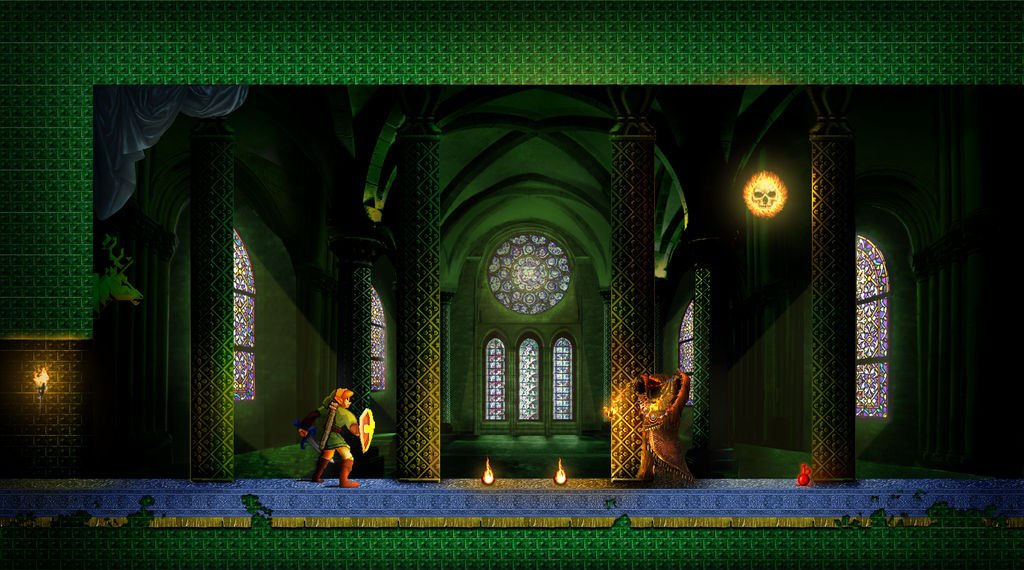
Link set out on his most adventuresome quest yet. Or so does promise the title card at the beginning of the black sheep from the Zelda series. And it is a sheep as dark and cruel as the evil shadow counterpart of Link debuting here as the last test of courage; a sheep so dark that there is not even a “The Legend of” in the title, just Zelda II. It was after all the humble beginnings of the series when a straightforward sequel with the same protagonist was all that it was needed instead of a convoluted legend spanning multiple eras and dimensions. Even so, the seeds for the legend are planted here since we meet a princess from the long past who is also named Zelda, opening the door to multiple characters from different eras sharing the same name and showing this is an ancient kingdom where actual legends have had time to develop. In fact, the narrative even claims this princess is the origin of the name Zelda and all the others princesses would be named after her (out-game the name originated from Zelda Fitzgerald, the wife of the acclaimed author, F. Scott Fitzgerald, which Miyamoto picked because it sounded mystical or exotic; The name “Zelda” ultimately derives from Grizelda, which may come from Germanic elements and in European folklore has come to mean “endless patience”, fitting for the role the many princesses and specially this one fulfill). Ironically, based on the narrative, this game would have the best case for deserving the name “The Legend of Zelda“
The game follows the Nintendo convention of making the sequels for their hit games weird (just look at the convoluted history of Super Mario Bros 2 or Metroid II ending up on Game Boy) and then making more natural follow ups for the third entry. At this point, series and their conventions were not established and the developers felt they wanted to experiment, the result being a Zelda meets Castlevania with more RPG elements and the hardest possible difficulty because, just like Mario, it was assumed that players were very familiar with the first entry and thus wanted a bigger challenge. Other reasons for the weirdness include the fact that the game started as a spinoff that grew too large and was promoted to sequel, and that practically none of the original developers who worked on the first entry, with exception of main producers Shigeru Miyamoto and Takashi Tezuka, participated in developing this one; this includes original composer Koji Kondo who was absent here in favor of Akito Nakatsuka, a composer of which very little information is known except that he has worked for Nintendo for many years and has been used more as a sound supervisor than for composing music (it is not even known if he remains at the company; probably not. His last credit was on Super Smash Bros. for Wii U).
Still, the game managed to expand on many of the elements from the first entry and this includes its soundtrack which is way more intricate than the short one for the original, having various cues for different settings including the new towns Link visits and battles he fights. The game had an overall good reception, it just gets weirder in the context of the entire series for its emphasis on side scroll action. Sadly, creator Shigeru Miyamoto has mostly disowned the game, claiming it as his most disappointing work ever and that the real sequel should be considered the one for the Super Nintendo which brought the original team back. Nevertheless, the music, which brings back the sense of adventure, modal mixture and Spanish Swashbuckler influences has never really been a point of complain but a rather good evolution that stands up to the original OST.
The presentation is also an evolution combined with the usual suspect traits from sequels of the time: a larger world—where it is even shown that the entire map of the first game is just a small corner of this map—more varied enemies, more people to talk with and more side quests. The story keeps on with traditional Western fantasy/fairy tale elements, like a sleeping beauty and having to resurrect Ganon by spilling the blood of his killer on the ashes, straight from Dracula (another connection with Castlevania alongside this music, the enemies and the fact that Link and Simon Belmont even share some sound effects). The temples have Greek elements similar to the Parthenon in Athens for some reason. There is also an Eastern element since this is the debut of the dark counterpart to Link, which the hero has to defeat as one of the requirements to be worthy of receiving the Triforce of courage that can only be passed to one who has a strong character with no evil thoughts; he has to purge himself.
Musical Analysis
The palace theme—since the word ‘temple’ was removed from the Western release—that concerns us here is where Zelda II finally meets Castlevania in both sound and gameplay (these temples for all intends and purposes belong to the Metroidvania genre and for some cruel reason whenever you fail in a dungeon you are brought back to the beginning of the overworld). So was it its main inspiration? or maybe was it James Bond? Well, in reality, just like the overworld theme was inspired and it is an expansion of the original The Legend of Zelda overworld, this one is most likely the analogous, way more expanded version of the gothic dungeon theme from the first entry too (which in turn were all inspired from the Deep Purple song ‘April’); but while the first one was just a claustrophobic short loop full of arpeggiated diminished chords, this one captures the exotic features of far away, ancient temples while retaining some of the gothic diminished aspects of the original thanks to its 007 vamp. it is a much more longer cue with many different sections as opposed to a single section and it is plenty more tuneful and danceable.
The piece in question is heavily based around a rhythm motif found all across the Zelda II score, a rhythm pattern that can be deemed as a half-clave since it contains the question rhythm of the traditional clave rhythm: two dotted quarter notes and a quarter note in 4/4 time. It is found all over the place in Zelda II, from its Title Theme to its battle themes to its towns and houses and also featured on the Great Palace theme; it is even featured in short celebratory cues. This gives the entire soundtrack cohesiveness or it is simply a rhythmic pattern that composer Akito likes a lot since he is big on syncopated, offbeat rhythms. It gives you the sensation of being attacked from above and from below, apt for the new way in which Link fights in this game. This rhythm is the basis for everything here, from the main arpeggio, to the bass line and melody of this dungeon music.
Right off the bat, the intro that establishes the key in Gm gets to the first section with a chromatic descent via this rhythmic device (Gm – Bb-A-Ab). The 007 arpeggio, even though it plays each eight note is clearly driven by this same rhythm since what the ears pick as the accented notes are in this half-clave pattern; this is often known as additive rhythm in music, which features nonidentical or irregular durational groups or pulse groupings. On this one, the first note of the group is perceived to be the D of the chord which will be moved chromatically up while the G and Bb remain as pedal notes in 007 fashion. Normally you just divide each beat into smaller halved sub groups—like for example the arpeggio of the Title Theme which is in eights and then sixteenths— This is called divisive rhythm. On this piece, the rhythm strongly reflects beat durations of 3 eighths, 3 eighths and then 2 eighths, which is just the half-clave rhythm. It can be notated as 3+3+2/8 or the more technical term CHUkaka CHUkaka CHuka.
The A Section gives us the 007 progression Gm – Eb – Edim – Eb. On the pulse channel arpeggio the note that changes chromatically is in the upper voice while on the bass line the lower voice is the one doing the chromatic movement. The melody is also based on the half-clave rhythms. There is then a short interlude which we could also call the B Section, where the bass dances in call and response, tango style, with the square waves; here the profile turns to the harmonic minor in the harmony since it sustains the dominant chord D in major form. Meanwhile the melody ends its questions alternating between going down and up, first from D to C then from D to Eb and finally from D to F. It then goes back to Section A, serving as a show stopper that ends similarly to the intro. There is a false relation there between the F# of the harmonic minor profile and the F natural in the melody. Rhythmically, the composer likes to put lots of notes on the offbeats as can be heard on the melodies of the interlude which contrast with the bass line that responds with notes on the beat. For the most part the percussion is completely in sync with the bass, functioning more as a reinforcement than an independent part.
After the reprise of Section A the piece gets more dissonant on the next one. The melody, arpeggio and bass line keep the essence of the half-calve pattern intact by making it its strong notes. The arpeggio changes its direction during the vamp on this section, first going downwards and then upwards.
D7 – Fm – D7 – Fm
Which would situate the piece in between a G Harmonic minor profile and its Phrygian version or between G Harmonic minor and F Dorian profiles. The melody is symmetric with straightforward question-answer blocks patterned with the same Zelda II rhythm.
A second show stopper interlude that goes D – Ebdim – D – D7 and complements the first interlude by also making heavy use of the offbeats reaches the most tense point by moving upwards towards the dominant chord. It launches into the busiest last section where the arpeggios get more frantic and the bass line is now in eights. The piece gets more desperate as all the chords are now minor Gm – Fm – Em – Fm, mimicking the player experience on these malevolent dungeons that put the Water Temple to shame. The rhythms of the melody get more interesting as they become full of triplets contrasting with the even accompaniment. The melody plays scales with the same rhythmic pattern apt for each of the underlying chords; since none of the other chords belong to the G Minor scale we could say it is traveling towards parallel profiles of G, first the Fm of the G Phrygian and then the Em of G Mixolydian. It ends with the first interlude that loops back to Section A.
Zelda II and specially its score have not received much love in terms of rearrangements or use of motifs for future entries. Almost all of its music has remained unused in future entries; It only took someone as eclectic as Super Smash Bros‘ creator ,Sakurai, to spill blood on the ashes and resurrect this particular track and make it popular as the theme for the Hyrule stage in Melee where its exotic qualities shine even more. The Great Palace theme was also used in Super Smash Bros. so it seems this fighting game is the only one that cares about this forgotten soundtrack anymore; fitting since it is battling in 2D. Even though this was also a Famicom Disk System game, meaning it had more audio capabilities, there are not substantial differences in the music with the NES counterpart because the extra audio capabilities were mostly used for sound effects. Only non gameplay tracks like the Title Theme benefited from the extra channel on the FDS.
Help to keep the rites going around here by supporting the shrine:

Media Files, requests and support for more interactive content

Thou shall donate since this is a cult and you are now a sheep

Help staying awake analyzing game tracks and writing posts or else everything will end up being written by A.I
- Inside The Score – Super Mario All-Stars – Ending Theme (SMB)
 Wedding bells Romance is in the air. Before credit themes were introduced into the series we had this little hymn for Princess Toadstool of the Mushroom Kingdom. A wedding march for when the plumber and the princess tie the knot at the end of the series—so never, since Peach works… Read More »Inside The Score – Super Mario All-Stars – Ending Theme (SMB)
 - Inside The Score – Super Mario All-Stars – Bowser Final Battle (SMB)Last show down The companion piece to the previous track in which composer Soyo Oko goes beyond the call of duty to musicalize the final battle of the original game even if it is not that much different from the other encounters with king Koopa (which technically are minions disguised… Read More »Inside The Score – Super Mario All-Stars – Bowser Final Battle (SMB)
- Inside The Score – Super Mario All-Stars – Bowser Battle (SMB)Latin fire Here is composer Soyo Oka bringing us yet another heavy metal subgenre from the millions that sprout each week—since even adding a cello to a song is apparently a new subgenre—in the form of Cuban metal. So try and enjoy this dance instead of killing king Koopa right… Read More »Inside The Score – Super Mario All-Stars – Bowser Battle (SMB)
- Inside The Score – Super Mario All-Stars – Castle (SMB)Inferno The musical equivalent of two walls closing in to crush you. The serpentine track written for the Koopa castle is the pinnacle of claustrophobia, taking the dissonance of the Underground theme to its extreme in this diminutive cue that keeps going and going stressing you out throughout the castle… Read More »Inside The Score – Super Mario All-Stars – Castle (SMB)
- Inside The Score – Super Mario All-Stars – Underwater (SMB)Floating in three steps A waltz that today is not only a famous video game track but a piece of music worth of being cultural heritage of a classical repertoire even if it has a diminutive length. Because this tune is as recognizable in pop culture as other famous waltzes… Read More »Inside The Score – Super Mario All-Stars – Underwater (SMB)
- Inside The Score – Super Mario All-Stars – Underground (SMB)Obscure influences The environment where the Mario brothers thrive and where we first encountered them both having fights with turtles; the reason why we even have pipes in the first place. This is the underworld, which is meant to be a juxtaposition with the colorful world above in all senses… Read More »Inside The Score – Super Mario All-Stars – Underground (SMB)