Sublime profundity
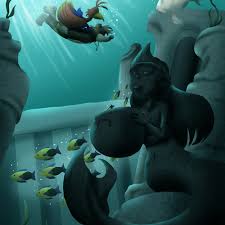
Who is to say that the weird harmonic language of Grant Kirkhope is only suited to be in the service of wackiness or the playfully sinister style? The man can clearly reach for the majestic with his cartoon orchestra and sit comfortably at the pantheon of water levels that capture the ethereal beauty and sense of wonder that only lost kingdoms under the sea—or in this case, a tiny lake at a seafaring town—can muster. Even if the penchant for wacky chord progressions based around tritones and employing chords outside the key remain intact. No minor chord will be uttered anywhere which is almost unheard of in a water level; that does not mean the piece will sound happy, which shows that what matters is the relationship between chords. And here we have as a main progression one that takes one chord from the major profile and the other chord from a minor profile, a staple of Kirkhope and video game music in general where modal mixture is the name of the game. The gist of the sublime water level tradition is here; the floating, soothing sensation of wavelike patterns, wobbly synths and, finally, we get to do justice to the use of harp whenever the Bear and the Bird go underwater after neglecting all the underwater arrangements of the series till now. This is the first time going underwater does not produce exclusively an arrangement of the main level theme but instead transitions into a brand new one because for all intents and purposes this is the 2nd part of the level, a world within a world.
The level is obviously based around the legendary lost city of Atlantis with the catch being that it is not a sunken continent but for some reason an entire mermaid civilization ended up under a small lagoon in a town. Which makes quite the impression once you realize the depth of the level—pun intended—that initially appeared as a small pirate town course; this is basically two levels for the price of one.
Musical Analysis
The harp is the one supporting the entire enterprise, which does not need much supporting since you ought to feel the lightness of floating underwater; plus the series has already established the harp as the main instrument for going underwater. The arpeggios descend and ascend in wavelike fashion mimicking the sensation of being suspended, like a giant medusa flapping its arms or whatever they are called up and down. The ambiguous sound of the piece is made possible by one of Grant Kirkhope’s favorite vamps, the I to bVI that is at the frontier between a major scale and a minor scale by borrowing a chord from the parallel minor of the C scale. Compared to other Banjo-Kazooie pieces there are less sections here and most will be based around this vamp and mainly a single melodic motif, with only the orchestration differentiating the different sections. The harp plays C to Ab, the high notes going down and the low notes going up. The progression is as if the piece cannot decide whether it wants to be in the C Ionian/Major scale or the C Aeolian/Minor. It is a pleasing chord change due to how little their component notes moves; the C stays put and the other two just move a semitone.
The traditional Banjo-Kazooie theremin sounding like that whale call also found in Aquatic Ambience from Donkey Kong as a shepherd tone is also heree. It even works for the aliens since among the treasures of this lost kingdom is an actual flying saucer from outer space; this alien ship is probably the first thing you will see when this music plays so the theremin is likely to be synced with this sight. Like many tracks from Kirkhope which are harmony first, melody gets attached later by force, the melodies found here just follow the profile belonging to the parent chord, meaning that if you are over the C chord you will play notes of its major scale and if you are over the Ab then you use the ones from the C natural minor scale. The theremin plays by way of pitch bending the main motif of the piece—so you don’t see the actual notes here, just a single note— which will be echoed by the lush strings that descend into the piece. Woodwinds also play the motif teasing it for when the melody plays fully in the next section with the marimba.
As only Banjo-Kazooie does, the theremin is then used as an accompaniment instrument playing chords with the wobbling tone perfect for the way water moves. The marimba plays the full melody during this second section doing its own accompaniment which is also in wavelike pattern. The melody is made with octaves having a slight delay as if the sounds are reverberating through the ancient ruins and hollow caves.
Section 3 is where the harmony changes proving that even the ridiculous Kirkhope cadence can sound majestic and epic in the right context. The tritone movement will be the basis of the next progression which does a Kirkhope cadence, the bII – V – I which gets its characteristic sound due to the tritone movement that takes place between the bII and the V, Db and G in this case. It then moves in the same fashion by cascading multiple Kirkhope cadences; this is all about tritone movements so it is no surprise that the composer considers it his favorite track in the game. The movement consists of going to the tritone chord and then a perfect fourth up giving us the progression:
Db – G – C – F# – B – F – Bb – Db – G7
It ends with the true Kirkhope cadence obviously.
The melody expertly tries to catch up with the selected harmony, jumping to the profile implied by each chord and managing to sound coherent in the process.
The Dominant seventh fulfills the role of returning us back to the tonic and the pleasant I to bVI vamp now with the strings playing a more prominent role. It is the same melody as in the previous section now played by the flute and counterpoint accompaniment by the clarinet which also plays the main motif of the piece, creating a more involved composition. Then we get the tritone section once again with the clarinet as lead and the flute doing counterpoint. The piece gains more body thanks to the low end of the strings; you are getting closer to the bottom where light does not reach.
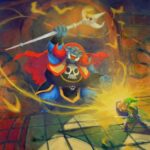
The outro of the piece is when you reach the deepest part the ocean, capturing the unknown and the danger of the creatures that inhabit these unexplored regions by way of the low melody of the menacing strings. The flute and clarinet ornamentation mimics the bear and the bird (or the submarine) slowly descending to the floor of the lake. The harmony and melody also have a slight change of tone almost imperceptible and uncanny since the arpeggios now just limit themselves to playing the C major scale and the main melody answer is changed, playing a F note that was not part of it during the other sections. We could interpret the lack of the Eb note in the arpeggios as implying a C to Ab aug chord progression which certainly contributes to this part sounding more sinister. You are now in the domains of Lord Woo Fak Fak and the sun does not reach this part.
By the way, this piece predates Banjo-Tooie by many years since it was originally written for the Banjo-Kazooie beta—I’m pretty sure that it was not meant for Project Dream since the theremin seems to be a Banjo-Kazooie specific instrument for reasons previously discussed. In the beta version there is a new section not present here with a totally new melody which was probably removed due to it losing the sense of underwater rhythms. It is also at a faster tempo. Even then, you at least find the original villain from Project Dream in this level, the pirate captain.

Help to keep the rites going around here by supporting the shrine:

Media Files, requests and support for more interactive content

Thou shall donate since this is a cult and you are now a sheep

Help staying awake analyzing game tracks and writing posts or else everything will end up being written by A.I
- Inside The Score – The Legend of Zeda: A Link to the Past – End Credits / Staff Roll
 The land rests As the last few minutes of this extensive journey that has now come to an end fly by, the nostalgia and reflective mood kicks in. Because such a massive enterprise as a Zelda game or a Lord of the Rings movie require multiple endings to convey everything… Read More »Inside The Score – The Legend of Zeda: A Link to the Past – End Credits / Staff Roll
 - Inside The Score – The Legend of Zelda: A Link to the Past – Ending / Epilogue ~ Beautiful HyruleFinal of the fantasy The Triforce has been touched. A wish has been granted. For the occasion, the newly undeceased king of Hyrule has commissioned a march in honor of the legendary hero to the Hylian Sousa, who might as well be composer Nobuo Uematsu since this piece is very… Read More »Inside The Score – The Legend of Zelda: A Link to the Past – Ending / Epilogue ~ Beautiful Hyrule
- Inside The Score – The Legend of Zelda: A Link to the Past – Triforce Chamber / Power of the GodsTake your boots off your feet And thus the Triforce spoke to men. And it became present in history. And you better treasure and contemplate this moment seldom witnessed in the course of the series. The elusive opportunity to interact and touch the most important artifact. You are now in… Read More »Inside The Score – The Legend of Zelda: A Link to the Past – Triforce Chamber / Power of the Gods
- Inside The Score – The Legend of Zelda: A Link to the Past – Ganon Battle / Prince of DarknessProgressive evil En Garde! And you better be prepared since you are about to duel the iconic enemy of the series at perhaps his canonically most powerful incarnation. Right after having touched the sacred Triforce which allowed him to conquer all of the Golden Land and whose evil and darkness… Read More »Inside The Score – The Legend of Zelda: A Link to the Past – Ganon Battle / Prince of Darkness
- Inside The Score – The Legend of Zelda: A Link to the Past – Boss Battle / Anger of the GuardiansQuick mayhem Ah, the simpler times when boss battles where not a multi epic orchestral suite but just an ostinato more basic that even what became the music for standard battle encounters out there. We are a long way from each boss having his own personalized track. And this early… Read More »Inside The Score – The Legend of Zelda: A Link to the Past – Boss Battle / Anger of the Guardians
- Inside The Score – The Legend of Zelda: A Link to the Past – Dark World Dungeon / Dungeon of ShadowsMemento mori We are getting closer to Ganondorf (or at least the wizard Agahnim who ultimately fulfills the same human side of evil role in this game) and that means getting closer to the profiles and motifs of his own theme song (which naturally was the theme of Agahnim at… Read More »Inside The Score – The Legend of Zelda: A Link to the Past – Dark World Dungeon / Dungeon of Shadows
655bet1, eh? Never heard of it before. Guess I’ll give it a whirl and see what’s what. Fingers crossed for some wins! 655bet1