Progressive forebodingness
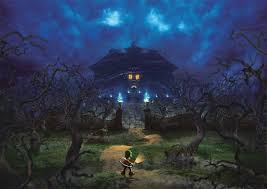
What’s Up readers! There are 316 days left till Halloween so getting in the mood for celebration here is Luigi’s Mansion (OK, maybe the name Luigi is trending and I just got a bunch of GameCube files). it is finally time for Player number 2, aka green Mario, to shine in the spotlight and also shine a light of his own on this endearing part parody, part genuine survival horror take on a Ghostbusters meets Resident Evil haunted mansion tale.
Luigi not only has the honor to launch the new GameCube system with an original adventure of his own before his brother, but he also beat Mario to the punch with the theme of having a multipurpose gadget developed by parapsychologist Professor E. Gadd attached to his back and traveling from the anything-goes world of the Mushroom Kingdom to a more realistic, almost uncannily so, setting where he will perform some exorcisms, one of the few professions Mario has not touched yet—Well, maybe Mario still comes on top since he already had his own haunted mansion solo adventure in Super Mario 64. It was due time for the taller brother to have adventures of his own (no, Mario Is Missing! and Luigi’s Hammer Toss don’t count). And somehow he ended up in a replica of the Spencer Mansion that he won in some shady contest he never entered; maybe he clicked in some spam e-mail he received due to having his data leaked. So remember to protect your privacy online. And here is where I would plug a VPN sponsor if I had one so in the meantime just use your preferred search engine, Google, to get one. So remember to subscribe, hit the like button and ring the bell for notifications.
Back to the analysis. Spooky houses are staples of horror; actually, the next step after the haunted castles that appear in European tales are the haunted houses more common in American stories since by the time the nation appeared it was too cumbersome to build castles anymore, so big, rich houses were the closest thing. And just like the castles, the broad spaces, poor illumination, sound cracks due to old age and echoey ambience lends itself naturally to tales about ghosts and other evil spirits to crop out, specially if they are abandoned. And it was the graphical capabilities of the GameCube that which prompted developers to put both Mario and Luigi in more realistic settings; they wanted to show off their system, play around with the lighting and interact with different objects—somehow Zelda did not get the memo thiugh; with the GameCube controller shoulder buttons Luigi uses wind and suction to interact with his realistic environment, just likes his brother will use water to interact with its own.
The mansion setting and concept of a haunted house came later, right after these functional considerations the developers were playing around with came together and after the connection between a vacuum cleaner and the film Ghostbuster was made. From there, Since Mario is known for his heroic deeds and not being afraid of anything and he already starred without Luigi on Super Mario 64, the developers decided Luigi would be more interesting to convey the scariness of the situation, fleshing out and cementing the personality of color swapped Mario once and for all in an adventure where he does not even jump (even though Luigi is the true Jumpman of the series since he jumps higher); it also makes sense since in Luigi’s Diary in Paper Mario 64, he notes that he hates ghosts as well as wishing that he had his own game, which would make Luigi even more believable as a frightened ghost hunter. This time around, it is a tale about a hero saving the dude in distress who was trapped in a painting by the King of the Boos, showing that maybe he is the one that did the enchanted paint work in Super Mario 64 Peach’s Castle.
Just like in Resident Evil and Eternal Darkness later, Luigi has to explore the house and solve puzzles, down to the iconic door opening animation of the Capcom series. Instead of biological research induced Zombies we have the more traditional cartoony, translucent ghosts able to be suctioned by the Poltergust 3000 from the Ghostbusters films. The colorful characters are juxtaposed with the realistic environments and sound design giving the whole project an uncanny tone—nothing more uncanny than seeing actual, realistic money in a Mario game though, and it even does the same ka-shing sound effect—The BAFTA award winning sound design is an example of why Nintendo was adamant at the time of not using recorded music, orchestra, or full motion video for its games, since at the time it was more difficult to make an interactive score out of already set in stone recordings as opposed to MIDI-like sequences that could be manipulated depending of what happens in-game. The project has a realistic sound for all the kinds of interactions you make with the objects and the music adapts dynamically to what is happening.
The score was written by Kazumi Totaka—so of course you get “Totaka’s Song”, a song featured on almost every game that he works, this time found by waiting on the controller configuration screen at the Training Room for about three and a half minutes—accompanied by Shinobu Tanaka who was also the gal who worked on Super Mario Sunshine. It consists of the standard battle, menus, failure and success cues plus the main theme of the series which is also the mansion theme, the “overworld”, which itself will be arranged throughout the game and used in all manner of ways as the principal leitmotif around which pretty much the entire soundtrack is based. So much that by now it is kind of the Luigi theme song who until this point had to be content with sharing the Mario theme with his brother. The game also features what might be the definitive performance of Mario and Luigi voice actor Charles Martinet, who before was usually asked to just do some shouts and smaller catchphrases and here he has the responsibility of giving Luigi the new personality and definitive voice, even participating in the soundtrack directly with his hums that add personality to the character.
Musical Analysis
Written by Kazumi Totaka, the main theme song used and heard while Luigi is exploring the dark hallways of the mansion has all the usual suspects and markings of the suspense genre. Still part serious, part spoof, the track has everything you would need to cook a cartoony survival horror track. The ultra low strings playing around with staccato bowing that leave ample space for the appropriate silence and spareness of an abandoned haunted house that is being walked on with caution; the ghostly, supernatural sound of the theremin that is required by law and also the church organ which is synonymous with classic gothic horror. Nonetheless, the main instrument is voice actor Charles Martinet himself, humming the theme as Luigi and making it a diegetic theme that the characters in game are aware of (seeing as how it is even the ringtone for the Game Boy Horror device and ghosts sing it and play it). Luigi’s humming is the only recorded sound, with Martinet recording three versions because, like the theme itself, it changes dynamically depending on how much Luigi is fearing for his own life. If he is in full health, he is scared but the theme is still steady. As he gets lower health, the theme progressively gets slower and the humming less accurate, erratic and with less confidence. This is a technique Totaka also employed in Yoshi’s Story, where the music got distorted when you were in low health (the music also has some similarities with the castle theme from that game). Still, it was not always the idea for the theme; originally it had more of a beat based production that was changed to feel more serious later but still with comedic tinges by using the most stereotypical instruments like the theremin and organ which by this point have lost most of their creep factor. Only thing missing here are the Psycho strings for the jump scares and the uncanny music box.
Here we can see all the variations heard inside the mansion, from high health down to the room cleared where you can see Luigi fully relaxed and just whistling the tune.
Musically, the piece is closer to the A harmonic minor profile with featured guests the tritone and the flat 2 adding the dissonance of the devil’s interval and the minor second; nevertheless the theme ends up being catchy and, obviously, hummable. There are just two main sections connected with an intro that introduces the tritone motif and a small climax that transitions the piece to the second section. From the harp harmony heard when you are outside the mansion we can get the implied chords for most of the piece, even if it is based around single notes in the accompaniment.
Am – B7 – Bm7(b5) – Am – G#dim
Am – B7 – Bm7(b5) – E – Am
Melody wise it is based around question-answer blocks with a descending contour with the common technique of making the second phrase a transposed version of the first one, with the first phrase ending up being based around the major third and the next one a minor third. Similar but different; a balance between repetition and variety that lends catchiness to the theme. Another way the melody finds variety is by shifting the answer to the second phrase. Notice that the composer could perfectly have the second answer follow the same pattern of the first one and end the phrase on the tonic A—in fact, many versions of the cue do exactly that, like the Game Boy Horror ringtone—but for the sake of variety the second answer is altered, subverting expectations. Melody is:
[ (E E E E C E D# – B) – (D D D D B D C – Bb B E) ]
It ends on the fifth note, which leaves the phrase more incomplete and in anticipation of a macro answer. In the symmetric version of the melody you would expect the second question-answer block to repeat the same pattern of the first, ending on A with a single note answer too.
The second pair of question-answer blocks that complete Section 1 are the same first question-answer block followed by a second one that once again disrupts the pattern and closes the entire phrase with a descending minor scale to the tonic A. The full melody being:
{[ (E E E E C E D# – B) – (D D D D B D C – Bb B E) ] – [ (E E E E C E D# – B) – (D D D D B D – E D C B A) ]}
The organ and theremin slowly enter the piece, one by one, with the theremin using its characteristic and otherworldly pitch bending to create the ghostly ambient.
After this, a tiny interlude where the piece stays dormant for a couple of bars in Am before aggressively waking up with an ascending figure that follows the harmony of Am – Cdim7 -E7. This ascending pattern is reminiscent of a figure found in the Disney Silly Symphony short ‘The Skeleton Dance’ which is the grandfather of cartoony horror and has the same tone as Luigi’s Mansion:
The piece enters Section 2 with the creepiness factor of multiple descending dim7 chords which are made of tritones all the way down; not only the tritone of the root note but also a tritone between the third and the seventh. The most diabolical chord. The organ now plays full chords. The pattern begins on what could be characterized as Ebdim7 (Ebdim7, Cdim7 and F#dim7 share the same notes) and descends chromatically until it reaches Bbdim7. It then ends up with the dominant E7 before restarting the loop. The melody tail a throwback to the same note rhythm of the tail in Section 1, a figure of eights.
Due to the happiness and relaxed feeling of having cleared the room, Luigi’s whistling gains a shuffle feel in the melody. The whistled is sequenced so it is probable that the original sample does not come from Charles Martinet.
The game Luigi’s Mansion added a new dimension to the character of Luigi and had a genuinely spooky atmosphere that captured the core of the survival horror genre as far as a cartoon character could. Just like the ghosts inhabiting this mansion, which most were unambiguously human contrary to typical Mario ghosts, the series stayed death for a long time, only being revived years later with the new entries not having that much dread and leaning more into the cartoon side. still, It marked a path for the green plumber, with his own series and many elements from it now identified with Luigi like his movements in Super Smash Bros and his personality. The theme and references to the game made a cameo in the Super Mario Bros. Movie, where a little part of it sounds in an appropriate scene.
For Luigi’s Mansion 2 the theme was transposed 1 semitone up. Maybe the tension for Luigi is higher now or the smaller DS speakers lend themselves better to the theme in a higher register.
Composer Kazumi Totaka is also the voice of the mad scientist Professor E. Gadd who seems to be the grandfather of Captain Olimar. He took inspiration from his other series Animal Crossing’s “Animalese” when inventing the voice.

Help to keep the rites going around here by supporting the shrine:

Media Files, requests and support for more interactive content

Thou shall donate since this is a cult and you are now a sheep

Help staying awake analyzing game tracks and writing posts or else everything will end up being written by A.I
- Inside The Score – The Legend of Zeda: A Link to the Past – End Credits / Staff Roll
 The land rests As the last few minutes of this extensive journey that has now come to an end fly by, the nostalgia and reflective mood kicks in. Because such a massive enterprise as a Zelda game or a Lord of the Rings movie require multiple endings to convey everything… Read More »Inside The Score – The Legend of Zeda: A Link to the Past – End Credits / Staff Roll
 - Inside The Score – The Legend of Zelda: A Link to the Past – Ending / Epilogue ~ Beautiful HyruleFinal of the fantasy The Triforce has been touched. A wish has been granted. For the occasion, the newly undeceased king of Hyrule has commissioned a march in honor of the legendary hero to the Hylian Sousa, who might as well be composer Nobuo Uematsu since this piece is very… Read More »Inside The Score – The Legend of Zelda: A Link to the Past – Ending / Epilogue ~ Beautiful Hyrule
- Inside The Score – The Legend of Zelda: A Link to the Past – Triforce Chamber / Power of the GodsTake your boots off your feet And thus the Triforce spoke to men. And it became present in history. And you better treasure and contemplate this moment seldom witnessed in the course of the series. The elusive opportunity to interact and touch the most important artifact. You are now in… Read More »Inside The Score – The Legend of Zelda: A Link to the Past – Triforce Chamber / Power of the Gods
- Inside The Score – The Legend of Zelda: A Link to the Past – Ganon Battle / Prince of DarknessProgressive evil En Garde! And you better be prepared since you are about to duel the iconic enemy of the series at perhaps his canonically most powerful incarnation. Right after having touched the sacred Triforce which allowed him to conquer all of the Golden Land and whose evil and darkness… Read More »Inside The Score – The Legend of Zelda: A Link to the Past – Ganon Battle / Prince of Darkness
- Inside The Score – The Legend of Zelda: A Link to the Past – Boss Battle / Anger of the GuardiansQuick mayhem Ah, the simpler times when boss battles where not a multi epic orchestral suite but just an ostinato more basic that even what became the music for standard battle encounters out there. We are a long way from each boss having his own personalized track. And this early… Read More »Inside The Score – The Legend of Zelda: A Link to the Past – Boss Battle / Anger of the Guardians
- Inside The Score – The Legend of Zelda: A Link to the Past – Dark World Dungeon / Dungeon of ShadowsMemento mori We are getting closer to Ganondorf (or at least the wizard Agahnim who ultimately fulfills the same human side of evil role in this game) and that means getting closer to the profiles and motifs of his own theme song (which naturally was the theme of Agahnim at… Read More »Inside The Score – The Legend of Zelda: A Link to the Past – Dark World Dungeon / Dungeon of Shadows