Uncomfortable laughter
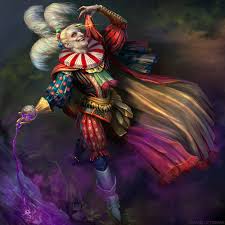
After spending some time with the playfully sinister circus music of the Banjo-Kazooie series, finally we arrive at a character who is the personification of that idea and actually lives up to the sinister moniker, seeing as how this nihilistic psychopath who looks like a comic-relief jester is actually one of the most dangerous bad guys in gaming—we are getting some of those in real life too—He is a villain who actually fulfills the ultimate dream of destroying the world. And right in the middle of the story. His success comes from the fact he does not have utter motives, he cannot be reasoned with or brought to his senses. He just wants to destroy and cause pain for the sake of it. This is the kind of unpredictable and egotistical childish personality that can make someone unambiguously evil.
Still, he is also a victim of the empire since his mind was irreparably damaged by the experiments that ultimately gave him power. He ends up becoming the main villain of the game in a twist that finds him betraying his own emperor. Like many a JRPG villain he ends up ascending to a higher god-tier level of power by the end.
As one of those characters that just wants to see the world burn it is unsurprising that he was inspired by the DC comics villain known as the Joker which is the poster child for sociopath maniac clowns whose methods are all in the service of machiavellic amusement.
This clown receives a theme that captures to a tea his aura and his narrative arc of descent into madness, with a tune written by Uematsu that begins light enough and even playful but, slowly, dissonances begin to creep in, unpredictable changes of mood, then the weight of his dangerous ways and finally the hopelessness of a nihilistic worldview.
As we progress in the game, the uncanny contrast between the light theme begins to sink in as we see the actions that the character is capable of and what appears to be just a fun tune gets new meaning with each new context until it gets unleashed at its most diabolical in the final battle.
Musical Analysis
The beginning with the pizzicatos and woodwinds playing the melody in octaves without any accompaniment is what makes the theme not feel threatening at all; just one of those fun, goofy side henchman that you love to hate and whose plans always backfire in comical fashion. But there are some clues of the derangement sprinkled in. The piece lives in the Bb harmonic minor profile for the most part but even this early the tritone note (E) sounds as if it was a little mistake, a little bad joke that makes the melody stop for a moment; after hesitating, it seems that he actually enjoyed that small amount of evil so he continues on, indulging himself in this bad behavior unchecked. The music sounds appropriate not for a circus clown but a more refined court jester thanks to the classical instrumentation of melodic writing; the snare playing here punctuating the joke. These hesitations make the melody sound more angular and unpredictable, signaling that Kefka always had something wrong with him.
This gives rise to the weighty part in which the strings accompany now. The low string sample is actually made of two notes one octave apart in order to sound more heavy. The piece goes back and forth between Bbm and Gb. This is the main section of the piece. The melody is written in a way that the first question-answer block features the tail part of the Bb natural minor profile (plus the tritone note E), a decidedly less playful profile than the harmonic minor, and the second question-answer block of it is then transposed to the head part of the scale now featuring the harmonic minor profile (in minor keys it is common to combine natural, harmonic and melodic profiles freely), making the first phrase sound with the Phrygian tetrachord and the second with the minor tetrachord. Both phrases have the same contour and rhythm, with both the tritone and the harmonic minor profile featuring the minor second interval with the starting note of each question-answer block.
Normally, you would then repeat this section but Kefka is not normal so this deranged clown abruptly interrupts this flow with an awkward, very short interlude that signals his easily changing and unpredictable mood swings. He just felt like it. This aggressive interruption is the gateway for the full percussion which now accompanies the proper continuation of the piece which restates the question-answer blocks with the harp adding arpeggio chords.
The mood swing strikes again and then the last part where the full evil nature of Kefka is in display plays. No more subtle pizzicatos, just the strings and horns playing singular lines. As if the villain is now plotting something truly sinister.
The final part with the chords signals the hopelessness of this worldview and that this villain is truly an unsettling character, with the tritone note E played with the flute sticking out amidst the chords as the loose screw. The uncanny harmony that forms would be Bbm – F7 – Bbm – Db – Gbmaj7 – Gb7. Then the loop begins in full, intro included.
An unassuming piece that will literally grow in stature and frightening power alongside the laugh of this iconic force of evil. There is a reason why these kinds of villain are always effective. Irrationality is one of the purest forms of evil and the most difficult to understand; because there is nothing to understand, just like Kefka admits at the end.
Help to keep the rites going around here by supporting the shrine:

Media Files, requests and support for more interactive content

Thou shall donate since this is a cult and you are now a sheep

Help staying awake analyzing game tracks and writing posts or else everything will end up being written by A.I
- Inside The Score – The Legend of Zeda: A Link to the Past – End Credits / Staff Roll
 The land rests As the last few minutes of this extensive journey that has now come to an end fly by, the nostalgia and reflective mood kicks in. Because such a massive enterprise as a Zelda game or a Lord of the Rings movie require multiple endings to convey everything… Read More »Inside The Score – The Legend of Zeda: A Link to the Past – End Credits / Staff Roll
 - Inside The Score – The Legend of Zelda: A Link to the Past – Ending / Epilogue ~ Beautiful HyruleFinal of the fantasy The Triforce has been touched. A wish has been granted. For the occasion, the newly undeceased king of Hyrule has commissioned a march in honor of the legendary hero to the Hylian Sousa, who might as well be composer Nobuo Uematsu since this piece is very… Read More »Inside The Score – The Legend of Zelda: A Link to the Past – Ending / Epilogue ~ Beautiful Hyrule
- Inside The Score – The Legend of Zelda: A Link to the Past – Triforce Chamber / Power of the GodsTake your boots off your feet And thus the Triforce spoke to men. And it became present in history. And you better treasure and contemplate this moment seldom witnessed in the course of the series. The elusive opportunity to interact and touch the most important artifact. You are now in… Read More »Inside The Score – The Legend of Zelda: A Link to the Past – Triforce Chamber / Power of the Gods
- Inside The Score – The Legend of Zelda: A Link to the Past – Ganon Battle / Prince of DarknessProgressive evil En Garde! And you better be prepared since you are about to duel the iconic enemy of the series at perhaps his canonically most powerful incarnation. Right after having touched the sacred Triforce which allowed him to conquer all of the Golden Land and whose evil and darkness… Read More »Inside The Score – The Legend of Zelda: A Link to the Past – Ganon Battle / Prince of Darkness
- Inside The Score – The Legend of Zelda: A Link to the Past – Boss Battle / Anger of the GuardiansQuick mayhem Ah, the simpler times when boss battles where not a multi epic orchestral suite but just an ostinato more basic that even what became the music for standard battle encounters out there. We are a long way from each boss having his own personalized track. And this early… Read More »Inside The Score – The Legend of Zelda: A Link to the Past – Boss Battle / Anger of the Guardians
- Inside The Score – The Legend of Zelda: A Link to the Past – Dark World Dungeon / Dungeon of ShadowsMemento mori We are getting closer to Ganondorf (or at least the wizard Agahnim who ultimately fulfills the same human side of evil role in this game) and that means getting closer to the profiles and motifs of his own theme song (which naturally was the theme of Agahnim at… Read More »Inside The Score – The Legend of Zelda: A Link to the Past – Dark World Dungeon / Dungeon of Shadows