Nuts ‘n’ Bolts
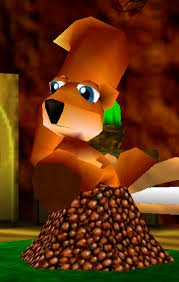
Nabnut’s Theme serves as a little time capsule of how Banjo-Kazooie sounded originally; innocent, earnest cartoon music appropriate for cute anthropomorphic animals, as if the squirrel is skipping, moving about in short, twitching movements without a care in the world through lush woods saying hello to all his animal friends (although in reality he has some cares). It remains in the game due to the developers at Rare finding it very catchy and addictive, one of their favorites, which surprises Grant Kirkhope since it was an easy song to write. The composition complies with the small children music most basic guideline standards: simple, repetitive melodies that are easy to remember and are structured in a very symmetric and delineated question-answer blocks on top of exclusively and unambiguously major tonalities, a far cry from the zany, slightly darker tone the music acquired mid development. Yet, the use of chromatic trills and a minor chord as opposed to the expected I IV V scheme chords adds an air of melancholy to the melody that gives it more character. Additionally, the piece is not in C major like many other tracks in the game; whenever this is the case, we know we probably are in an F tonality. It is also a bit of an anomaly in that it does not have an intro.
This is all very much in line with the cartoon influences of Nabnut, the squirrell, who is preparing to receive his girlfriend—of course pink colored— for the winter hibernation and needs the help of Banjo and Kazooie through the various seasons to collect food for storage. Animals are a staple of children media and stories, going back to Mickey, the mouse when it comes to cartoons or even Aesop fables in literature, since they posses reliable features and personalities that are easy to distinguish at a glance, sometimes even codified in the species they are supposed to represent—like wolf and snakes are usually not good guys, predators and poisonous creatures are just evil—They’re animals who think, talk and act mostly like human beings. The Funny Animal has almost all the mannerisms of people. Sometimes, only their appearance distinguishes them from the hairless primates who draw them. The world of the bear and the bird is a world of funny animals just like many of the golden age of animation; even though both Banjo and Nabnut live in houses and conditions that share similarities with human beings, Banjo belongs to the dressed animal cartoon category while Nabnut doesn’t.
Musical Analysis
Structure: {ABA’ – O }
Tempo: 130
Melodic and Harmonic Profiles: F Ionian/Major
The music takes the motif and harmony previously heard on the cue ‘Bottles’ puzzle Challenge’ and runs with it—even though this was likely composed first and is the original source of the motif and harmony—It relies on the same question motif and only altering slightly the answering phrases in order to create repetition, changing only the pitches to adapt to the underlying harmony. It still retains the bouncyness and effervescence of the Banjo-Kazooie style; the oom-pah rhythm is there, just more delicate courtesy of the pizzicatos sounding like the skipping steps of a light animal. There are basically just two melodies and then small variations and permutations of the A melody.
The basic harmony for the A section is
F – C7 – Gm – C7 – F
The contrasting B section naturally goes to the subdominant or fourth degree of the scale, in this case Bb, generating a descending voice leading based progression:
Bb – F – C7 – F
Bb – F – G7 – C
Or alternatively, just like the pizzicatos play it, the C7 can be seen as an Edim chord, and G7 as a Cdim one. Functionally they are the same thing, serving as leading chords to the tonic and to the dominant respectively (the key of becoming leading is the economy of movement to the root of the next score, just a half step).
The most spicy chord is the G since it does not belong to the F major scale, serving as a small bridge and pseudo-dominant to the chord C. After that, Grant just plays around with the A Section to create new sections, one with the melody harmonized with a voice on top in thirds, sounding to the ear like a new melody since the ear tends to favor the tune in the higher voice. Another is changing the instruments that play the melody and then finishing off with repeating exclusively the answer phrases iteratively, as if to drill it more into the ear.
Just how much Rare likes the tune? A lot apparently since it was one of only two tracks to receive a special treatment in an official soundtrack release of Banjo-Kazooie, where it was remixed and rearranged with better sounding samples (the other one was the cinematic overture).
Nabnut is not the only animal friend of this animated fable. There are many more animals not represented in the sound effects found on these woods. Woodpeckers are not the only construction workers in animal land after all.

Help to keep the rites going around here by supporting the shrine:

Media Files, requests and support for more interactive content

Thou shall donate since this is a cult and you are now a sheep

Help staying awake analyzing game tracks and writing posts or else everything will end up being written by A.I
- Inside The Score – The Legend of Zeda: A Link to the Past – End Credits / Staff Roll
 The land rests As the last few minutes of this extensive journey that has now come to an end fly by, the nostalgia and reflective mood kicks in. Because such a massive enterprise as a Zelda game or a Lord of the Rings movie require multiple endings to convey everything… Read More »Inside The Score – The Legend of Zeda: A Link to the Past – End Credits / Staff Roll
 - Inside The Score – The Legend of Zelda: A Link to the Past – Ending / Epilogue ~ Beautiful HyruleFinal of the fantasy The Triforce has been touched. A wish has been granted. For the occasion, the newly undeceased king of Hyrule has commissioned a march in honor of the legendary hero to the Hylian Sousa, who might as well be composer Nobuo Uematsu since this piece is very… Read More »Inside The Score – The Legend of Zelda: A Link to the Past – Ending / Epilogue ~ Beautiful Hyrule
- Inside The Score – The Legend of Zelda: A Link to the Past – Triforce Chamber / Power of the GodsTake your boots off your feet And thus the Triforce spoke to men. And it became present in history. And you better treasure and contemplate this moment seldom witnessed in the course of the series. The elusive opportunity to interact and touch the most important artifact. You are now in… Read More »Inside The Score – The Legend of Zelda: A Link to the Past – Triforce Chamber / Power of the Gods
- Inside The Score – The Legend of Zelda: A Link to the Past – Ganon Battle / Prince of DarknessProgressive evil En Garde! And you better be prepared since you are about to duel the iconic enemy of the series at perhaps his canonically most powerful incarnation. Right after having touched the sacred Triforce which allowed him to conquer all of the Golden Land and whose evil and darkness… Read More »Inside The Score – The Legend of Zelda: A Link to the Past – Ganon Battle / Prince of Darkness
- Inside The Score – The Legend of Zelda: A Link to the Past – Boss Battle / Anger of the GuardiansQuick mayhem Ah, the simpler times when boss battles where not a multi epic orchestral suite but just an ostinato more basic that even what became the music for standard battle encounters out there. We are a long way from each boss having his own personalized track. And this early… Read More »Inside The Score – The Legend of Zelda: A Link to the Past – Boss Battle / Anger of the Guardians
- Inside The Score – The Legend of Zelda: A Link to the Past – Dark World Dungeon / Dungeon of ShadowsMemento mori We are getting closer to Ganondorf (or at least the wizard Agahnim who ultimately fulfills the same human side of evil role in this game) and that means getting closer to the profiles and motifs of his own theme song (which naturally was the theme of Agahnim at… Read More »Inside The Score – The Legend of Zelda: A Link to the Past – Dark World Dungeon / Dungeon of Shadows