Monkey business
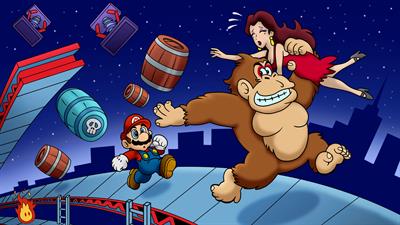
You know him well, he is finally back to kick some tail…We are celebrating the return of the Kong, the leader of the bunch who once again belongs to the spotlight and sidelines Mario as the main 3D plaformer on the Nintendo Switch 2 with the release of Donkey Kong Bananza; where does all this recent focus on the trusty ape comes from? Thank the opening of the DK section at the Nintendo parks for that since they are now integrating their games with their outside projects like films, parks and museums, becoming a cultural juggernaut following in the steps of Disney in the process thanks to its age and its contributions to the interactive medium. We are truly in the transmedia age.
And DK is indeed the leader of the bunch since, as the first officially named character of the original trio and namesake of the game, he has the claim to being the very first big character of Nintendo and one towards which the company has deep affection.
Just like Pauline and DK, we have to travel to the core, the core of Nintendo back when the two of them debuted alongside Mario and Shigeru Miyamoto on a game that cemented the Japanese gaming industry, being the youngest brother of the big three after Space Invaders and Pac-Man; unlike those this one introduced the concept of gravity into the mix, creating the platform genre. Its amount of screens and soundtrack showcases how ambitious Miyamoto was (the programmers practically viewed it as four games in one). This is the game that kickstarted the Nintendo that people are familiar with, filtering American influences through the lens of Japanese playful Kawaii in order to create a product that ditches shooting with spaceships or guns in favor of actual characters and a little comic-book like plot of four panels based around the damsel in distress abducted by a monster trope (The US release actually butchered the storyline by putting the original final level as the second level, since making it more difficult this early made players spend more coins and have shorter turns; devilishly clever).
We already covered the interesting development history of the game and how it is the genesis of Mario here:
For posterity you can also see on the thumbnail the original design of Pauline, showing that the vision was always for her to be a brunette in a red dress; but for functional reasons it was changed—who can see a brunette when your background is black? Plus the red dress does not mix well with the platforms. Her singing shtick is also not a recent invention, she was planned to be a songstress back in an unreleased game called ‘Donkey Kong’s Music Play‘
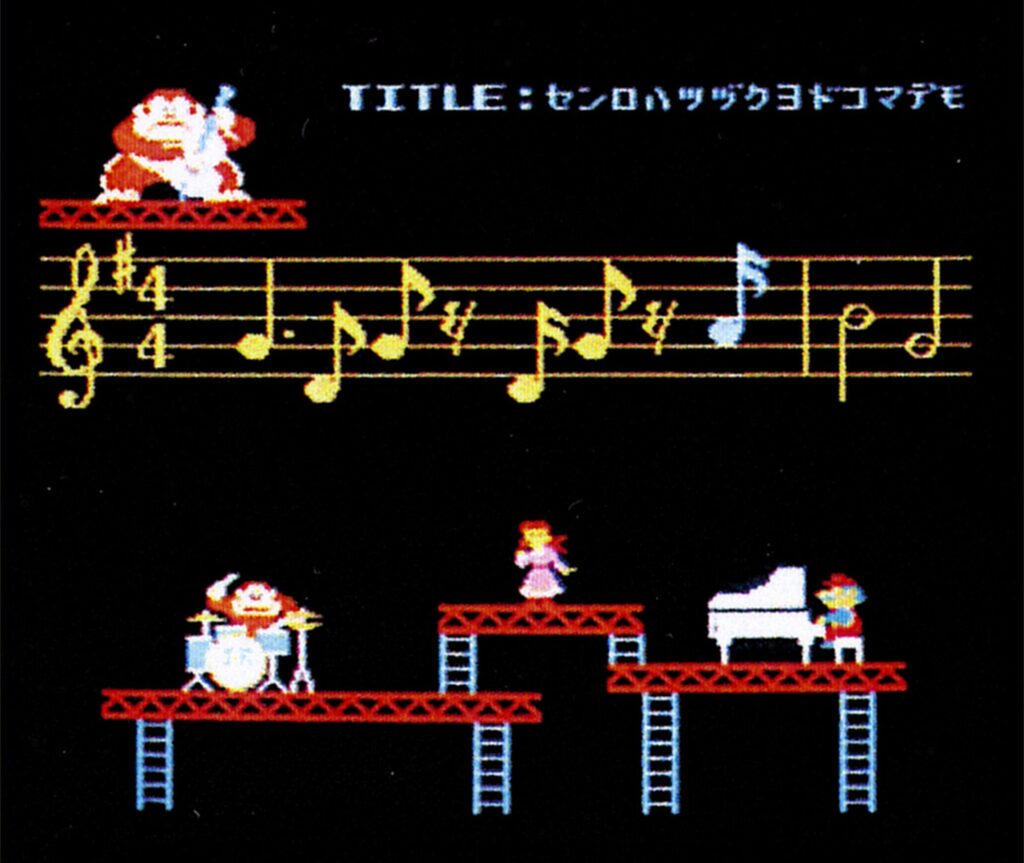
Here the focus is on the barebones yet complete soundtrack from the depths of video game music history. Back when they could barely be called scores and the only people working on the music were just programmers who enjoyed it or were themselves amateur musicians; and it shows, since pieces of that time where either just rearrangements of public domain tunes or very repetitive background music like the case here. Still, Nintendo has gotten some mileage out of the compositions found in here with various famous rearrangements across the ages—including the newly released Bananza—plus the fact that the soundtrack has remained untouched in re-releases—except for the abysmal PC and Atari ports which do not even bother to accurately recreate the songs with their proper intervals and sound completely out of tune—shows that the beeps that accompanied the plumber on his first adventure are already ingrained into this iconic game as a piece of history. This was the pre-Kondo era, so who was here behind the keyboards?
That is something I myself have been confused for a long time since there are multiple claims out there. Officially the composer for the game is Yukio Kaneoka, an electrical engineer that specialized in the sound for these early games alongside Hirokazu Hip Tanaka; at the beginning he often did the music while Tanaka did mostly sound effects, their roles reversed later (The last known credit for Kaneoka was as supervisor in Super Smash Bros. Brawl so it is likely he has already retired). But surprisingly, the creator of the game himself, Shigeru Miyamoto, is said to have written some of the music for his own game, which is credible since he has a musical background playing guitar and banjo. Here are a couple of quotes from Miyamoto that elucidate somewhat the music situation:
“Well, there are two versions of Donkey Kong, and the version on the Nintendo Entertainment System I did only a very little bit of the music. But in the arcade version, I did the opening music and then the end of it as well”
“I grew up watching a lot of cartoons and anime, so I just had this image that at the beginning there’s always this dramatic music to start things off — that’s where the dramatic (sings tune) came from. And then for the ending, I play guitar a little bit, and so the end song I put together as a bit of a parody of a song I used to play on guitar”
Based on this it seems Miyamoto actually did the most musically complex tracks on the soundtrack since the level themes are basic boogie-woogie riffs. He did the “cutscene” tracks while Kaneoka did the level tracks. I expected it would be the other way around. In any case, the Title Theme, one that can be argued to be the main theme of the character, fighting that honor with the ‘DK Island Swing’, was written by Kaneoka for the NES release. The Blues, vaudeville theme that Miyamoto wrote for the ending was also replaced on the NES version for some reason.
The game was completely made with American audiences in mind since the company was looking for a hit in the United States. Thanks to Miyamoto’s influences it achieved just that by using common Western elements like a story based on the film King Kong, the love triangle of Popeye, the New York setting, the stars on the Donkey Kong logo and of course the blues/Tin Pan Alley based music.
Musical Analysis
The deconstruction here is from the NES version, which does not have level 2, aka the pie factory, which is a relief anyway because it has the worst background music seeing as how it is just a single note repeated with a galloping rhythm. It also needs to be said that the NES tracks are a whole step higher in pitch since presumably the developers accounted for the smaller speakers of home TVs and that a higher pitch would be better. Yet, the NES hardware specifications were made specifically with this game in mind.
Instead of level 2 we get the iconic Title Theme now repurposed as part of the main song of Pauline in Donkey Kong Bananza and which also functioned to showcase the evolution of game sound when it was used for the first resurrection of the character in Donkey Kong Country. The piece is the most musical and melodic on the soundtrack and it is a nostalgic major key composition in F mixing major and minor chords in a common progression from various popular music standards: the chords would be:
F – Gm – Bb – C – Am – Bb – F – C – F
You can also hear the use of a pulse wave with a duty cycle of 12.5%, meaning the shape of the wave was not technically a square but rather something like a rectangle; this gives the sound a thin, rough timbre and this was the only way composers back then were able to modify the timbre of their lead instruments.
On this video the audio phenomenon is explained by Sakurai:
Up next we get the classic dramatic sting straight from the TV Series Dragnet which itself took it from earlier radio mystery shows. Its main feature is of course the tritone that tells you that it is time to worry alongside the emphasis on the second minor interval which are the most dissonant. A simple, but very effective unbreakable spell. The harmony is just monolithic perfect fifths.
After all the dread we get the How high can you get? teasing from Donkey Kong accompanied with a carnivalesque piece that brings back the fun. It is just a perfect cadence in the same key [C – F] and then a run through the F Ionian/Major profile straight from vaudeville.
Now for the level cue we get the 25m bassline which has become iconic in its own right even though it is a basic blues riff heard in countless tunes such as “The Ballad of John and Yoko” from The Beatles. In fact it is just an incomplete 12-bar blues progression since probably due to memory constraints it just stays forever on the tonic C; normally you would expect for it to go to the IV, in this case F, and then later the V.
The exclusive use of the triangle channel is understandable since all other channels are in service of the sound effects, which during this era were even more important as a source of feedback for the players; and being descendants from the pinball machines, arcades were always having effects playing—even Mario’s footsteps have sound!
By now everyone knows that this basic riff was repurposed as the basis for the bridge part in Jump Up Superstar! from Mario Odyssey sung by Pauline, where she does the exact same dance as her sprite here. These tracks are also the basis for a DK stage in Mario Kart World.
The hammer cue also purports bringing to mind a fanfare that energizes you, akin to the Popeye spinach fanfare—Fitting since the hammer replaced spinach cans during development—or horse race trumpets or even the Rocky film theme song beginning fanfare. It just plays notes from the C major chord with galloping rhythms. Everyone knows this theme from Smash brothers by now.
The brief moment of happiness when Mario and Pauline’s eyes meet is accompanied by a short success cue harmonized in thirds.
Next level does not have a background cue since the triangle wave probably was also needed to generate the sound effect of the springs failing.
And last level seems to try and mimic a militaristic march since this is the final boss. It is just two notes a major third apart, C and E.
The first ever Mario’s Death sound is also heard and it uses the mickey mousing technique of following the movements of Mario rotating on screen and then getting a halo. Unlike the other cues, it is based around a minor third within the C major chord because now you are supposed to be sad. Other sadness signalers are the descending contours of the melody and the bassline having a downward motion.
Then the story is complete. DK falls to his demise accompanied by a short cue that I forgot to put in here. But it is just two notes alternating (G and E) so it may as well be a sound effect. Then the brand new ending theme likely composed by Kaneoka is unsurprisingly a happy carnival tune in which the blues influence is retained only with the minor third at the end adding that bluesy edge. The chords are:
G
C – Dm – G – C
For some reason the soundtrack sometimes uses a square wave for the bass instead of the more conventional triangle wave.
All in all, a serviceable score that gets the job done in order to tell its story and very ambitious for the time. It is the origin of Miyamoto’s career and the Nintendo infatuation with Western influences which managed to break even further the Japanese companies into the global video game industry even if they did not originated it, a phenomenon that has not being replicated with either films or music when it comes to global entertainment. This Western influence will serve well the company since other big hits of the era like The Legend of Zelda and Metroid have Western origins.

Help to keep the rites going around here by supporting the shrine:

Media Files, requests and support for more interactive content

Thou shall donate since this is a cult and you are now a sheep

Help staying awake analyzing game tracks and writing posts or else everything will end up being written by A.I
- Inside The Score – The Legend of Zeda: A Link to the Past – End Credits / Staff Roll
 The land rests As the last few minutes of this extensive journey that has now come to an end fly by, the nostalgia and reflective mood kicks in. Because such a massive enterprise as a Zelda game or a Lord of the Rings movie require multiple endings to convey everything… Read More »Inside The Score – The Legend of Zeda: A Link to the Past – End Credits / Staff Roll
 - Inside The Score – The Legend of Zelda: A Link to the Past – Ending / Epilogue ~ Beautiful HyruleFinal of the fantasy The Triforce has been touched. A wish has been granted. For the occasion, the newly undeceased king of Hyrule has commissioned a march in honor of the legendary hero to the Hylian Sousa, who might as well be composer Nobuo Uematsu since this piece is very… Read More »Inside The Score – The Legend of Zelda: A Link to the Past – Ending / Epilogue ~ Beautiful Hyrule
- Inside The Score – The Legend of Zelda: A Link to the Past – Triforce Chamber / Power of the GodsTake your boots off your feet And thus the Triforce spoke to men. And it became present in history. And you better treasure and contemplate this moment seldom witnessed in the course of the series. The elusive opportunity to interact and touch the most important artifact. You are now in… Read More »Inside The Score – The Legend of Zelda: A Link to the Past – Triforce Chamber / Power of the Gods
- Inside The Score – The Legend of Zelda: A Link to the Past – Ganon Battle / Prince of DarknessProgressive evil En Garde! And you better be prepared since you are about to duel the iconic enemy of the series at perhaps his canonically most powerful incarnation. Right after having touched the sacred Triforce which allowed him to conquer all of the Golden Land and whose evil and darkness… Read More »Inside The Score – The Legend of Zelda: A Link to the Past – Ganon Battle / Prince of Darkness
- Inside The Score – The Legend of Zelda: A Link to the Past – Boss Battle / Anger of the GuardiansQuick mayhem Ah, the simpler times when boss battles where not a multi epic orchestral suite but just an ostinato more basic that even what became the music for standard battle encounters out there. We are a long way from each boss having his own personalized track. And this early… Read More »Inside The Score – The Legend of Zelda: A Link to the Past – Boss Battle / Anger of the Guardians
- Inside The Score – The Legend of Zelda: A Link to the Past – Dark World Dungeon / Dungeon of ShadowsMemento mori We are getting closer to Ganondorf (or at least the wizard Agahnim who ultimately fulfills the same human side of evil role in this game) and that means getting closer to the profiles and motifs of his own theme song (which naturally was the theme of Agahnim at… Read More »Inside The Score – The Legend of Zelda: A Link to the Past – Dark World Dungeon / Dungeon of Shadows