Path to damnation

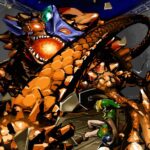
Only the nature of Mario and specially with its early 3D rough polygon design could allow for such idiosyncratic levels that seem to come straight from the King Koopa’s nightmare. A true 3D platform world made in free form alongside other surreal moments such as the infinite staircase and the Princess Peach painting that slowly transitions into Bowser. The dragon turtle levels had never been this abstract—unless until Super Mario Galaxy which in many ways brings back this type of vibe, and even the music—looking like they belong to another infernal dimension; that is why it is called Bowser’s Dark World, not being just another more common gothic castle or villain lair.
The music takes note of this change and it is a perfect example of what Koji Kondo means when he says Mario music should be cool first and foremost, meaning the music has to be taken seriously, ditching the more cartoonily evil tracks in favor of a truly solemn track that is able to walk the line between dread and heroic. No wonder why it was brought back to the Super Mario Galaxy score since it its the spirit of that game and music. The way you do it more epic instead of just plain sad is by bringing modal mixture, transposition and an emphasis on the Dorian profile. The synthesized choirs are the perfect instrument to convey this parallel, twisted dimension sounding as lost souls chanting.
Musical Analysis
The main motif of the theme is naturally taken from the four note Bowser cue used whenever he talks and on the boss battles with him, having become sort of his leitmotif. The only difference is that that motif opens with a perfect fourth and this one with a minor third but the contours and rhythmic profile of the melody are the same.
Only the intro uses the metal Mario orchestra hits alongside the trumpets in descending fashion sounding as if you just picked a wrong answer in Who Wants to be a Millionaire. Trumpets are doubled by low octaves to fill the soundscape.
The piece is in D Dorian and has an ascending progression alongside the militaristic snare, which includes tastefully placed rim shots with a brush to accentuate and create interesting drum patterns; it is reinforced with the standard timpani and cymbal crashes. We still get fire world instruments though, thanks to the presence of the tabla and the tanpura Kondo favors and actually uses for the lava levels since not only this is used on a fire world but it is also the element that represents the dragon turtle. Since the similar sonority of the sitar is also the main soloist of the Bowser Battle theme we get some teasing of it with the high notes at the end alerting us of Bowser’s presence.
The epic progression, made mostly in monolithic fifths, would be: Dm – Em – F – G. It then is transposed a minor third up to start in F Dorian. These progressions are all about giving you motivation to keep climbing but the minor chords retain the sense of apprehension.
The truly angsty part is the next section which uses a Phrygian major vamp—another popular profile for villains—to create a section based around call and response from the choirs and the tanpura; there are mixed in some strategically placed high choir notes sounding as if they were a different instrument; in some sense this means the choirs play three roles in the composition since they also provide their own accompaniment which also sounds like a different instrument. The high strings add some more ambiguous harmony to generate more otherworldy sounding chords. The vamp would be Abmaj7 – G7
After going back and forth between these two chords the coda of the piece gets progressively more dissonant; you are getting closer to Bowser. The last few chords remaining from the harmony would be: D/F# – G7 – F#dim7 – G.
The piece loops back to the beginning of the melody, meaning the cue has two intros, the stingy Who Wants to be a Millionaire one and the harmony establishing intro with just the trumpets and low choir.
As a fun fact it seems the main motif and heroic nature of this theme was taken as the basis for the Super Smash Bros. Melee main theme.
Help to keep the rites going around here by supporting the shrine:

Media Files, requests and support for more interactive content

Thou shall donate since this is a cult and you are now a sheep

Help staying awake analyzing game tracks and writing posts or else everything will end up being written by A.I
- Inside The Score – The Legend of Zeda: A Link to the Past – End Credits / Staff Roll
 The land rests As the last few minutes of this extensive journey that has now come to an end fly by, the nostalgia and reflective mood kicks in. Because such a massive enterprise as a Zelda game or a Lord of the Rings movie require multiple endings to convey everything… Read More »Inside The Score – The Legend of Zeda: A Link to the Past – End Credits / Staff Roll
 - Inside The Score – The Legend of Zelda: A Link to the Past – Ending / Epilogue ~ Beautiful HyruleFinal of the fantasy The Triforce has been touched. A wish has been granted. For the occasion, the newly undeceased king of Hyrule has commissioned a march in honor of the legendary hero to the Hylian Sousa, who might as well be composer Nobuo Uematsu since this piece is very… Read More »Inside The Score – The Legend of Zelda: A Link to the Past – Ending / Epilogue ~ Beautiful Hyrule
- Inside The Score – The Legend of Zelda: A Link to the Past – Triforce Chamber / Power of the GodsTake your boots off your feet And thus the Triforce spoke to men. And it became present in history. And you better treasure and contemplate this moment seldom witnessed in the course of the series. The elusive opportunity to interact and touch the most important artifact. You are now in… Read More »Inside The Score – The Legend of Zelda: A Link to the Past – Triforce Chamber / Power of the Gods
- Inside The Score – The Legend of Zelda: A Link to the Past – Ganon Battle / Prince of DarknessProgressive evil En Garde! And you better be prepared since you are about to duel the iconic enemy of the series at perhaps his canonically most powerful incarnation. Right after having touched the sacred Triforce which allowed him to conquer all of the Golden Land and whose evil and darkness… Read More »Inside The Score – The Legend of Zelda: A Link to the Past – Ganon Battle / Prince of Darkness
- Inside The Score – The Legend of Zelda: A Link to the Past – Boss Battle / Anger of the GuardiansQuick mayhem Ah, the simpler times when boss battles where not a multi epic orchestral suite but just an ostinato more basic that even what became the music for standard battle encounters out there. We are a long way from each boss having his own personalized track. And this early… Read More »Inside The Score – The Legend of Zelda: A Link to the Past – Boss Battle / Anger of the Guardians
- Inside The Score – The Legend of Zelda: A Link to the Past – Dark World Dungeon / Dungeon of ShadowsMemento mori We are getting closer to Ganondorf (or at least the wizard Agahnim who ultimately fulfills the same human side of evil role in this game) and that means getting closer to the profiles and motifs of his own theme song (which naturally was the theme of Agahnim at… Read More »Inside The Score – The Legend of Zelda: A Link to the Past – Dark World Dungeon / Dungeon of Shadows