Heavy dragon
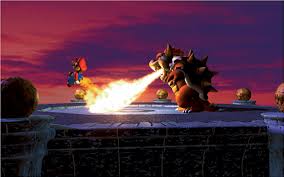
And as a bonus to complete the Bowser’s Trilogy here we got the one and only Bowser’s Theme from which all other of the dragon turtle themes sprouted. A true 70s heavy metal track made to sound otherworldly thanks to the sample choices. Originally named Koopa’s Theme due to this being the original Japanese name of this new kind of dragon who, like his peers during medieval times, abducts princesses from important kingdoms in order to gain status and power; it just happens that he is also a turtle due to the sewer dwelling nature of his nemesis Mario, an unconventional overweight knight not clad in any sort of thing remotely resembling an armor.
For the history of Mario check the blog post:
As we have pointed out, the heavy metal associations with Bowser can be traced at least as far back as his first battle theme made with bleeps in Super Mario Bros. 3. And made more blatantly on the previous Super Mario World 2 in which we at least had something resembling electric guitars. Not only is the genre perfect for Bowser due to the evil associations and imagery of the subculture but also because Bowser himself has metal fashion thanks to his hair, his own spikes and those of his armbands. Here, thanks to the nightmarish, abstract world where we fight the King Koopa—prompting players to make use of their 3D sticks while destroying their palms in the process—Kondo creates yet another of the thousand subgenres by employing unconventional sound samples that we can hear as mimicking the standard metal ensemble yet are still twisted and unique sounding, as if the staple lava instruments like the tanpura and the sitar have been put through a distortion pedal. The kick and snare are also unusually compressed to create this characteristic effect of powerful drums heard at least since the days of Def Leppard and their use of specialized samples with a lot of compressed reverb effect applied to.
As said, this one was probably the origin of Bowser’s main leitmotif from the game, just like Princess Peach and Toad (and even Lakitu) get one, its notes resounding all over the castle the moment we set foot in for the first time and then mocking us whenever we cannot open a door; so hearing it in full is a cathartic moment for a theme that was foreshadowed since the beginning of the game and to a lesser degree on Koopa’s Road.
Metal music is supposed to sound evil to be consistent with its imagery of witchcraft, death, and the occult. Used since the times of the blues to add flavor, it was only with the work of Black Sabbath that the tritone interval was codified in popular music with the explicit purpose of sounding evil since this interval can also be known as the Devil”s Interval (and to make things more metal, the tritone was also employed by the band due to it being a note easier to reach for their guitarist who had burned the fingers on his hand; so functional and aesthetic reasons were at play in this development). It has been the focus of metal riffs since the 70s. Therefore it is no surprise that a track such as the boss battle with the fire breathing demon turtle has a riff focusing on this interval alongside minor seconds and perfect fourths; the theme is all about dissonance.
In fact, since Koji Kondo is a big fan, it is likely that this track’s centerpiece riff is based around similar sounding iconic riffs such as Deep Purple’s Smoke on the Water, which all guitar players are required to learn, or Iron Butterfly’s In-A-Gadda-Da-Vida. The gist of these riffs is that they introduce the tritone note somewhere and lots of cool chromatic movements. We see here a riff that could fit alongside these classics but not played with proper electric guitars doing power chords but a strange synthesized sound that only requires octaves to sound growling, as if the tanpura has been distorted instead of a guitar. The main motif is varied throughout the piece to generate alternative riffs.
Musical Analysis
The first pass will allow us the opportunity to hear the drum work Koji Kondo did on this track to accompany the dynamics and accentuate certain parts, like the coda of the piece that ends up sounding as if it were on 6/8 because of the way the drums accent every three notes. The huge drums also mark the fact that we are fighting against a very gigantic version of Bowser, combining nicely with the footsteps of this big dragon. The drums as they are arranged are likely impossible to play by normal drummers with all notes but the beat itself is very well arranged.
The only lead instrument is also a sample that sounds demonic, unique and distorted; in fact all of the samples from this track come from the same source, which means that the source itself might have inspired the direction of the track. The instruments all come from a sample library known with the apt name of ‘A Poke In The Ear With A Sharp Stick’, a library known for strange soundscapes that has been used in other games with weird ambience such as Silent Hill. You can pretty much hear all the sounds on the demo of the library here:
The samples are called:
Metal Kick
Metal Snare (Rimshot)
Hi Hats
Tonal Darksynth – Convolution 001
Interplanetary Ethnic – Lathna
If somebody knows what the developers of the library mean by Lathna let me know. In any case all these sounds are claimed to be organic sounds heavily distorted for sound design purposes.
The melodic phrases payed by this lead instrument are inconsistent in rhythm, the last phrase sounding slightly faster and offbeat.
Like the previous world, the piece is pretty much in a D minor profile but with the focus on the tritone and minor second intervals making it sound more dissonant and closer to a diminished profile. The main motif is a perfect fourth followed by a perfect fifth that is quickly distorted to the diminished fifth, aka the tritone. So just this single motif is already an embodiment of evil. It is a matter of playing with this motif in a question-answer format and then a tail like any other well written guitar riff—the tail of the riff, specially with that heavy syncopation, and the fact that it ends on the tonic is what gives off the Deep Purple vibes.
The theme naturally has stuck for Bowser, just like the other leitmotifs from the game, being used for the character alongside proper electric guitars, including its incorporation on the song Break Free from Mario Odyssey.

Help to keep the rites going around here by supporting the shrine:

Media Files, requests and support for more interactive content

Thou shall donate since this is a cult and you are now a sheep

Help staying awake analyzing game tracks and writing posts or else everything will end up being written by A.I
- Inside The Score – The Legend of Zeda: A Link to the Past – End Credits / Staff Roll
 The land rests As the last few minutes of this extensive journey that has now come to an end fly by, the nostalgia and reflective mood kicks in. Because such a massive enterprise as a Zelda game or a Lord of the Rings movie require multiple endings to convey everything… Read More »Inside The Score – The Legend of Zeda: A Link to the Past – End Credits / Staff Roll
 - Inside The Score – The Legend of Zelda: A Link to the Past – Ending / Epilogue ~ Beautiful HyruleFinal of the fantasy The Triforce has been touched. A wish has been granted. For the occasion, the newly undeceased king of Hyrule has commissioned a march in honor of the legendary hero to the Hylian Sousa, who might as well be composer Nobuo Uematsu since this piece is very… Read More »Inside The Score – The Legend of Zelda: A Link to the Past – Ending / Epilogue ~ Beautiful Hyrule
- Inside The Score – The Legend of Zelda: A Link to the Past – Triforce Chamber / Power of the GodsTake your boots off your feet And thus the Triforce spoke to men. And it became present in history. And you better treasure and contemplate this moment seldom witnessed in the course of the series. The elusive opportunity to interact and touch the most important artifact. You are now in… Read More »Inside The Score – The Legend of Zelda: A Link to the Past – Triforce Chamber / Power of the Gods
- Inside The Score – The Legend of Zelda: A Link to the Past – Ganon Battle / Prince of DarknessProgressive evil En Garde! And you better be prepared since you are about to duel the iconic enemy of the series at perhaps his canonically most powerful incarnation. Right after having touched the sacred Triforce which allowed him to conquer all of the Golden Land and whose evil and darkness… Read More »Inside The Score – The Legend of Zelda: A Link to the Past – Ganon Battle / Prince of Darkness
- Inside The Score – The Legend of Zelda: A Link to the Past – Boss Battle / Anger of the GuardiansQuick mayhem Ah, the simpler times when boss battles where not a multi epic orchestral suite but just an ostinato more basic that even what became the music for standard battle encounters out there. We are a long way from each boss having his own personalized track. And this early… Read More »Inside The Score – The Legend of Zelda: A Link to the Past – Boss Battle / Anger of the Guardians
- Inside The Score – The Legend of Zelda: A Link to the Past – Dark World Dungeon / Dungeon of ShadowsMemento mori We are getting closer to Ganondorf (or at least the wizard Agahnim who ultimately fulfills the same human side of evil role in this game) and that means getting closer to the profiles and motifs of his own theme song (which naturally was the theme of Agahnim at… Read More »Inside The Score – The Legend of Zelda: A Link to the Past – Dark World Dungeon / Dungeon of Shadows