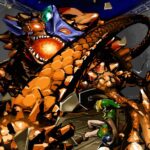
The wise Owl-knowing one

You cannot spell knowledge without owl.
Fighting against Navi herself and Tingle for the title of most disliked character in the Zelda series due to his bad timing and how he tricks you into listening to him multiple times, this infamous owl, like Navi, had the goal of orienting players in the then under explored world of 3D gaming, so his presence certainly made more sense in 1998 than in the modern gaming landscape.
Because if you thought only Navi would be interrupting you and caring for the quest while you just cut grass, play mini-games and explore the field, you are in for a treat—or likely not—as a father or rather grandfather figure steps in to guide Link at the most inappropriate moments. Just when you are about to explore the openness of a 3D Zelda world for the first time, you first have to receive wisdom from a character out of nowhere. Apparently he has taken an interest in our young boy, appearing throughout the child portion of the adventure to teach him and the player something about the world he apparently has inhabited for quite a long time. According to a Gossip Stone, he is rumored to be the reincarnation of an ancient Sage; and although not explicit in the game, Link later on meets the real sage that took on an animal form to guide him. He also transports Link from time to time with his claws. His forebear was actually the owl that fulfilled the same role in The Legend of Zelda: Link’s Awakening.
Nintendo never shies away from using cliches to make a point immediately apparent, and the use of a sage owl to guide the players is stepped firmly on the tradition of seeing these birds as wise and as symbols of knowledge. Could it be because they appear as if they have glasses? Because they have that ancient monk look to them amongst birds (specially when their heads are upside down)? Or because they are silent and mysterious and can see in the dark? Most likely those were some of the traits that lent them their importance in various ancient cultures, especially the Greeks, where the owl was the bird of Athena, the goddess of, among other things, wisdom. Ironically, Athena’s bird was the owl not because the Greeks themselves saw owls as wise, but because Athena’s patron city Athens (and its environs) swarmed with wild little owls.
He is one of the few characters with the honor of having his own theme tune, a playfully mysterious track that captures both his grandfatherly worry for child Link that can also annoy you and his ancientness and propriety.
Do you not want to not read an analysis of my theme?
No
Yes <
Musical Analysis
Structure: Section 0 / Section 1 / Section 2
Time Signature: 4/4
Tempo: 80 (Ritardanto at the end of phrases 70-50)
Melodic and Harmonic Profiles: G Mixolydian (section 0); C Aeolian/Minor, C harmonic minor (Section 1) ; Eb Ionian/Major (Section 2)
The music choice for our wise owl is possibly self aware of his annoying nature, being playful yet slightly dark in Section 1; having two contrasting main sections, with Section 1 having that mischievously playful melody that you may hear in your head when your grandpa is giving you a boring talk with advice from his times, and Section 2—the parallel major scale of Section 1— with one of those bittersweet melodies that Kondo seems to pull off in his sleep, capturing how grandpa also has genuine intentions and it’s worried about your well being.
The transition between the Hyrule Field theme and the owl theme is smooth due to how Section 0 functions within a G Mixolydian profile, the same as in most of Hyrule Field. The main vamp there being G to F, exactly the intro heard here. As in other intros it also ends in the dominant of the main profile in order to start on the tonic. The playfully sinister tone is brought courtesy of the Harmonic minor scale in C and the emphasis on its main note, the B natural.
The bassoon is appropriate as the instrument of the owl since birds are woodwinds in the musical tradition and the wisest and oldest sounding (as you age your voice gets naturally lower) one is the bassoon.
The strings melody adds counterpoint to the piece, making the owl straight from an even older musical tradition and with a more complex understanding of music; the dual nature of this human/animal hybrid is in full display.
The harmony would be something like:
Section 0
G – F – G
Section 1
Cm – Eb – G
Cm – Fm – G – Cm
Section 2
Eb – Fm – Bb – Eb
Eb – Fm – Bb – Fm – Bb – Eb
The theme marks the owl as a proper well educated character from high society, with his baroque piece and symmetrical melodic phrases where you can differentiate easily question-answer blocks. The melody has a swing feel. In order to give movement to the piece, during Section 2 the harp changes its accompaniment style from stacked intervals to full on arpeggio sice in this part the chord changes are also slower.
Even if you find Kaepora Gaebora annoying, at least he is a character integrated into the story as opposed to impersonal menus appearing on your screen to explain an interface. That is not the Miyamoto style. Any exposition needs to still have some charm to it and Kondo helps with that by making a nostalgic tune. Speaking of Miyamoto’s style, he is quite fond of some Americana, which is why Ocarina of Time forgets for a moment its medieval European roots in order to deliver us a Western saga.
Would you like to donate and support the project?
OK
Yes<
Help to keep the rites going around here by supporting the shrine:

Media Files, requests and support for more interactive content

Thou shall donate since this is a cult and you are now a sheep

Help staying awake analyzing game tracks and writing posts or else everything will end up being written by A.I
- Inside The Score – The Legend of Zeda: A Link to the Past – End Credits / Staff Roll
 The land rests As the last few minutes of this extensive journey that has now come to an end fly by, the nostalgia and reflective mood kicks in. Because such a massive enterprise as a Zelda game or a Lord of the Rings movie require multiple endings to convey everything… Read More »Inside The Score – The Legend of Zeda: A Link to the Past – End Credits / Staff Roll
 - Inside The Score – The Legend of Zelda: A Link to the Past – Ending / Epilogue ~ Beautiful HyruleFinal of the fantasy The Triforce has been touched. A wish has been granted. For the occasion, the newly undeceased king of Hyrule has commissioned a march in honor of the legendary hero to the Hylian Sousa, who might as well be composer Nobuo Uematsu since this piece is very… Read More »Inside The Score – The Legend of Zelda: A Link to the Past – Ending / Epilogue ~ Beautiful Hyrule
- Inside The Score – The Legend of Zelda: A Link to the Past – Triforce Chamber / Power of the GodsTake your boots off your feet And thus the Triforce spoke to men. And it became present in history. And you better treasure and contemplate this moment seldom witnessed in the course of the series. The elusive opportunity to interact and touch the most important artifact. You are now in… Read More »Inside The Score – The Legend of Zelda: A Link to the Past – Triforce Chamber / Power of the Gods
- Inside The Score – The Legend of Zelda: A Link to the Past – Ganon Battle / Prince of DarknessProgressive evil En Garde! And you better be prepared since you are about to duel the iconic enemy of the series at perhaps his canonically most powerful incarnation. Right after having touched the sacred Triforce which allowed him to conquer all of the Golden Land and whose evil and darkness… Read More »Inside The Score – The Legend of Zelda: A Link to the Past – Ganon Battle / Prince of Darkness
- Inside The Score – The Legend of Zelda: A Link to the Past – Boss Battle / Anger of the GuardiansQuick mayhem Ah, the simpler times when boss battles where not a multi epic orchestral suite but just an ostinato more basic that even what became the music for standard battle encounters out there. We are a long way from each boss having his own personalized track. And this early… Read More »Inside The Score – The Legend of Zelda: A Link to the Past – Boss Battle / Anger of the Guardians
- Inside The Score – The Legend of Zelda: A Link to the Past – Dark World Dungeon / Dungeon of ShadowsMemento mori We are getting closer to Ganondorf (or at least the wizard Agahnim who ultimately fulfills the same human side of evil role in this game) and that means getting closer to the profiles and motifs of his own theme song (which naturally was the theme of Agahnim at… Read More »Inside The Score – The Legend of Zelda: A Link to the Past – Dark World Dungeon / Dungeon of Shadows