The hidden princess
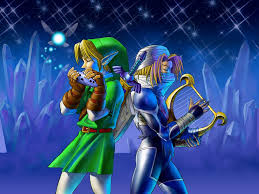
There is a mysterious young warrior that has been waiting for the return of Link for seven long years. Is it a friend or foe? The music tells us immediately that there is nothing to be afraid of.
Sheik, one of the most memorable characters encountered in Ocarina of Time, is the cryptic Sheikah ninja that watches over Link for the remainder of the adult portion of the game, appearing or disappearing without notice as only the best ninjas do, and whose encounters feel as oases in the middle of the destruction and environmental damage cast upon Hyrule. Her soothing and encouraging words are accompanied by an appropriate cue that extracts every last drop of power that could be gained from a MIDI performance at the time by making full use of the dynamics, expression and articulation of its two instruments.
It seems royalty and their bodyguards are adept at playing musical instruments since this warrior plays a lyre; unsurprisingly, her cue is arranged for how such an instrument could sound. Like only the best royals do in war times, the Hylian crown actively participates in the field. Ocarina of Time introduced the notion of a damsel not so in distress into the series, creating a true and memorable plot twist. Her theme in disguise form remains caring but also yearning to see her kingdom the way it was before mistakes were made.
Only the music gives away the dual identity of this lyre-wielding warrior.
Musical Analysis
Structure: Section 1 / Section 2 / Section 3
Time Signature: 3/4
Tempo: Dynamic (between120 and 50)
Melodic and Harmonic Profiles: Bb Ionian/Major
You see, Sheik herself plays the lyre, teaching Link new melodies and continuing the musical motif of the game. Her tune uses the harp, the lyre’s younger brother, to represent the sonority of that ancient string instrument. With it, we get a chordal melody, meaning here that each note has an underlying chord as opposed to standard accompaniment, with an appropriate harp strum style.
The dreamy harmony provided by the accompaniment harp interwoven seamlessly into the track deserves to be heard by itself:
Its rapid changing chords implying at all times lush, extended harmony with just a few notes—a specialty of composers who cut their teeth on the limited NES era. They are played with the characteristic sweep glissando strumming of a real harp.
Unpacking some of this impressionistic harmony reveals a descending motion in the chords; there isn’t a song that can’t be reduced to its more bare essential elements in order to look directly at its core and this song is no exception. The superficial underlying harmony can be interpreted as:
Bbadd9 – Cm7 – Dm – Am7(b5) – F7] – [Repeat]
[Bbadd9 – Cm7 – Am7(b5) – F7] – [Repeat]
[Bbadd9 – Cm7 – Dm7 – Cm7 – Dm7 – Am7(b5) – F7]
These dressed up extended chords can be simplified to reveal the more pure harmony of
[Bb – Eb – Dm – Cm – F] – [Bb – Eb – Dm – Adim – F]
[Bb – Eb – Adim – F] – [repeat]
[Bb – Eb – Dm – Eb – Dm – Cm – F]
We can even go further and just have the melody played on top of fifth intervals and the spirit of the piece will still be preserved:
[Bb5 – Eb5 – D5 – A5(b5) – F5] – [Repeat]
[Bb5 – Eb5 – C5 – F5] – [Bb5 – Eb5 – A5(b5) – F5]
[Bb5 – Eb5 – D5 – Eb5 – D5 – A5 (b5) – F5]
(As you can see from these examples, in this context the Cm chord and the Adim chord pretty much give the same vibe and can be substituted for each other depending on the color you prefer).
Even though the piece has a major profile, the tonic only plays at the beginning of phrases which often end on the dominant that leaves these melodic phrases as open questions. Thus we ger some broken perfect cadences, adding a more wistful tone than you could get from I – IV – V progressions.
The melody consists of three main distinctive question-answer pairs, in which the upper notes limit themselves to the nostalgic major pentatonic scale, this combined with the fact that the harmony accompaniment never settles on the tonic give the piece a more sorrowful tone than would be characteristic of a major profile. It seems this Sheik fella has some unresolved grief. The dynamic tempo that makes for a rubato performance adds an extra tinge of melancholy.
And speaking of Sheik, her true identity is only revealed near the end of the game, but Koji Kondo sneaks a clue that gives away who is behind the mask of this lyric-wielding warrior. The very last section of the this expressive piece has ingrained the main motif of Zelda’s Lullaby; the theme of the princess is repeated two times in a quick flick [G-Bb-F]. A spoiler that foretells us that, for the first time in the series, this damsel may not necessarily be in distress.

Help to keep the rites going around here by supporting the shrine:

Media Files, requests and support for more interactive content

Thou shall donate since this is a cult and you are now a sheep

Help staying awake analyzing game tracks and writing posts or else everything will end up being written by A.I
- Inside The Score – The Legend of Zeda: A Link to the Past – End Credits / Staff Roll
 The land rests As the last few minutes of this extensive journey that has now come to an end fly by, the nostalgia and reflective mood kicks in. Because such a massive enterprise as a Zelda game or a Lord of the Rings movie require multiple endings to convey everything… Read More »Inside The Score – The Legend of Zeda: A Link to the Past – End Credits / Staff Roll
 - Inside The Score – The Legend of Zelda: A Link to the Past – Ending / Epilogue ~ Beautiful HyruleFinal of the fantasy The Triforce has been touched. A wish has been granted. For the occasion, the newly undeceased king of Hyrule has commissioned a march in honor of the legendary hero to the Hylian Sousa, who might as well be composer Nobuo Uematsu since this piece is very… Read More »Inside The Score – The Legend of Zelda: A Link to the Past – Ending / Epilogue ~ Beautiful Hyrule
- Inside The Score – The Legend of Zelda: A Link to the Past – Triforce Chamber / Power of the GodsTake your boots off your feet And thus the Triforce spoke to men. And it became present in history. And you better treasure and contemplate this moment seldom witnessed in the course of the series. The elusive opportunity to interact and touch the most important artifact. You are now in… Read More »Inside The Score – The Legend of Zelda: A Link to the Past – Triforce Chamber / Power of the Gods
- Inside The Score – The Legend of Zelda: A Link to the Past – Ganon Battle / Prince of DarknessProgressive evil En Garde! And you better be prepared since you are about to duel the iconic enemy of the series at perhaps his canonically most powerful incarnation. Right after having touched the sacred Triforce which allowed him to conquer all of the Golden Land and whose evil and darkness… Read More »Inside The Score – The Legend of Zelda: A Link to the Past – Ganon Battle / Prince of Darkness
- Inside The Score – The Legend of Zelda: A Link to the Past – Boss Battle / Anger of the GuardiansQuick mayhem Ah, the simpler times when boss battles where not a multi epic orchestral suite but just an ostinato more basic that even what became the music for standard battle encounters out there. We are a long way from each boss having his own personalized track. And this early… Read More »Inside The Score – The Legend of Zelda: A Link to the Past – Boss Battle / Anger of the Guardians
- Inside The Score – The Legend of Zelda: A Link to the Past – Dark World Dungeon / Dungeon of ShadowsMemento mori We are getting closer to Ganondorf (or at least the wizard Agahnim who ultimately fulfills the same human side of evil role in this game) and that means getting closer to the profiles and motifs of his own theme song (which naturally was the theme of Agahnim at… Read More »Inside The Score – The Legend of Zelda: A Link to the Past – Dark World Dungeon / Dungeon of Shadows