The natural conclusion to the concept of duality
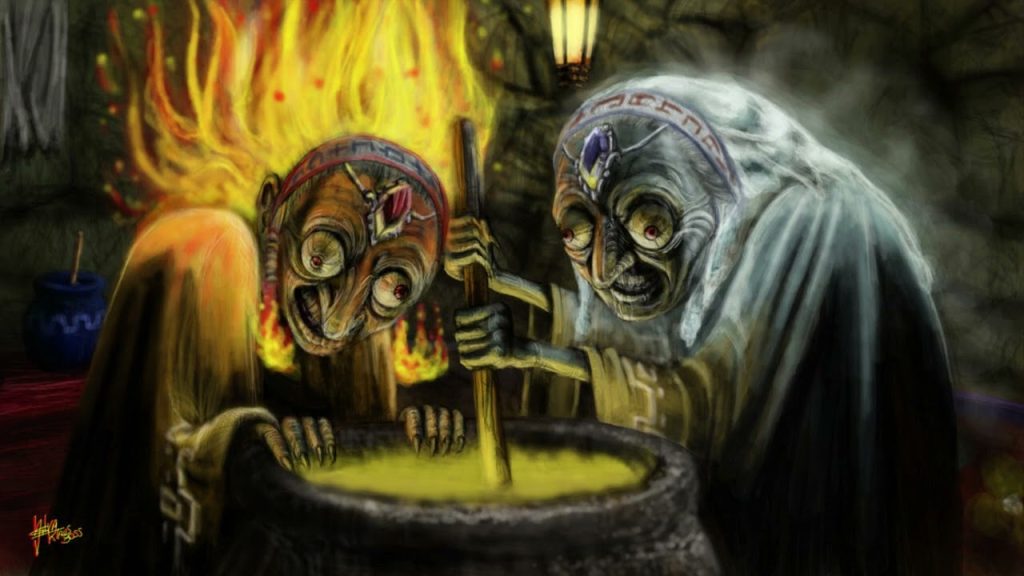
The most characterized bosses in the entire game and the ones with whom we most interact of course get their own theme song. They are Koume and Kotake, the twin surrogate mothers of Ganondorf and the ones who probably taught him the path of black magic—which is probably what turns your skin green—and the history of Hyrule, sowing in him the seeds of hatred towards the better off Hylian people and the thirst for power. Their influence on the Gerudo tribe due to their age may even be greater than we think since their final form could even be the goddess that the tribe worship on the dual Spirit Temple. Their individual names come from the Japanese mystery novel Village of Eight Gravestones. In it, a pair of elderly twin sisters bear these names. Do these sisters really come from the Gerudo desert or could they be from further East? Maybe the music can give us some clues or maybe they take the Romani influence of the Gerudo and represent some kind of gypsy witches with their esoteric magic.
Koume and Kotake have their own theme song whenever you interact with them. They are the only villains along with Ganondorf himself that receive this treatment (well, unless you count Ingo as a villain). This speaks to their importance, alongside the fact Link encounters them various times before their definitive confrontation. This includes an unprecedented mini-boss battle against a brainwashed Nabooru right after opening the boss door inside the temple. They have a small narrative arc unique to the boss of the Spirit Temple, the dungeon with the most cinematic cutscenes.
Being twins, they take the duality and mirror theme of the dungeon to its natural conclusion. One of them specializes in fire, the other in ice; burning hot and freezing cold, two proprieties shared with the desert itself, an unforgiving place that produces strong and resourceful people. Koji Kondo also escalates the duality notion to match the character of these witches in the music; mystical, evil and quirky, the witches benefit from the ability Kondo has of capturing various emotions on a single track.
Using a similar device to the ‘Legend of Hyrule’ cue, where choirs represent the voices of the goddesses, here Koji also creates a narrative arc for Koume and Kotake, each represented with the timbres of two piccolo flutes.
Musical Analysis
Structure: Section 0 / Section 1 / Section 2 / Section 3
Time Signature: 4/4
Tempo: 110
Melodic and Harmonic Profiles: A Harmonic Minor
The song opens with similar instruments to the ‘Potion Shop’ theme; establishing that these are witches with strange and exotic magical powers. After their mysticism is captured, it’s time for their personalities to shine. The piccolos start to talk over each other, mirroring their melodic lines, like they want to one up on one another, bickering on top of each other like the actual characters do in the game. They clash for most of the piece, with the voices only fully harmonizing together at the very end, a representation of the fusion the witches perform at the end of their battle; creating a being named Twinrova. The music captures all of the facets of these characters’ arc such as their fondness for imitating each other—even the strings have a duality factored into their performance.
The dulcimer appears from time to time to add and recharge the mystical flavor to the music. The main string accompaniment is in the figure of oom-pah rhythms. These rhythms alongside the harmonic minor profile are common in media to represent witches; a prime example of this is the music of the Banjo-Kazooie series whose main villain is a witch thus coloring the entire soundtrack with those Germanic oom-pah rhythms straight from the origins of Halloween.
Contributing to this dichotomy of playful and malevolous are the accompanying strings, alternating between ascending through a minor scale in foreboding sustained chords and perky oom-pah like rhythm. The low strings play deep octave intervals and the high strings responding in sixth intervals.
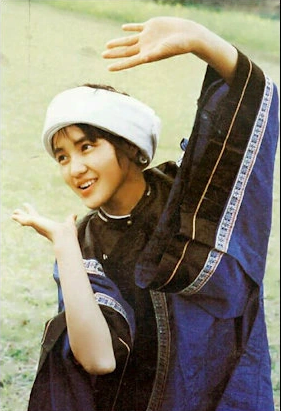
The percussion that plays at the intro does a pattern figure characteristic of Chinese and Japanese drama, where the drumming begins slow and then starts accelerating—we will see a lot more of this style in the Chinese-Inflected soundtrack of Majora’s Mask— These Asiatic patterns have their own language, easily understandable for people familiar with the opera art forms from the East. Perhaps the way the gong sits alongside this commencing drum pattern and a dulcimer that on the intro sounds more like it’s emulating the plucked Guzheng from China is telling us that these witches are not really from around here. Perhaps their names and robe design do not seem to belong to Gerudo tradition after all. In fact, their attire suggests the vibes of the Tujia people from China, Which would make them technically what is known as a Wu, sorceresses from the East:
The danger, malevolence, playfulness, humor, mysticism, and story beats of these characters is all matched in the music with just a few elegant seconds. It plays one last time when Link sends the two of them to heaven(?), bickering and fighting but still sisters, just like the two piccolo flutes.
Help to keep the rites going around here by supporting the shrine:

Media Files, requests and support for more interactive content

Thou shall donate since this is a cult and you are now a sheep

Help staying awake analyzing game tracks and writing posts or else everything will end up being written by A.I
- Inside The Score – The Legend of Zeda: A Link to the Past – End Credits / Staff Roll
 The land rests As the last few minutes of this extensive journey that has now come to an end fly by, the nostalgia and reflective mood kicks in. Because such a massive enterprise as a Zelda game or a Lord of the Rings movie require multiple endings to convey everything… Read More »Inside The Score – The Legend of Zeda: A Link to the Past – End Credits / Staff Roll
 - Inside The Score – The Legend of Zelda: A Link to the Past – Ending / Epilogue ~ Beautiful HyruleFinal of the fantasy The Triforce has been touched. A wish has been granted. For the occasion, the newly undeceased king of Hyrule has commissioned a march in honor of the legendary hero to the Hylian Sousa, who might as well be composer Nobuo Uematsu since this piece is very… Read More »Inside The Score – The Legend of Zelda: A Link to the Past – Ending / Epilogue ~ Beautiful Hyrule
- Inside The Score – The Legend of Zelda: A Link to the Past – Triforce Chamber / Power of the GodsTake your boots off your feet And thus the Triforce spoke to men. And it became present in history. And you better treasure and contemplate this moment seldom witnessed in the course of the series. The elusive opportunity to interact and touch the most important artifact. You are now in… Read More »Inside The Score – The Legend of Zelda: A Link to the Past – Triforce Chamber / Power of the Gods
- Inside The Score – The Legend of Zelda: A Link to the Past – Ganon Battle / Prince of DarknessProgressive evil En Garde! And you better be prepared since you are about to duel the iconic enemy of the series at perhaps his canonically most powerful incarnation. Right after having touched the sacred Triforce which allowed him to conquer all of the Golden Land and whose evil and darkness… Read More »Inside The Score – The Legend of Zelda: A Link to the Past – Ganon Battle / Prince of Darkness
- Inside The Score – The Legend of Zelda: A Link to the Past – Boss Battle / Anger of the GuardiansQuick mayhem Ah, the simpler times when boss battles where not a multi epic orchestral suite but just an ostinato more basic that even what became the music for standard battle encounters out there. We are a long way from each boss having his own personalized track. And this early… Read More »Inside The Score – The Legend of Zelda: A Link to the Past – Boss Battle / Anger of the Guardians
- Inside The Score – The Legend of Zelda: A Link to the Past – Dark World Dungeon / Dungeon of ShadowsMemento mori We are getting closer to Ganondorf (or at least the wizard Agahnim who ultimately fulfills the same human side of evil role in this game) and that means getting closer to the profiles and motifs of his own theme song (which naturally was the theme of Agahnim at… Read More »Inside The Score – The Legend of Zelda: A Link to the Past – Dark World Dungeon / Dungeon of Shadows