Multi-color ray of hope
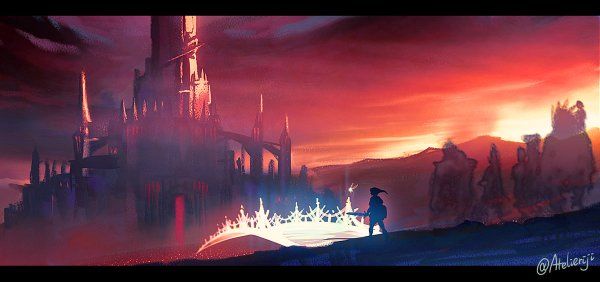
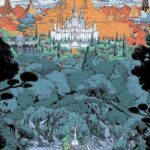
This is pretty much the land of Mordor, only thing missing is the giant eye of Ganon scorching the entirety of Hyrule. As we will see later neither this Ganondorf fella nor the developers are subtle in presenting the evilness of this villain. We are now back in classic mode, the knight rescuing a princess trapped inside a black fortress. Only the sages and goddesses will be the light that remains accompanying Link and helping to break the barriers in front of them. This is only the first one to be conqueres, the huge pit of lava over which the castle floats (I told you it wasn’t subtle).
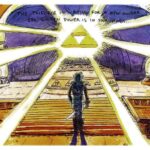
Accompanying Link in assaulting Ganondorf’s castle are the spirits of the sages coming directly from the Sacred Realm. With the effort both Link and the player put in, the impassable pit to what used to be Hyrule Castle is finally open. The sages conjure a magical bridge, an iridescent structure made with the color spectrum that represents the sages and their medallions. The scene gives an extra operatic touch to this musical game since the moment parallels the last scene from Richard Wagner’s Das Rheingold in which the gods also summon a rainbow to reach the castle.
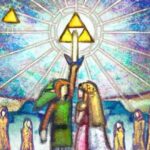
In our last encounter with Sheik she told us another legend related to the golden goddesses and the Triforce. As with the previous retellings of the legends of the kingdom, the music is accompanied by the goddesses choir; however, the cutscene is not allowed to finish with the ‘Triforce cadence’ originally heard in A Link to the Past and on the story told by the Great Deku Tree; it simply fades out before that section. The missing piece of that cutscene is heard right here. The Triforce cadence in all of its glory is summoned to complete the piece; it only appears when divine intervention creates something. Hyrule’s mysticism is sonically represented, providing cohesiveness to the myths and legends of this old kingdom.
Musical Analysis
Structure: Section 1
Time Signature: 4/4
Tempo: 67
Melodic and Harmonic Profiles: G# Ionian/Major; G#Aeolian Dominant; G# Aeolian/Minor; Whole Tone
The harp and the glockenspiel play the usual accompaniment of the sacred cues, cascading and adding extended color to the music. The entire piece plays with the number three at many different levels. The particular rhythm of the accompaniment can be counted in groups of three—either in 3/4 or 6/8 or 12/8 or triplets in 4/4 Here are the harp and the glockenspiel soloed to hear the rhythm.
Like the Triforce itself, the cue only uses three chords that can be though of as taken from three different profiles which in turn are accompanied by a melodic motif of just three notes. The music is in a G# major tonality, but the other chords that are sitting side by side to the G# do not belong to that tonality; they are three different and independent chords. Two major chords, one dissonant, just like the protagonists of this story. It’s is indeed a fitting theme for The Legend of Zelda series overall. Three Triforce pieces for three protagonists across three timelines.
The harmony can be interpreted as:
G# – F# (b5) – E – G#
This harmony differs from the original, exclusively triumphant from A Link to the Past‘s Title Theme which was:
G# – B – C# – G#
Besides that, this theme from Ocarina of Time also incorporates the quintessential ‘major’ Andalusian cadence emblematic of the entire Zelda series. it appears in the descending bass line; two whole steps plus one half step that are indelible to Zelda music.
Neither when we dispel barriers at Ganon’s Castle, nor even when we bring down the entire energy field protecting the tower, much less when we actually defeat the demon king himself; this will be the very last fanfare we hear on The Legend of Zeda: Ocarina of Time. It could not be any other way.

Help to keep the rites going around here by supporting the shrine:

Media Files, requests and support for more interactive content

Thou shall donate since this is a cult and you are now a sheep

Help staying awake analyzing game tracks and writing posts or else everything will end up being written by A.I
- Inside The Score – The Legend of Zeda: A Link to the Past – End Credits / Staff Roll
 The land rests As the last few minutes of this extensive journey that has now come to an end fly by, the nostalgia and reflective mood kicks in. Because such a massive enterprise as a Zelda game or a Lord of the Rings movie require multiple endings to convey everything… Read More »Inside The Score – The Legend of Zeda: A Link to the Past – End Credits / Staff Roll
 - Inside The Score – The Legend of Zelda: A Link to the Past – Ending / Epilogue ~ Beautiful HyruleFinal of the fantasy The Triforce has been touched. A wish has been granted. For the occasion, the newly undeceased king of Hyrule has commissioned a march in honor of the legendary hero to the Hylian Sousa, who might as well be composer Nobuo Uematsu since this piece is very… Read More »Inside The Score – The Legend of Zelda: A Link to the Past – Ending / Epilogue ~ Beautiful Hyrule
- Inside The Score – The Legend of Zelda: A Link to the Past – Triforce Chamber / Power of the GodsTake your boots off your feet And thus the Triforce spoke to men. And it became present in history. And you better treasure and contemplate this moment seldom witnessed in the course of the series. The elusive opportunity to interact and touch the most important artifact. You are now in… Read More »Inside The Score – The Legend of Zelda: A Link to the Past – Triforce Chamber / Power of the Gods
- Inside The Score – The Legend of Zelda: A Link to the Past – Ganon Battle / Prince of DarknessProgressive evil En Garde! And you better be prepared since you are about to duel the iconic enemy of the series at perhaps his canonically most powerful incarnation. Right after having touched the sacred Triforce which allowed him to conquer all of the Golden Land and whose evil and darkness… Read More »Inside The Score – The Legend of Zelda: A Link to the Past – Ganon Battle / Prince of Darkness
- Inside The Score – The Legend of Zelda: A Link to the Past – Boss Battle / Anger of the GuardiansQuick mayhem Ah, the simpler times when boss battles where not a multi epic orchestral suite but just an ostinato more basic that even what became the music for standard battle encounters out there. We are a long way from each boss having his own personalized track. And this early… Read More »Inside The Score – The Legend of Zelda: A Link to the Past – Boss Battle / Anger of the Guardians
- Inside The Score – The Legend of Zelda: A Link to the Past – Dark World Dungeon / Dungeon of ShadowsMemento mori We are getting closer to Ganondorf (or at least the wizard Agahnim who ultimately fulfills the same human side of evil role in this game) and that means getting closer to the profiles and motifs of his own theme song (which naturally was the theme of Agahnim at… Read More »Inside The Score – The Legend of Zelda: A Link to the Past – Dark World Dungeon / Dungeon of Shadows