A peaking behind the scenes
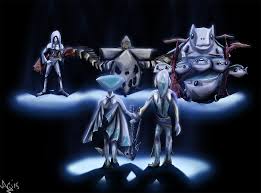
After meeting (and becoming) the lead guitarist in a band, it’s time to a face to face encounter with his band mates and become acquainted with their internal dynamics, their style and personalities, going to their dressing rooms and, why not, even helping with writing none other than the end credits theme of the game. Another facet of the surrealism and boldness of Majora’s Mask that befits the modern sensibilities of the people from Termina and its culture.
The band also helps to create a further connection with Clock Town since the player presumably already met with their manager lamenting their situation, something that makes the game feel even more cohesive. The Indigo-Go’s consists of five members, all with cool American short artistic names—two syllable are the most memorable —and a design inspired in the image of rock stars. Their lead singer is currently unable to perform due to her eggs being stolen by pirates, making the other members feel for her, jeopardizing the future of the band and ultimately causing the decease of their guitar player. This is something that Link must try to hide from them by taking in the spirit of the famous Zora guitarist; so good thing Link is a musician too.
After entering the Zora Hall, as Mikau, Link now has unprecedented access to the room of each of the band members, where he can catch them practicing some tunes. The style of the band is Latin-jazz, a genre of music popular in Japan and very close to the heart of series composer Koji Kondo; it may even be his true style and favorite genre of music, playing it as a keyboardist throughout his pre-Nintendo years and citing local jazz fusion artists like Sadao Watanabe and the band Casiopea as some of his biggest influences. The whole Great Bay region and band saga might have been some of his favorite parts to score on the game (we are dealing with the composer of Super Mario music after all). Still ,the tunes each member is playing are actually some easter eggs referencing the series musical legacy; three tunes from vintage Zelda. let’s see what we got.
Musical Analysis
Structure: Section 1 / Section 2 / Section 3
Time Signature: 4/4 (Section 1); 4/4, 5/4 (Section 2); 2/4 (Section 3)
Tempo: 110 (Section 1); 90 (Section 2); Dynamic (79 To 87) (Section 3)
Melodic and Harmonic Profiles: atonal, gb chromatic (section 1); G Double Harmonic Minor; F Double Harmonic Minor; D Neapolitan Minor; D Diminished (Section 2); C Ionian/Major (Section 3)
We have the drummer, a Zora manta ray playing the underground or cavern music from A Link to the Past. There is also the bassist, a John Lennon-type figure who jams to the tune of the dungeon theme from the original The Legend of Zelda, a theme in which the bass channel from the NES (a triangle wave) took the lead melody. Finally, there is the leader of the band, the main composer who doesn’t like when other band members write the music (something you should never encourage the drummer to try anyway). He is playing the underrated game over theme from the original The Legend of Zelda, also the end credits song of said game—he also has a good pair of headphones like any phony keyboard player out there and the biggest instrument and room of them all. Koji, being a keyboardist, is definitively biased.
Overall, three tunes selected from very dark contexts in the series, fitting for the dire situation of the ocean and the game over of their own guitarist (also giving fuel to those claiming Link is actually dead on this game).
Some notes about the tracks:
The drum kit is a hack. The bass drum is instead our old friend, the low timpani; this is because it functions better for the cavern arrangement of ALttP since that theme had the low timpani as one of its main characteristics. The ride cymbals is the one doing the melody, originally played with trumpets, something almost impossible to do on a real drum kit. There is an actual snare sound but it is drowned by the timpani (the same technique used to emulate the bass drum sound on the Hyrule Field cue. Again, Koji didn’t use the normal bass drum sound of his kit because it wasn’t close enough to his arrangement from A Link to the Past), remaining only the shaker-like sound as the true snare; this is because in jazz, the use of brushes to play the snare is very common to create an elegant, soft sound. Besides those, the only sounds from a real drum kit are the cymbals—just like the design of the drum set from the game where the drums are actually blowfishes and cymbals— it is all made to sound very jazzy and chill; although in jazz, normally the ride cymbal would do the role that the hi-hat and the brushes are doing here. It ends with a mini fill. Sadly, there is no equivalent to the sounds of water puddles, a key sound design choice in the original theme from the SNES game.
The angular, transposing melody from the underground dungeons from the original NES Zelda is played by the cool, virtuous musician known as Japas on his bass. The classic diminished melody taken by Kondo from the song April by Deep Purple, one of his favorite bands:
A song that inspired the music sensibilities of the entire The Legend of Zelda series with its Andalusian influences.
He also makes some cool string bends on his instrument (portamento for boring musicians). The practice ends with a mistake; Japas plays the wrong note Ab instead of Gb. He immediately stops and then starts again.
Then we got Evan, the progressive rock keyboardist who is playing the game over cue also from the original game, a very melodic tune that is more in line with the Mario series, perhaps the reason the theme has not been featured in the series after its original appearance…until Majora’s Mask that is, a game that does whatever it wants. Yet for all the technology he has at his disposal and how crazy about sounds are keyboardists and synth enthusiasts, he only plays with a standard piano sound from any cheap electric piano. It is technically an arrangement of the end credits song because on that first game it was the only way to hear the melody harmonized. Here it is played in rubato time. The piece is an early example of Kondo using voice leading to transition between chords, making sure the bass line still feels melodic. The heart of the music has always being the ragtime style, meant to be played in a murky bar in old America by a honky tonk uptight piano which has lost its tuning slightly; this is why it feels closer to the Mario tradition than Zelda.
The ragtime comes across thanks to the accidentals that sometimes make the melody feel salacious (Eb) and other times bittersweet (Ab), a staple of this style of music. And also due to the walking bass lines on the left hand. The progression can be thought of as:
C – B aug – C – C – F – Fm – C – G
If you listen closely, you can identify two of the samples Koji used for the piano sound, one for the bass and two for middle and upper notes; the bass sample only plays in one instance right at the end of the accompaniment (low G) and it sticks out compared to the rest of the instrument sound.
There will be plenty of time to jam—for Link that is—but before that there is the more pressing matter of recovering the stolen unborn babies of the Zora idol singer, a promise that Mikau, the Zora hero (and possible father) was never able to fulfill. With the help from Link, they can infiltrate this dangerous pirate navy, After all, the Hero of Time already has experience sneaking into these Middle Eastern women’s lairs.
As a fun bit of trivia, the Japanese name of this Zora band is Blue Swamp, which is a play on the words “Aounuma”, the last name of the director. Since the English translator felt that this name didn’t have enough of a ring to it, he spent some time at Nintendo headquarters trying to come up with a name for the English markets. Contrary to popular belief, the name was not inspired by the group Indigo Girls, the translator just wanted to maintain the relationship with the color blue, thus he used “indigo” he then combined it with the name of the American group The Go Go’s to create the wordplay.

Help to keep the rites going around here by supporting the shrine:

Media Files, requests and support for more interactive content

Thou shall donate since this is a cult and you are now a sheep

Help staying awake analyzing game tracks and writing posts or else everything will end up being written by A.I
- Inside The Score – The Legend of Zeda: A Link to the Past – End Credits / Staff Roll
 The land rests As the last few minutes of this extensive journey that has now come to an end fly by, the nostalgia and reflective mood kicks in. Because such a massive enterprise as a Zelda game or a Lord of the Rings movie require multiple endings to convey everything… Read More »Inside The Score – The Legend of Zeda: A Link to the Past – End Credits / Staff Roll
 - Inside The Score – The Legend of Zelda: A Link to the Past – Ending / Epilogue ~ Beautiful HyruleFinal of the fantasy The Triforce has been touched. A wish has been granted. For the occasion, the newly undeceased king of Hyrule has commissioned a march in honor of the legendary hero to the Hylian Sousa, who might as well be composer Nobuo Uematsu since this piece is very… Read More »Inside The Score – The Legend of Zelda: A Link to the Past – Ending / Epilogue ~ Beautiful Hyrule
- Inside The Score – The Legend of Zelda: A Link to the Past – Triforce Chamber / Power of the GodsTake your boots off your feet And thus the Triforce spoke to men. And it became present in history. And you better treasure and contemplate this moment seldom witnessed in the course of the series. The elusive opportunity to interact and touch the most important artifact. You are now in… Read More »Inside The Score – The Legend of Zelda: A Link to the Past – Triforce Chamber / Power of the Gods
- Inside The Score – The Legend of Zelda: A Link to the Past – Ganon Battle / Prince of DarknessProgressive evil En Garde! And you better be prepared since you are about to duel the iconic enemy of the series at perhaps his canonically most powerful incarnation. Right after having touched the sacred Triforce which allowed him to conquer all of the Golden Land and whose evil and darkness… Read More »Inside The Score – The Legend of Zelda: A Link to the Past – Ganon Battle / Prince of Darkness
- Inside The Score – The Legend of Zelda: A Link to the Past – Boss Battle / Anger of the GuardiansQuick mayhem Ah, the simpler times when boss battles where not a multi epic orchestral suite but just an ostinato more basic that even what became the music for standard battle encounters out there. We are a long way from each boss having his own personalized track. And this early… Read More »Inside The Score – The Legend of Zelda: A Link to the Past – Boss Battle / Anger of the Guardians
- Inside The Score – The Legend of Zelda: A Link to the Past – Dark World Dungeon / Dungeon of ShadowsMemento mori We are getting closer to Ganondorf (or at least the wizard Agahnim who ultimately fulfills the same human side of evil role in this game) and that means getting closer to the profiles and motifs of his own theme song (which naturally was the theme of Agahnim at… Read More »Inside The Score – The Legend of Zelda: A Link to the Past – Dark World Dungeon / Dungeon of Shadows