The Illegal Navy
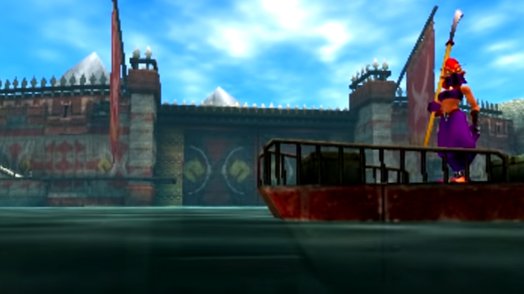
We meet an organized group of thieves in Majora’s Mask and, once again, they are none other than the all-female Middle-Eastern influenced Gerudo, just this time they are the people of the sea as opposed to the people of the desert; everything is twisted upside down in Termina after all (analogous to the Goron situation). However, don’t think for a second that these are your typical swashbuckler adventure loving pirates. We are dealing here with a truly dangerous guerrilla warfare unit, an organized paramilitary army with structure, tactics, training and a whole lot of weapons inside a fortress; a true navy. So don’t expect parrots hanging on their shoulders, eye patch and much less some generic Irish music played with accordion and fiddles—the Wind Waker is still two years in the future—No, we have here the second military cue of the game. An unapologetically battle march that could musicalize any standard world war film.
The dynamics of the Gerudo basically remain the same; Link will have to hide from them while navigating the fortress in order to recover Lulu’s babies, something that mortally wounded Mikau, the Zora hero, failed to do. The music that accompanies this mission is closer to a first person shooter like GoldenEye 007 than to The Legend of Zelda. Link mission here is also similar to the adventures of games like Metal Gear Solid after all.
Musical Analysis
Structure: Section 0 / Section 1 / Section 2 / Section 3 / Section 4
Time Signature: 4/4
Tempo: 120
Melodic and Harmonic Profiles: A Aeolian/Minor; A Phrygian; F Phrygian; G Phrygian
The track brings to mind a war that is already in process, with many loses and destruction around; there is an air of sadness and dignity to it, but also a sense of danger like an army going to a battle they know they probably will not come back from. If the music for the Bremen mask was the fun training period playing soldier, the Pirate Fortress theme is what it sounds like after one year of constant warfare, when the realities of war sink in and you realize it is not that fun.
Here, the clarinets even try to co-opt the sounds of a big military navy boat using its horns in the open seas, and of course the boats from Termina are totally motorized, not even a talking boat would surprise them because it would still operate with primitive sails. Nonetheless, the spirit of the Gerudo can still be felt by the stealth mission and then crossing the same “desert” where you can get lost. This time the desert is underwater though.
Of course the snare drum is the centerpiece of any military band, but here it is not paying a constant, pulsating, always-moving-forward march that matches… well…the march of human feet. It seems to be slower; with more care, not in a duple meter and ending its phrase with a triplet rhythm. After all, the piece has more focus on the movement of boats on water; you can picture Koji Kondo, who is very particular about kinetic composition and capturing movement on screen, spending a lot of time on the level observing the Gerudo going around on board their motorboats till he found the perfect spot for the sustained chords and the snare tempo. The snare alternates between being answered by the timpani and a cool triplet pattern to end phrases. The low timpani is possibly functioning as just mimicking another articulation of the snare drum to make the pattern more dynamic.
On top of that, the piano begins to hype the piece with an ostinato that only plays at the intro; it consist of a pair of question-answer blocks where the question is always just the gloomy low A note and the answers go between a descending major second interval and an ascending minor third. This pattern is the same of the pizzicato bass line which will play throughout the entire piece.
The GoldenEye 007 feel shines through the treatment of the low strings (actually high strings, which are the ones panned to the left) playing perfect fifths in long sustained notes following a Phrygian profile appropriate for infiltrating any Soviet Union hideout; the use of Phrygian scales might or might not be related to the original Middle-Eastern Gerudo, whose cue on the Spirit Temple used these same profiles. To end the piece and pump the stakes, the music is transposed in order to access the notes Ab and Gb.
The main martial melody is carried by the trombones playing clear defined phrases with easily identifiable question-answer pairs; the questions are always the perfect fifth between A and E (A E E E). Melodies can be thought of as functioning in similar fashion to the Russian matryoshka dolls, with question-answer blocks nested inside bigger question-answer blocks; in this track we have the question 1 and answers 2,3, 4 and 5 (the differences between the answers are minimal, sometimes it is just a matter of one note); This concept is easier to explain with diagrams or icons, but trying with numbers, the main melody would go something like this:
Question 1 = A E E E
Section 1———————–Section 3
{ [ (1-2) – (1-3) ] Interlude [ (1-4) – (1-5) ] }
Question-answer blocks nested inside bigger question-answer blocks.
{ } encompasses a self sustained mega phrase, what in the classical tradition would be considered a double period; a unit of melodic organization made up of four balanced phrases in succession. It follows then that [ ] represents a period. The double period { } consists of two periods, with a stronger cadence at the end of the second period; just like this theme exemplifies.
Answer 5 is further differentiated by changing the underlining harmony; it is the saddest part of the piece due to the emphasis on the Aeolian profile given by the B natural note, which was absent on the main ostinato.
Answers 2 and 3 can’t ever hope to successfully complete a phrase since they always end up on the dominant, which is the note that most wants to rest on the tonic. However, answer number 5 doesn’t end on the tonic either, so there is still steam left for one more reiteration of question 1 from which we will pivot directly into Section 4 of the piece. A mark of good music composition because Kondo could simply gotten away with pilling up answers, creating answer 6, 7, etc and never be able to escape the loop, or simply finishing on the tonic. But pondering one last question and then straight to section 4 breaks the pattern and gives variation. Balancing the expected with the unexpected is always key in music and this is an example of balance between symmetry and asymmetry; additionally, Kondo manages to insert an echo of the previous trumpet interlude during this new Section 4. The piece has a lot of balance.
The remaining instruments play important countermelodies (clarinets), ornamental reinforcement (timpani) and interludes that separate the main phrases played by the trombone (trumpets). They infuse the piece with sounds reminiscent of boat horns and war brass sections. The trumpets always disrupt the scale by using the notes Ab and Eb, sticking out and upending the danger and risk. The clarinets plat the entire piece in fourths.
Overall, we end up with a brand new style added to Koji Kondo’s resume and the Zelda series.
After traversing the underwater desert and finding the remaining eggs stolen from the Zora it is time to watch the miracle of life at the Marine Research Laboratory, where in a surrealist scene, the ones that teach Link the key song to open the path to the temple are the babies themselves forming musical notation in an imaginative sequence. The game keeps surprising and, as we will see, the technology is still present by way of of a fully fledged water treatment plant.
Help to keep the rites going around here by supporting the shrine:

Media Files, requests and support for more interactive content

Thou shall donate since this is a cult and you are now a sheep

Help staying awake analyzing game tracks and writing posts or else everything will end up being written by A.I
- Inside The Score – The Legend of Zeda: A Link to the Past – End Credits / Staff Roll
 The land rests As the last few minutes of this extensive journey that has now come to an end fly by, the nostalgia and reflective mood kicks in. Because such a massive enterprise as a Zelda game or a Lord of the Rings movie require multiple endings to convey everything… Read More »Inside The Score – The Legend of Zeda: A Link to the Past – End Credits / Staff Roll
 - Inside The Score – The Legend of Zelda: A Link to the Past – Ending / Epilogue ~ Beautiful HyruleFinal of the fantasy The Triforce has been touched. A wish has been granted. For the occasion, the newly undeceased king of Hyrule has commissioned a march in honor of the legendary hero to the Hylian Sousa, who might as well be composer Nobuo Uematsu since this piece is very… Read More »Inside The Score – The Legend of Zelda: A Link to the Past – Ending / Epilogue ~ Beautiful Hyrule
- Inside The Score – The Legend of Zelda: A Link to the Past – Triforce Chamber / Power of the GodsTake your boots off your feet And thus the Triforce spoke to men. And it became present in history. And you better treasure and contemplate this moment seldom witnessed in the course of the series. The elusive opportunity to interact and touch the most important artifact. You are now in… Read More »Inside The Score – The Legend of Zelda: A Link to the Past – Triforce Chamber / Power of the Gods
- Inside The Score – The Legend of Zelda: A Link to the Past – Ganon Battle / Prince of DarknessProgressive evil En Garde! And you better be prepared since you are about to duel the iconic enemy of the series at perhaps his canonically most powerful incarnation. Right after having touched the sacred Triforce which allowed him to conquer all of the Golden Land and whose evil and darkness… Read More »Inside The Score – The Legend of Zelda: A Link to the Past – Ganon Battle / Prince of Darkness
- Inside The Score – The Legend of Zelda: A Link to the Past – Boss Battle / Anger of the GuardiansQuick mayhem Ah, the simpler times when boss battles where not a multi epic orchestral suite but just an ostinato more basic that even what became the music for standard battle encounters out there. We are a long way from each boss having his own personalized track. And this early… Read More »Inside The Score – The Legend of Zelda: A Link to the Past – Boss Battle / Anger of the Guardians
- Inside The Score – The Legend of Zelda: A Link to the Past – Dark World Dungeon / Dungeon of ShadowsMemento mori We are getting closer to Ganondorf (or at least the wizard Agahnim who ultimately fulfills the same human side of evil role in this game) and that means getting closer to the profiles and motifs of his own theme song (which naturally was the theme of Agahnim at… Read More »Inside The Score – The Legend of Zelda: A Link to the Past – Dark World Dungeon / Dungeon of Shadows