Forced destruction
“I… I shall consume. Consume… Consume everything..”
This is not how you are supposed to use the gongs from the Chinese opera! Yet this is not a concern for Koji Kondo, who will chase his musical idea wherever it takes him; if he wants to use his gongs in a melodic role, creating a brand new unnerving sound that still manages to be grounded in the sound palette he designed for the character of Majora, he will do it.
The chains are broken and with one last impulse from the evil mask the moon is at its most dangerous, not even the four giants being able to resist much longer. Even so, Link didn’t come this far just to once again quit and start from the first day; it’s all in now, so he follows Majora to the very center of the moon, a truly abstract plane of existence where the lines between reality and dream are completely annihilated and time stands still.
Musical Analysis
Structure: Section 0 / Section 1 / Section 2
Time Signature: 4/4
Tempo: 180
Melodic and Harmonic Profiles: Bb Diminished; Bb Chromatic; C Chromatic
A lesser composer maybe would have used this for the ‘Last Hours’ music, a track full of adrenaline pumping escalation and climax sensibilities. But Kondo only deploys it for this last scene where the stakes are very high, creating a frightening cacophony that gives impact and gravitas to the proceedings; a truly unnerving cutscene where the gongs from the Majora troupe have gone as berserk as the mask and the moon themselves. You can almost feel the weight each giant is supporting right now and the sense of having to run desperately and stop this situation whatever the cost. The opera gongs belong to the moon as much as they belong to Majora; after all, we first heard them on the title screen when we got the daunting first sight of the ominous astrological body. Still, the moon never looked this frightening.
This is the analogous track and moment to the destruction of Ganon’s castle in Ocarina of Time; the storm before the calm, punctuated by a short cue meant to create a sense of urgency and with Section 2 being a direct reference to the last part of the ‘Chase’ cue, a bunch of ascending scales starting progressively higher. The tempo is at its fastest, the beat placing its accents at different parts on the measure, creating a driving rhythm. We also see for the first time a single string instrument doing four parts as if on a string quartet doubling and covering multiple octaves, with Kondo employing one set of strings each one playing two chromatic lines. And who needs cymbals when the chau gongs are manically pondering with fast strokes and heavy sustained hits.
By the way, the gongs were not tuned to how a normal keyboard displays the notes (again, because no sane person uses them this way), Kondo just found the note he wanted by ear; the small opera gong is in truth sounding a perfect fifth lower than notated, alternating between F# and G. Similarly to how the cymbals accentuated each start of the ascending arpeggio on the ‘Chase’ theme, here that role is taken by the chau gong. The fact that the timpani and chau gong don’t coordinate add to the cacophony, just a mad man hitting things (the definition of a drummer).
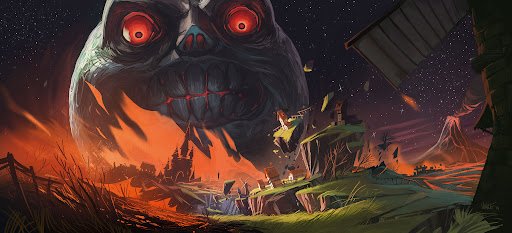
The gongs from the Chinese opera are back and the small opera gong is used in violent fashion, creating a melodic instrument unlike any other. The music consist of just two ostinatos or phrases, one repeated, the second shorter and transposed as it is standard for battle music, this time a semitone. It’s a short racket that adds to the terror of the cutscene. Overall one of the most stress inducing and full of anxiety moments in the game and the music of course plays a central role in it—You know, and the fact that there is something really disturbing about seeing the moon with the mouth wide open.
The intro is a reprise of the theme of Majora, technically making this cue the first of the four part ‘battle-with-the-mask’ series, all starting with the Majora motif.
Everything is about to the destroyed, the cataclysmic apocalypse is on full steam but then a game like Majora’s Mask has to subvert its own climax, what Link finds at the verge of annihilation after a leap of faith is…peace.
Help to keep the rites going around here by supporting the shrine:

Media Files, requests and support for more interactive content

Thou shall donate since this is a cult and you are now a sheep

Help staying awake analyzing game tracks and writing posts or else everything will end up being written by A.I
- Inside The Score – The Legend of Zeda: A Link to the Past – End Credits / Staff Roll
 The land rests As the last few minutes of this extensive journey that has now come to an end fly by, the nostalgia and reflective mood kicks in. Because such a massive enterprise as a Zelda game or a Lord of the Rings movie require multiple endings to convey everything… Read More »Inside The Score – The Legend of Zeda: A Link to the Past – End Credits / Staff Roll
 - Inside The Score – The Legend of Zelda: A Link to the Past – Ending / Epilogue ~ Beautiful HyruleFinal of the fantasy The Triforce has been touched. A wish has been granted. For the occasion, the newly undeceased king of Hyrule has commissioned a march in honor of the legendary hero to the Hylian Sousa, who might as well be composer Nobuo Uematsu since this piece is very… Read More »Inside The Score – The Legend of Zelda: A Link to the Past – Ending / Epilogue ~ Beautiful Hyrule
- Inside The Score – The Legend of Zelda: A Link to the Past – Triforce Chamber / Power of the GodsTake your boots off your feet And thus the Triforce spoke to men. And it became present in history. And you better treasure and contemplate this moment seldom witnessed in the course of the series. The elusive opportunity to interact and touch the most important artifact. You are now in… Read More »Inside The Score – The Legend of Zelda: A Link to the Past – Triforce Chamber / Power of the Gods
- Inside The Score – The Legend of Zelda: A Link to the Past – Ganon Battle / Prince of DarknessProgressive evil En Garde! And you better be prepared since you are about to duel the iconic enemy of the series at perhaps his canonically most powerful incarnation. Right after having touched the sacred Triforce which allowed him to conquer all of the Golden Land and whose evil and darkness… Read More »Inside The Score – The Legend of Zelda: A Link to the Past – Ganon Battle / Prince of Darkness
- Inside The Score – The Legend of Zelda: A Link to the Past – Boss Battle / Anger of the GuardiansQuick mayhem Ah, the simpler times when boss battles where not a multi epic orchestral suite but just an ostinato more basic that even what became the music for standard battle encounters out there. We are a long way from each boss having his own personalized track. And this early… Read More »Inside The Score – The Legend of Zelda: A Link to the Past – Boss Battle / Anger of the Guardians
- Inside The Score – The Legend of Zelda: A Link to the Past – Dark World Dungeon / Dungeon of ShadowsMemento mori We are getting closer to Ganondorf (or at least the wizard Agahnim who ultimately fulfills the same human side of evil role in this game) and that means getting closer to the profiles and motifs of his own theme song (which naturally was the theme of Agahnim at… Read More »Inside The Score – The Legend of Zelda: A Link to the Past – Dark World Dungeon / Dungeon of Shadows