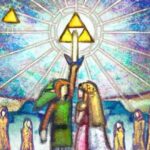
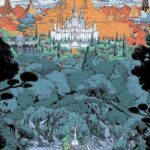
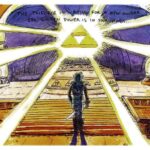
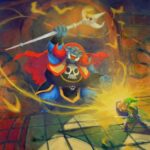
Purified land, purified soul
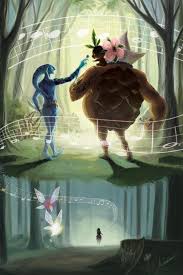
End of the discussion, the carnival proceeds; turns out the carnival’s committee was right all along, people were indeed just spreading unfounded rumors, misinformation and fear about the moon destroying everything. The Clock Town troupe can finally return and play music together just in time for the festivities. The dawn of a new day is upon us.
And this track is happiness, a truly good happiness. No attempt is being made at making it ambiguous or melancholic; it is pure undistilled bliss. Koji Kondo is always known to imbue his end credits themes with a natural sense of nostalgia and in some ways the Majora’s Mask staff roll are an exception; they are happy, celebratory and elegant through and through, one last subversion of expectations the game throws at us. Perhaps the darkest, most unsettling game on the series is the one that has the most unapologetically happy tune at the end, from a time where the end credits usually had original songs and not just rearrangements of previous heard material—here the Milk Bar theme or Astral Observatory tunes give some strong staff roll energy and could have been used here if Kondo wanted to.
Koji is a musician that somehow expertly drives the line between atmospheric and melodic seamlessly, with a boldness and originality that identifies Nintendo music, not sounding overtly Hollywood nor overtly Japanese, a truly original sensibility. Majora’s Mask is his last gig as the main composer in a Zelda title, with other composers directed and entrusted to carry on his legacy. It is fitting that he says good bye in his favorite style of music.
Musical Analysis
Structure: Section 0 / Section 1 / Section 2 / Section 3 / Section 4 / Section 5 / Section 6 / Section 7 / Section 8 / Section 9 / Section 10 / Section 11 / Section 12 / Section 13 / Section 14 / Section 15 / Section 16 / Section 17 / Section 18
Time Signature: 4/4; 6/8 (Section 17); 2/4 (Section 18)
Tempo: 115 ritardando to 70 first time and to 64 second time ) (Section 0, 1, 7, 8, 9, 10, 11, 12, 13, 14, 15); 98 (Section 2, 3, 4, 5, 6); 100 (Section 16, 18); 70 (Section 17)
Melodic and Harmonic Profiles: Atonal (Section 0); A Ionian/Major; D Ionian/Major; D Dorian; E Dorian; A Aeolian/Minor; B Aeolian/Minor; D Aeolian/Minor; C Aeolian Major; C Ionian/Major; C Mixolydian; C Aeolian/Minor; D Lydian; Bb Diminished; Gb Diminished; A Aeolian Major; D Mixolydian; F Lydian
Like in the Ocarina of Time’s massive campfire, Kondo brings a lot of instruments to make players feel as if they are hearing all the people celebrating with music. And this is how the carnival of time is supposed to sound, a baroque dance in line with the style of the Clock Town theme, with most of the instruments of that cue combined with the Deku Palace to play that kind of baroque dance and gigue perfect for bonding together, which ultimately, was the point of the whole game; friendship, helping others, and growing the hero through his good deeds and empathy with other sentient beings—since the mandolin is here, this seems as if the Clock Town troupe and the Deku troupe are playing all together— Perhaps the most nostalgic aspect of the piece would be its chord progression which is as standard as it gets, just moving through the scale degrees of a major scale [ I ii iii V ]: A – Bm – C#m – E, a harmony progression apt for a nursery rhyme—the reason the tune is not one hundred percent nostalgia is because it does not use the IV chord right off the bat, opting instead for the more triumphant V chord; a classic Kondo nostalgia tune usually has his trademark I – IV going back and forth.
Then, almost immediately, the piece gets transposed a perfect fourth higher to give it a more exciting feel: D – Em – F#m – Esus4 – E This arrangement allows the accordion to harmonize with the piccolo since the accordion repeats the original melody that was in A Ionian/Major.
Like in many other tracks, Kondo’s greatest strength is that he always manages to capture the tone but does not do it in a predictable way, sometimes doing it in eclectic and bold ways, creating a true original voice that truly feels designed for the medium of video games. What follows is a different style from the one usually heard in the series, in line for a different game from the one usually found in the series. Just like in the previous game, the End Credits consists of various parts meant to reflect the action on screen; we get the standard carnival music based around the instrumentation of Clock Town, the long awaited presentation of the group of Zora rockstars—in the premiere of the tune the player helped to come to life, the song of the hero, a wedding and the cyclical return to the opening cutscene to this game about cycles, this time with a twist. The track begins by teasing just with the first part of the carnival music before transitioning to a different piece.
If the last chord played by the mandolin on the intro sounds like a Super Mario sound effect, that is because the Indigo-Go’s tune rings closer to that series’ sensibility, but nonetheless slightly retaining the dark vibes and mystery of Majora’s Mask.
We didn’t write the end credits theme just for us to abandon our comrades Indigo-Go on their presentation. Mikau, the legendary Zora guitarist has to be present after all, as seen on the background in the show at the Milk Bar. And boy does Evan has worked hard on the arrangement after we put on him the initial spark, creating more sections and giving this Latin fusion tune a more full-blown big band jazz feel with the characteristic chromaticism, truly elegant jazz-like cadences full of starts, stops and phrase transpositions. The gig was everything the people were expecting, a success for the legendary band of Termina; you can feel the joy of Koji Kondo pouring out as he works this type of music close to his heart and influences into the Zelda series, a fitting end for his run as lead composer. Only Majora’s Mask could be the kind of game that allowed him to insert this more Mario-esque tune and play with it without feeling weird (although feeling weird was probably the goal of this game all along). The piece is given even more elegance by accompanying it with a lush string section—now we know why Toto the manager was rehearsing with strings at the sound check we did at the Milk Bar. Like a good jazz tune it has elements of darkness and street to it, just like the game it is on, diminished chords adding to the grittiness alongside chromatic movements.
The brand new section to this jazz fusion tune is a mesmerizing big band part full of brass as the style cries for. Japas on his bass is now doing a walking line apt for the venue their are playing at, with even more sultry chromaticism; he’s just feeling it. the saxophone melody really makes this feel like an ending to a Japanese animated story. The saxophone is harmonized as if a second baritone sax had joined it.
The ending to the jazz tune couldn’t be more koji kondoesque, with a false ending first and then into the real transposed ending, a favorite move in jazz music and that false ending transposing the melody is quintessential Super Mario ending. All the instruments play in a very authentic way to the style. Zelda didn’t have an ending like this since the original which also had a Mario ragtime piece as the staff roll. The brand new part to the piece has a very disco- pop progression going close to F – G – Em -Am, obviously in their jazz form that only jazz musicians can conjure, adding chromaticism, dissonances and tritones for tension and flavor, interplaying with the cool jazz bass waking. Like the opening section, this Indigo-Go’s tune has always been designed with transpositions in mind, going through different tonal palettes. It’s the same harmonic profile but Kondo has fun with adding color to the different chords. The brass section is pure voice leading forming all kinds of intervals.
For fun, here is just the “instrumental” version of this jazz banger:
Along the way on the story, we are presented with visuals of all the fruits of the labor caused by the Hero of Time across the land; each mask Link managed to acquire opening a window into the life of that person and into how their spirits were healed. Link really became a happiness salesman after all.
After the tension-filled ending to the jazz tune in a G chord, we return to the European dance of the Deku scrubs and Clock Town. This time we hear the full version with all the melodies played in the Deku style of answering each other phrases with different instruments. The theme returns in a different key connected to the jazz ensemble. The second batch of phrases are full of accidental notes to make it more carnivalesque—like on the ‘Music Box’ theme— it then manages to reach the D major tonality, the same one from the Clock Town cue.
The chords on these sections start to descend towards the tonic from the fifth degree and then back to the fifth:
F – Em – Dm – C
F – Em – F – G
Just like the bridge section of the Clock Town cue usually did in this pastoral manner. This time the piece is aided by the regal horns that foreshadow the next transition.
The song begins to transition into none other than the main theme of the series, connecting the sections smoothly into the modal sensibility of the Overworld with the low strings providing a pedal note on C. The one we heard all over our travels in the land of Termina, however this time completely triumphant, the song of the hero can be heard loud and proud now alongside his rainbow body. There is only one way Kondo would dare to end this triumphant moment and that is, you know it, the return of the Mario cadence, or at least an extended one that goes to the dominant scale degree in order to connect perfectly with the carnival of time music: Ab – Bb – G….C.
After one last reprise of the music from the carnival at its most grandest and fuller, during which we get one last visual glimpse at the Zora band playing their show, we get to see that Link is no longer with them, it looks like he has already left this world. The important thing is that he made sure that everyone was having a blast at the Milk Bar.
The carnival music begins to slow down. Wedding bells are in the air and the music takes the solemn approach to this moment, a sacred ceremony that signals the end of the most involved quest of the entire adventure; reuniting the lovers Anju and Kafei; he can finally look the bride eye to eye, meaning that he has returned to an adult body—if you don’t complete the quest, the scene plays as if Kafei was still a child—seems like the Hero of Time is not the only one who grew up during this story. Kondo brings his melodic sensibility to create a touching moment that means a lot for players who managed to literally stay until the end just to see the couple reunited, using the appropriate harmony for a ceremonial hymn uniting partners that promised each other to get married at the carnival of time for good luck. This time around it seems Kondo truly sat down and came up with the most appropriate arrangement for the chords as opposed to using his melodic voice leading, picking 6th and 7th chords for maximum romantic and sacred color; it has all the markings of a professional crafted string arrangement. Our send off of the world we got to know and care for, the world of Termina, is accompanied by the very last Mario cadence we will hear, in the tonality of the Clock Town cue: Bb – C – D.
…And back to the beginning. In a game about cycles, we then go back to the forest were everything started, the curtain opening music to the game is heard once again. However, in The Legend of Zelda Majora’s Mask not everything can be happiness and triumphs; sadly, there was a soul that was not healed directly through the efforts of the Hero of Time. In a game with a strong thematic beat about grief, we get to see the personification of this emotion in the figure of the a Deku father kneeling in pain beside his deceased son, one of the heroes that accompanied Link during his adventure, the only mask where the Hero of Time didn’t directly participate in its creation, the only mask that didn’t originate as part of Link’s healing and enlightening process; Majora took away this spirit in a violent, untimely manner and the exorcism was performed by the Happy Mask Salesman to Link after all. Forever in the limbo between Hyrule and Termina; outside the mask quest, outside the personal journey of the hero.
A similar grieving situation by their people must be happening simultaneously with the heroes of the other two races, Darmani and Mikau, brave souls that fought and found healing in the deeds performed in Termina by a young boy.
So what about this young boy? We find him once again at the same forest from the beginning riding his horse, as if nothing had ever happened. But something did happen. He is not the same man from the opening, completely lost and alienated; something has changed and somehow he knows where he is heading now. At the beginning of this adventure we find a hero robbed of his identity, without a guide, without purpose. Not anymore. He found what he was looking for in the mysterious land of Termina, a land that needed him as much as he needed the land. This recovery of a path is reflected in the music as well which also manages to find its way back to a resolution. The last glimpse we get is a drawing depicting Link’s adventures and his repaired friendship with the forest child, carved on a tree located in the middle of a meadow with the same Lily flowers as the ones found in the Bodhi tree inside the moon.
Link has finally made peace with his childhood and his past. He has become an awakened being; a true grown up and an enlightened sentient creature closer to the divine than to the human realm. Now it is just a matter of guiding other beings who happen to find themselves on their own path towards enlightenment. He will become a new sage of light that shapeshifts into an animal just like the sage of light that guided him before.
And so The Legend of Zelda Majora’s Mask ends with its main theme both musically and thematic. The last sound we heard is none other than the Song of Healing, which has fulfilled its purpose. It is because of this that this time the song has been given the opportunity to revert to its original form, the bringer of joy, the bringer of friendship, the Lost Woods theme. The things the boy without a fairy learned to give in order to receive back, just like the Happy Mask Salesman promised when they first met. With one last pat to his mount, he moves with full confidence and conviction towards the light.
There it goes, a mini encyclopedia covering some of the musical and cultural influences of two of the seminal games in this important series. it seems Kondo ended his run as lead composer on a good note, and director Koizumi, after abandoning his intentions of becoming a filmmaker arguing that video games had the potential to told innovative stories in different ways, managed to fulfill his promise of telling an unique story that only the video game medium allowed him.
It was certainly interesting and exciting diving into so much music from one of the most important composers in media right in the middle of two of the most ambitious projects at the time. The sounds may be old but their lessons about melody, harmony, arrangement and context are timeless. Koji Kondo had no other option but to develop those skills cutting his teeth during the 8-bit music era, no way to hide behind production values and lush orchestration, a testament to using a few resources in new ways.
I hope this can become a reference and a good resource to composers, songwriters, video game enthusiasts or just anybody with enthusiasm about music in general. The original goal of the project was making it more interactive, but still, the music visualizations somehow aid in hearing better the different arrangements. The good thing about an internet based project is that it can continually be updated and corrected so I will stay alert for any mistakes pointed out or corrections that need to be made, plus any updates and new interesting tidbits of information about the series that I come upon.
Thanks to all that enjoyed this run of tracks and those who share their love for this music. I hope that, like me, you got to see new dimensions to these classics. Special thanks to those that support and wanted to contribute to the project in different ways. I want to continue the series with different games and with more resources to learn and interact with video game music, perhaps even an interactive website and other collaborators. You can support the project and future developments here.
….Or perhaps I just need to get a Switch 2…
In any case you will find that the MIDI files for the tracks are already up there if you wanna check out note for note what the composer did and make different arrangements and orchestration yourself. I’m excited to hear covers and new ideas come out of the project.
So think about it, what other games deserve to be covered in their entirety? Or which tracks are so dear to you that you would like to see how they were made? Join the community and request what should be covered next. I will also see if i can also upload from time to time just the music visualizations by themselves in order to create a music library.
Now onto research more about video game music and audio files!

Help to keep the rites going around here by supporting the shrine:

Media Files, requests and support for more interactive content

Thou shall donate since this is a cult and you are now a sheep

Help staying awake analyzing game tracks and writing posts or else everything will end up being written by A.I
- Inside The Score – The Legend of Zeda: A Link to the Past – End Credits / Staff Roll
 The land rests As the last few minutes of this extensive journey that has now come to an end fly by, the nostalgia and reflective mood kicks in. Because such a massive enterprise as a Zelda game or a Lord of the Rings movie require multiple endings to convey everything… Read More »Inside The Score – The Legend of Zeda: A Link to the Past – End Credits / Staff Roll
 - Inside The Score – The Legend of Zelda: A Link to the Past – Ending / Epilogue ~ Beautiful HyruleFinal of the fantasy The Triforce has been touched. A wish has been granted. For the occasion, the newly undeceased king of Hyrule has commissioned a march in honor of the legendary hero to the Hylian Sousa, who might as well be composer Nobuo Uematsu since this piece is very… Read More »Inside The Score – The Legend of Zelda: A Link to the Past – Ending / Epilogue ~ Beautiful Hyrule
- Inside The Score – The Legend of Zelda: A Link to the Past – Triforce Chamber / Power of the GodsTake your boots off your feet And thus the Triforce spoke to men. And it became present in history. And you better treasure and contemplate this moment seldom witnessed in the course of the series. The elusive opportunity to interact and touch the most important artifact. You are now in… Read More »Inside The Score – The Legend of Zelda: A Link to the Past – Triforce Chamber / Power of the Gods
- Inside The Score – The Legend of Zelda: A Link to the Past – Ganon Battle / Prince of DarknessProgressive evil En Garde! And you better be prepared since you are about to duel the iconic enemy of the series at perhaps his canonically most powerful incarnation. Right after having touched the sacred Triforce which allowed him to conquer all of the Golden Land and whose evil and darkness… Read More »Inside The Score – The Legend of Zelda: A Link to the Past – Ganon Battle / Prince of Darkness
- Inside The Score – The Legend of Zelda: A Link to the Past – Boss Battle / Anger of the GuardiansQuick mayhem Ah, the simpler times when boss battles where not a multi epic orchestral suite but just an ostinato more basic that even what became the music for standard battle encounters out there. We are a long way from each boss having his own personalized track. And this early… Read More »Inside The Score – The Legend of Zelda: A Link to the Past – Boss Battle / Anger of the Guardians
- Inside The Score – The Legend of Zelda: A Link to the Past – Dark World Dungeon / Dungeon of ShadowsMemento mori We are getting closer to Ganondorf (or at least the wizard Agahnim who ultimately fulfills the same human side of evil role in this game) and that means getting closer to the profiles and motifs of his own theme song (which naturally was the theme of Agahnim at… Read More »Inside The Score – The Legend of Zelda: A Link to the Past – Dark World Dungeon / Dungeon of Shadows