The might of a long lived kingdom

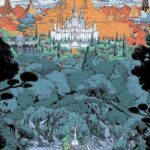
Another big, imposing medieval castle means another big, imposing royal fanfare inspired composition full of all the loud and powerful instruments that a mighty kingdom with an army on their side could pay for. Because, just like the similar track from Zelda: A Link to the Past, even if the good guys are supposed to belong here and realm here, the place has to feel fearsome and treacherous, after all not everything that happens to Crono and friends here is pleasant. The ancestry of Guardia is ancient; it most likely traces its origin from the Kingdom of Zeal itself so there needs to be a commanding track for it. This is a nation in the midst of war; if it weren’t you would probably hear some classically inspired dance as opposed to a military march infused theme.
Musical Analysis
The piece takes as its basis what would be the royal fanfare of the kingdom of Guardia played on the trumpets. A fanfare is a type of motif that was traditionally used in medieval Europe to celebrate the arrival of a royal person or other important events. The form usually involved brass played in a bombastic and stirring manner. When it comes to kings and queens everything has to be loud and proud, as the title of the piece implies, using the loudness of the trumpets, orchestral cymbals, timpani and military march snare drum to convey force and might. The trumpet fanfare is then taken as the main pedal ostinato of the track, playing a chord melody that uses inversions of the main chord vamp B – Db while the underlying harmony changes. The cue uses the notes of the Gb Ionian/Major and its sister keys to provide the musical tone, using harmonies and vamps that feature specific modal profiles.
It begins with the percussion, a bombastic pre-intro that treats the orchestral cymbals as a rhythmically relevant instrument throughout the intro and the A Section as opposed to their typical role of ornamentation or augmentation. The timpani will be the bedrock of the harmony. They begin with the tonic Gb before jumping into the back and forth B to Db, a vamp that implies the B Lydian profile for this section, profile that uses the same notes from Gb Ionian. The melody taken by the violin is a stirring and uplifting question-answer based phrase where the second question is transposed a whole tone up (first starting on Gb then on Ab) following the chord progression that is also based around a whole tone change (B to Db). The low strings play more of a reinforcement role to make more clear the timpani note.
The piece picks up the rhythmic and thus exciting pace for its B section, inserting another set of strings that play a fast accompaniment consisting of an arpeggiated Db sus4 chord. The tune now carries a heavy sense of history apt for a powerful kingdom that might have done both good and evil throughout its long history and its influential mark on it. The instruments get more frantic and the orchestral cymbals return to their traditional reinforcing role. The vamp is now tinged with the sadness of a minor chord, going from B to Ebm (where Db features as a transition chord). For some reason the question-answer melody—this time both questions being the same—for this part is suspiciously similar to the famous theme tune for the film A Summer Place:
Coda is characterized by a call and response between the flute and trumpets echoing each other playing tetrachords that are layered out on top of the incomplete maj7 harmony provided by the strings. The piece’s harmony is now tinged with the sister minor profiles of Gb, borrowing the major chords A and D from its parallel Aeolian/Minor scale and G and Em from the parallel Phrygian mode. It gives us the sequence Amaj7 – Dmaj7 – Gmaj7 – Em – Gb. The call and response melodies stay as pedal during the A to D, the minor tetrachord they play acquiring a different color thanks to the underlying changing harmony. Naturally, for the Phrygian progression they shift to the corresponding Phrygian tetrachord. The outro is once again percussion only in order to set up the loop towards the fanfare based intro.
One of the definitive fantasy castle pieces that combines rousing flourishes with the sense of power and heavy history of a kingdom that lives on for centuries. Safe to say that it accomplishes what royal fanfares are supposed to: announce its presence and importance.

Help to keep the rites going around here by supporting the shrine:

Media Files, requests and support for more interactive content

Thou shall donate since this is a cult and you are now a sheep

Help staying awake analyzing game tracks and writing posts or else everything will end up being written by A.I
- Inside The Score – The Legend of Zeda: A Link to the Past – End Credits / Staff Roll
 The land rests As the last few minutes of this extensive journey that has now come to an end fly by, the nostalgia and reflective mood kicks in. Because such a massive enterprise as a Zelda game or a Lord of the Rings movie require multiple endings to convey everything… Read More »Inside The Score – The Legend of Zeda: A Link to the Past – End Credits / Staff Roll
 - Inside The Score – The Legend of Zelda: A Link to the Past – Ending / Epilogue ~ Beautiful HyruleFinal of the fantasy The Triforce has been touched. A wish has been granted. For the occasion, the newly undeceased king of Hyrule has commissioned a march in honor of the legendary hero to the Hylian Sousa, who might as well be composer Nobuo Uematsu since this piece is very… Read More »Inside The Score – The Legend of Zelda: A Link to the Past – Ending / Epilogue ~ Beautiful Hyrule
- Inside The Score – The Legend of Zelda: A Link to the Past – Triforce Chamber / Power of the GodsTake your boots off your feet And thus the Triforce spoke to men. And it became present in history. And you better treasure and contemplate this moment seldom witnessed in the course of the series. The elusive opportunity to interact and touch the most important artifact. You are now in… Read More »Inside The Score – The Legend of Zelda: A Link to the Past – Triforce Chamber / Power of the Gods
- Inside The Score – The Legend of Zelda: A Link to the Past – Ganon Battle / Prince of DarknessProgressive evil En Garde! And you better be prepared since you are about to duel the iconic enemy of the series at perhaps his canonically most powerful incarnation. Right after having touched the sacred Triforce which allowed him to conquer all of the Golden Land and whose evil and darkness… Read More »Inside The Score – The Legend of Zelda: A Link to the Past – Ganon Battle / Prince of Darkness
- Inside The Score – The Legend of Zelda: A Link to the Past – Boss Battle / Anger of the GuardiansQuick mayhem Ah, the simpler times when boss battles where not a multi epic orchestral suite but just an ostinato more basic that even what became the music for standard battle encounters out there. We are a long way from each boss having his own personalized track. And this early… Read More »Inside The Score – The Legend of Zelda: A Link to the Past – Boss Battle / Anger of the Guardians
- Inside The Score – The Legend of Zelda: A Link to the Past – Dark World Dungeon / Dungeon of ShadowsMemento mori We are getting closer to Ganondorf (or at least the wizard Agahnim who ultimately fulfills the same human side of evil role in this game) and that means getting closer to the profiles and motifs of his own theme song (which naturally was the theme of Agahnim at… Read More »Inside The Score – The Legend of Zelda: A Link to the Past – Dark World Dungeon / Dungeon of Shadows