A Fistful of Rupees
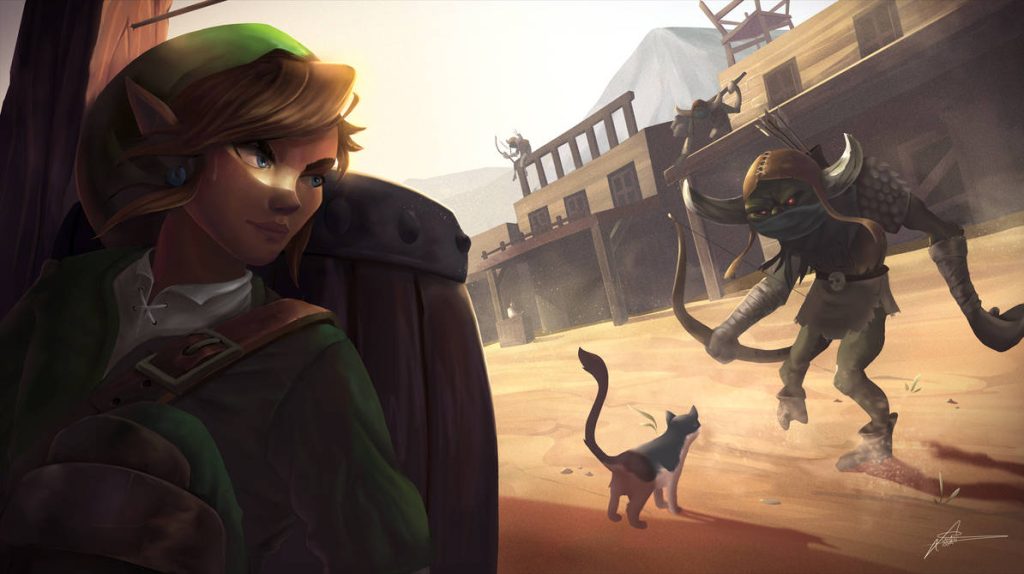
Befitting the most westernized iteration of the Zelda series, here is an out of field sub-film where our vaquero steps into a non-medieval town that comes right from the Wild West in order to deal justice to some bandits tormenting its people (population: 1) and probably obtain some bounties accompanied by an appropriate period score; jut like in Gerudo Valley it is as if the game changed identity for a moment. This ol’ town is not big enough for both these bandits and The Man with No Name (because you literally choose it). So come enjoy this Cowboy shootout on a theater near you for the final part of the ‘Rupees Trilogy’ titled A Fistful of Rupees (first part was the Ingo saga rescuing Epona: “For A Few Rupees More”; second part was rescuing the kids in Kakariko Village from these same bandits “The Good, The Bad and King Bulblin”).
This is not as out of place as it initially seems; for starters there is the rule of having at least one exotic track included in a Zelda game since Gerudo Valley. But more than that, The Legend of Zelda has always been the cocktail beverage of the fantasy genre, taking things from any Mythology, fairy tale or fiction as long as they are cool and sneaking them under its medieval high fantasy coat, going to some funky places that something grander than life like the Lord of the Rings would never go. And ever since Shigeru Miyamoto started injecting his Americana influences into the ranch parts for Ocarina of Time—where even the music is anachronistic bluegrass—this Western influence continued growing with the wagon chase in Majora’s Mask and now has fully blossomed on the spiritual successor to Ocarina of Time which has an actual parallel Spaghetti Western film imbued within it, starting with Link, the humble ranch hand and prodigious rider herding the cattle and then having to rescue the kids from his village from the bandits at an actual Old West inspired town complete with Native American shaman residents. We also get some adventures at the mines and a wagon chase. It is a Western patch sewed into the high fantasy coat. This is just the culmination and stretching the concept to its absolute limit.
This development has its origins at the gameplay stage. And it is all thanks to the second spirit animal that guided the developers throughout the project; one spirit animal meant for the dark twilight world and one spirit animal for the light world. And we are not talking about the actual Native American spirit animals that serve as the guides for our sheriff Link Eastwood throughout his adventures in Hyrule; we are talking about wolf Link for the Twilight world, a development that came slightly later, and what the developers really wanted to do here as a first step, which they could not make back in the Ocarina of Time days. And that is: a complete use of horse combat and horse riding mechanics. So a big part of the spotlight is shed on loyal companion Epona right from the beginning of the adventure.
From the heavy focus on horse stuff which, unlike in Ocarina of Time, you get to experience right away at its most realistic fashion, we get all this Western ideas that poured into the DNA of Twilight Princess after being injected in Ocarina of Time; even the main theme of the game, the overworld is based around horse galloping rhythms. And with Epona as a centerpiece of the adventure, the Eldin region has now become the Wild West with two Kakariko Villages (towns named after the sounds cuckoos, its official residents and most characteristic aspect since the beginning, make) becoming Western towns complete with very un-medieval colonial houses and saloons straight from a movie set. This is where Link will live his own Spaghetti Western adventure with his horse, his hat and his gun complete with musical pastiches of those film soundtracks and native American traditional music.
The track that concerns us here is just the most unapologetic example of the trend which ironically does not include the horse; she lives only in the musical rhythms and that is because composer Toru Minegishi decided to recall the only possible sounds that could fit this scene and those are the Ennio Morricone scores for the Sergio Leone Western films, dubbed Spaghetti Westerns since they were made by Italians. The only thing missing here are the surf electric guitars which would really be out of place in The Legend of Zelda, so we get to keep things medieval by rather using one of the electric guitar ancestors as the lead instrument.
The gunfight actually takes place at the old Kakariko Village town from Ocarina of Time, making the connection between the two towns clear since there is an actual sign at the Hidden Village saying ‘Welcome to old Kakarico”. It is not the first Western relationship with Kakariko Village since even in Ocarina of Time the musical arrangement was pretty Western sounding. The Western theme of old Kakariko is even completed with the classic ‘Wanted’ posters all across town depicting a real cowboy and a bounty of an exorbitant amount of rupees, who knows what he did and where he’s at. The musical theme of new Kakariko Village incorporates the main motif of the original Kakariko theme combined with the Morricone coyote call lick from The Good, The Bad and the Ugly, some of the A Link to the Past Dark World Theme B section which itself guides some of the motifs from the Twilight Princess overworld theme (itself based on Midna’s Theme, perhaps the centerpiece of the entire soundtrack as the titular character, which is itself inspired by Princess Zelda’s Theme; yes, the Twilight Princess score is one of the most based around leitmotifs and rich in callbacks. A balancing act of paying homage to the musical legacy of the series and creating new material). Both Kakariko themes are also connected by a vamp between the B and A chords.
Musical Analysis
In contrast with the Hollywood Westerns, The European ones dealt way more with Mexican stuff since they were shoot in Spanish deserts and had lower budgets, this affected directly the musical direction since functional considerations have probably the most weight in art, with composer Morricone ditching the more expensive lush orchestras front to back in favor of simpler instruments and sounds that in any case fit better its harsh, sparse environments (except for the anachronistic electric guitar which, in similar fashion to the spy genre, was probably inspired by the surf craze of the day). The track here is an amalgam of mainly the scores of the famous Dollars Trilogy, using some of the same timbres and composition techniques; it is as direct as homage as you can get, even though some roots of the Western style could be heard a little bit on the MIni-boss Battle theme from The Wind Waker.
The main replacement here is the sonority of the Middle Eastern Oud in place of the Electric guitar. The intro cue here marks the beginning of this Mexican standoff, when the cinematic show the Hylian with no name that arrives at this solitary town, the cowboy jew harps straight from the Dollars Trilogy and the confident whistling made realistic with pitch manipulation play the main motif. Three percussion stings sync with the camera edits to show the bounty. This was the original Red Dead Redemption.
The Hidden Village proper cue starts with the galloping rhythms on the snare and the plucked strings; the acoustic guitars only need a single galloping strum to establish the vibe. The piece uses the harmony and melodies you would expect to hear on these Morricone Westerns. It is based around B Aeolian/Minor and its Bm to A vamp. The oud metallic attack adds more character to the acoustic guitar lead. The whistling responds with snippets from the Twilight Princess main theme.
Another common device in these Spaghetti Western melodies is to transpose the melody initially played against a minor chord to one playing against a major chord, which also happens here when the theme goes into the D chord. The Full progression here would be:
Bm – A5 –
D5 – A5 – B5 – F#5 – G5 – A5 – D5
For the C Section, just like in the new Kakariko Village theme, we go to a version reminiscent of the second section of the Hyrule Field theme with some chords outside the scale also typically employed by Spaghetti Westerns, like the bII and V due to their Mexican/Spanish influence. We get a descending by half steps harmony figure now with full chords as opposed to just fifths made with:
C – Bm – Bb – Am
C – Bm – G – F#
Native American ocarinas, are now responding, no connection whatsoever with the previous use of the instrument in the series. Just a full on Western thing.
The last section is a restatement of the main motif in the Mexican mariachi style with the trumpets. Link is battling at the frontier.
And so our outlaw Link dismantles this organization of bandits causing trouble all over the region and tormenting the locals; they function simultaneously as Tolkien orcs and cowboy ruffians. Peace returns to the Wild East of Hyrule (or in the proper West in the historically accurate Wii version) and so Link rides into the sunset with his faithful steed Epona knowing full well that he has realized his creator dream of inserting a Western saga and aesthetic into his high fantasy series.

Help to keep the rites going around here by supporting the shrine:

Media Files, requests and support for more interactive content

Thou shall donate since this is a cult and you are now a sheep

Help staying awake analyzing game tracks and writing posts or else everything will end up being written by A.I
- Inside The Score – The Legend of Zeda: A Link to the Past – End Credits / Staff Roll
 The land rests As the last few minutes of this extensive journey that has now come to an end fly by, the nostalgia and reflective mood kicks in. Because such a massive enterprise as a Zelda game or a Lord of the Rings movie require multiple endings to convey everything… Read More »Inside The Score – The Legend of Zeda: A Link to the Past – End Credits / Staff Roll
 - Inside The Score – The Legend of Zelda: A Link to the Past – Ending / Epilogue ~ Beautiful HyruleFinal of the fantasy The Triforce has been touched. A wish has been granted. For the occasion, the newly undeceased king of Hyrule has commissioned a march in honor of the legendary hero to the Hylian Sousa, who might as well be composer Nobuo Uematsu since this piece is very… Read More »Inside The Score – The Legend of Zelda: A Link to the Past – Ending / Epilogue ~ Beautiful Hyrule
- Inside The Score – The Legend of Zelda: A Link to the Past – Triforce Chamber / Power of the GodsTake your boots off your feet And thus the Triforce spoke to men. And it became present in history. And you better treasure and contemplate this moment seldom witnessed in the course of the series. The elusive opportunity to interact and touch the most important artifact. You are now in… Read More »Inside The Score – The Legend of Zelda: A Link to the Past – Triforce Chamber / Power of the Gods
- Inside The Score – The Legend of Zelda: A Link to the Past – Ganon Battle / Prince of DarknessProgressive evil En Garde! And you better be prepared since you are about to duel the iconic enemy of the series at perhaps his canonically most powerful incarnation. Right after having touched the sacred Triforce which allowed him to conquer all of the Golden Land and whose evil and darkness… Read More »Inside The Score – The Legend of Zelda: A Link to the Past – Ganon Battle / Prince of Darkness
- Inside The Score – The Legend of Zelda: A Link to the Past – Boss Battle / Anger of the GuardiansQuick mayhem Ah, the simpler times when boss battles where not a multi epic orchestral suite but just an ostinato more basic that even what became the music for standard battle encounters out there. We are a long way from each boss having his own personalized track. And this early… Read More »Inside The Score – The Legend of Zelda: A Link to the Past – Boss Battle / Anger of the Guardians
- Inside The Score – The Legend of Zelda: A Link to the Past – Dark World Dungeon / Dungeon of ShadowsMemento mori We are getting closer to Ganondorf (or at least the wizard Agahnim who ultimately fulfills the same human side of evil role in this game) and that means getting closer to the profiles and motifs of his own theme song (which naturally was the theme of Agahnim at… Read More »Inside The Score – The Legend of Zelda: A Link to the Past – Dark World Dungeon / Dungeon of Shadows