Solitary space opera
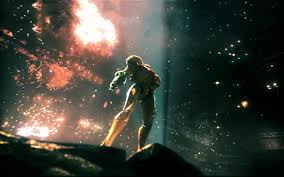
Coming from the outer reaches of space, from the wreckage of a space station orbiting a planet with a pulsating glow, is the transmission of the official interplanetary distress signal that means the organic creatures known as Metroid have been identified on the surface. Similar to the ancient Morse code that has fallen out of favor for the human race, the emergency order dubbed M510 consists of six tones that anyone in the Galaxy Federal Police is trained to recognize; the encoded long spaced tones that go one minor sixth ascending, a perfect fourth descending; then one minor seventh up, one major second down [ (D-Bb-F)-(D-C-Bb) ] echoes through the vastness of the cosmos until they are decoded by a lone ship in search of adventure. A knight clad in shining metal prepares for the dangers ahead, aware of the sense of dread that this signal entails but knowing full well that she can get through this. The ship arrives to the surface of this pulsating planet with a biosphere full of predatory lifeforms. Hilarity does not ensue, just pure, claustrophobic cosmic horror.
This is just the kind of environmental storytelling that one could extract from the bleeps and bloops of the short but effective piece used for the title screen of the first entry which will come to be synonymous with the series as a whole. It kickstarts, cements and culminates the philosophy that composer Hirokazu ‘Hip’ Tanaka left to the entire series as his legacy; that the sounds that the environment makes should be the sounds that the player hears, where music and sound design get blurred together and where musical instruments can be used as sound effects and sound effects can be used as musical instruments. When Hip Tanaka said he wanted to make a score that made players feel like they were encountering a “living organism”he was likely thinking of this specific track which finds Samus face to face with a breathing biosphere. With just 8-bit tools the cue managed to be organic, mechanical, isolated, dangerous and heroic all at the same time while also capturing the sense of wonder, enormity and fear conveyed by outer space. It is all things Metroid in distilled form, just like the very first thing you hear in Mario and Zelda that also went on to define their respective series. It is all about atmosphere, tension, and adventure. It has the honor of being the main musical motif of the Metroid series, perhaps sharing the distinction of being the main theme of the series with the Zebes Ground Theme.
It achieves this by exploring the registers of its limited timbres and being indecisive on whether it wants to be a major key piece or a minor key piece, a careful balancing act that produces a menacing track that slowly evolves towards exuding heroism and then shifts back into low droning tones dragging like the heartbeat or the breathing of some hideous creature; or maybe a core that is about to explode; because, you know, that is exactly what happens when Samus arrives to your planet. The new sound design direction was bold and dark, the intention being to avoid the common game music cliches of just having hummable tunes looping everywhere. The developers were not even sure if this was the right direction for the score due to how brood it sounded. Another unique use of the sound chip and this philosophy is in the room where you fight the bio-mechanical entity known as Mother Brain.
Musical Analysis
Right on the title screen you can see the planet moving as if it was alive alongside the vastness of space that the theme captures. The first part is the distress signal section which plays the Metroid series motif, subsequently used on almost all of the Metroid intros, over a drone perfect fifth interval. It is as blurred as the line between sound effects and music can get—well, except that Mother Brain cue—It is a bold move to start the series with what could perfectly fit as a Game Over cue, not encouraging at all—which is maybe a reason why the remake of this game removed the first section—The delayed notes of the melody are meant to be an echo which comes more naturally to the Famicom Disk Version since it has the two square waves free. Here the piece is unambiguously and appropriately within minor profiles.
Then we get to the ‘vastness of space’ section where Hip Tanaka takes us outside the atmosphere by reaching escape velocity and entering a floating state. The square waves in very high registers sounding like the sparkly stars and, proving that the triangle wave is not only for bass lines, the melody timbre taking on a tone as close to a theremin as an 8-bit machine can get or maybe some satellite signal. The piece begins its filtration with both major and minor profiles; while the first section used the F natural which is unambiguously in the minor tetrachord head of the D Aeolian/Minor profile, here the pedal arpeggio notes in downward fashion use the F# which belongs to the major tetrachord head. But the sense of ambiguity comes from the melody line which descends chromatically and stays in notes that belong to minor tetrachord tails like C natural and Bb. Dissonances start to arise, like the tritone interval between F# and C, giving the sense of mystery by contrasting an accompaniment with a major profile and a tune with a more ambiguous but mainly minor profile. The noise channel turns now to be a snare drum with a marching beat. This section will return triumphantly on the ending theme of the game where the arpeggio intervals are slightly altered to sound happier.
For the Famicom Disk System version, the wavetable tone that allows more expressive, smooth timbres takes over the melody as the song evolves towards a more tuneful line that brings the sense of loneliness and wonder of exploring space by yourself; the sublime qualities of space section. The triangle wave drops an octave down and turns out that its melody was a bass line all along over which the new melody soars. The long form melody begins with a major profile that contrasts with the minor profile of the bass line. It eventually lands on the sublime touch of the Bb note that makes the profile close to the D Aeolian dominant (major tetrachord head, Phrygian tetrachord tail; basically a scale that starts major and ends minor). It is the kind of modal mixture also used in Zelda that is also appropriate for a bounty hunter like Samus. Note that the piece will never use the C# which would disclose a full major key commitment since it would be the characteristic note of a major tetrachord tail and would ruin the vibe of Metroid by sounding too “major”. So at best the major profile would be the Mixolydian. The back and forth between using Bb and B natural is the key for the crisis of identity the cue has.
Next section picks up the pace, with the track smoothly and almost imperceptibly transitioning to a different rhythmic profile based around triplets, like a 12/8 meter. This is the section where our bounty hunter gets her ship in full speed moving towards the signal with full confidence in her mission; the heroine section. The bass line goes for more standard tonic to fifth notes creating the progression: D – Bbsus2 – Eb – Esus4 – E. The melody and arpeggios keep dancing between the major and minor profiles until it reaches the climax that purports to be the dominant chord of a perfect cadence in the making, from E to A, which would be the secondary dominant of the D Ionian/Major profile. Suspended chords, that are also a staple of Metroid music, appear for the first time and there is also a borrowed Eb from the parallel Phrygian profile. It is as if the piece was going to end triumphant, it teases a a perfect cadence in a new A Ionian/Major key, but alas this is Metroid; the last section finds Samus arriving at Zebes and encountering the danger directly, the living ecosystem. The piece goes back to the droning sound in D albeit without the distress signal since it has been received; only the pulsating core of the planet remains and you as the player are left wondering what kinds of horror you will face at this planet very much alive.
Here you can hear how the piece was then rearranged for the NES release since there was one less channel available. Only the timbres and dynamics change and the square waves have to do double duty and their own delay by repeating notes. The last section drone is the most different since, on the NES version, three channels contribute to the drone while on the FDS the intro and the outro are the same drone. The main difference between FDS and NES can be noticed mostly in title themes and staff rolls since normally the extra channel advantage is exploited for letting sound effects play—which in the NES, annoyingly, a music channel has to stop playing in order to sound an effect. Musically, the NES accompaniments usually use fast arpeggios to convey chords; with the FDS extra channel you can just actually play the chord with the two squares and let the more articulated wavetable channel be in charge of the melody. For this deconstruction a little panning and reverberation were added to the tracks. Super Smash Bros’ creator has a video where he showcases a little bit of how this early chiptune dynamic worked:
The leitmotiv for the Metroid creatures themselves is not only used for title screen but it is also incorporated within levels throughout the series. Here a mini-film that defines the story is encoded into the music that by virtue of being in a key limbo conveys all the aspects of the series and brought sophisticated sound design to the NES with ingenious use of the primitive chip tune timbres.
Help to keep the rites going around here by supporting the shrine:

Media Files, requests and support for more interactive content

Thou shall donate since this is a cult and you are now a sheep

Help staying awake analyzing game tracks and writing posts or else everything will end up being written by A.I
- Inside The Score – The Legend of Zeda: A Link to the Past – End Credits / Staff Roll
 The land rests As the last few minutes of this extensive journey that has now come to an end fly by, the nostalgia and reflective mood kicks in. Because such a massive enterprise as a Zelda game or a Lord of the Rings movie require multiple endings to convey everything… Read More »Inside The Score – The Legend of Zeda: A Link to the Past – End Credits / Staff Roll
 - Inside The Score – The Legend of Zelda: A Link to the Past – Ending / Epilogue ~ Beautiful HyruleFinal of the fantasy The Triforce has been touched. A wish has been granted. For the occasion, the newly undeceased king of Hyrule has commissioned a march in honor of the legendary hero to the Hylian Sousa, who might as well be composer Nobuo Uematsu since this piece is very… Read More »Inside The Score – The Legend of Zelda: A Link to the Past – Ending / Epilogue ~ Beautiful Hyrule
- Inside The Score – The Legend of Zelda: A Link to the Past – Triforce Chamber / Power of the GodsTake your boots off your feet And thus the Triforce spoke to men. And it became present in history. And you better treasure and contemplate this moment seldom witnessed in the course of the series. The elusive opportunity to interact and touch the most important artifact. You are now in… Read More »Inside The Score – The Legend of Zelda: A Link to the Past – Triforce Chamber / Power of the Gods
- Inside The Score – The Legend of Zelda: A Link to the Past – Ganon Battle / Prince of DarknessProgressive evil En Garde! And you better be prepared since you are about to duel the iconic enemy of the series at perhaps his canonically most powerful incarnation. Right after having touched the sacred Triforce which allowed him to conquer all of the Golden Land and whose evil and darkness… Read More »Inside The Score – The Legend of Zelda: A Link to the Past – Ganon Battle / Prince of Darkness
- Inside The Score – The Legend of Zelda: A Link to the Past – Boss Battle / Anger of the GuardiansQuick mayhem Ah, the simpler times when boss battles where not a multi epic orchestral suite but just an ostinato more basic that even what became the music for standard battle encounters out there. We are a long way from each boss having his own personalized track. And this early… Read More »Inside The Score – The Legend of Zelda: A Link to the Past – Boss Battle / Anger of the Guardians
- Inside The Score – The Legend of Zelda: A Link to the Past – Dark World Dungeon / Dungeon of ShadowsMemento mori We are getting closer to Ganondorf (or at least the wizard Agahnim who ultimately fulfills the same human side of evil role in this game) and that means getting closer to the profiles and motifs of his own theme song (which naturally was the theme of Agahnim at… Read More »Inside The Score – The Legend of Zelda: A Link to the Past – Dark World Dungeon / Dungeon of Shadows