The power of large numbers
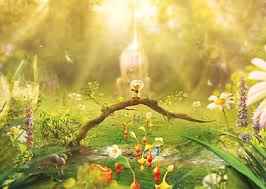
Continuing on with our communist agenda here is now the Pikmin series which exemplifies how you can accomplish all of your party goals as long as you are willing to make personal sacrifices and work together for the benefit of the cause; there is definitively strength in numbers. This time the cause is the rescue of Captain Olimar—a pseudo anagram of Mario just as his companion Louie is analogous to Luigi— who has become stranded in a not so foreign planet with high concentrations of oxygen that are deadly to our miniature hero. The game proves that sometimes micromanagement, in the absolutely most literal sense, can be fun.
The last brainchild original series from the man with the Midas touch—Nintendogs is just Tamagoshi on steroids—developer Shigeru Miyamoto conceived the idea of combining his recent hobby of gardening with the way insects operate in colonies and the capability of the new console to generate multiple characters on screen—this is what became of the legendary lost title Super Mario 128—generating the whimsical Nintendo version of the real time tactical strategy gameplay that does not involve armies of medieval soldiers but plants whose cuteness make you question twice whether they deserve to be sent to the battlefield for your selfish goals of survival. This is pretty much Lemmings in 3D. For some reason the titular Pikmin take a liking to you and, as their new dark overlord, you decide what is best for them, which is you yourself. You use their hive mind services to recover the stranded parts of your S.S Dolphin ship, which just like Delfino Plaza is named after the codename for the GameCube console, and making it spaceworthy again.
The Pikmin themselves are named after ‘ippiki’, the Japanese word for counting small animals, which during development evolved to Piki”, then “Picky” and finally “Pikmin. An example of how language evolves at (literal) work. As you explore this curious planet and find some large objects that you recognize, you start to realize the implications that the cute front of the series is just an excuse to tell one of the darkest post-apocalyptical Nintendo stories, a tale of how humans are long gone and the flora and fauna we knew has been replaced by strange creatures most likely product of some nuclear holocaust; the geiger counter is constantly in action after all (or perhaps the Pikmin are just some kind of alien Von Neumann machines that take up the resources of planets as they continue to expand through the galaxy). So take care of nature—or not because it would be cool to have Pikmin around. The planet ended up being named PNF-404 – “humanity not found”
And it is nature the protagonist here. You are stranded, alone, surviving in the wilderness, and the music lets’s you breath it. You can feel the thickness and the heavy air of the environment through this track. Sometimes nature need not be enchanted or mystical to be dangerous. All by herself, sister nature is enough to become a hazard and the greatest threat you encounter. The Pikmin main theme, as used for the first time in the title screen of the game, captures this devoid of magic nature, the savage aspects of being in the mud of a deep jungle grasping for survival. After all, The jungle is a harsh and hostile place, frequently deadly for its denizens, but even more ferocious to outsiders no matter what gear they bring with them. You should treat this jungle as a semi-sentient entity that is always hungry and has not evolved yet a protective mechanism towards cuteness; it is merciless.
Musical Analysis
The track, directly named jungle.jam in the game files, was written by the sole composer for the first game, Hajime Wakai, who entered the company during the Nintendo 64 era and had previously worked on the level and battle themes for Star Fox 64, some tracks on F-Zero X and on Pokemon Stadium. He was in charge of providing the new identity to the latest property for Nintendo. The job was to mix the space age elements pertaining to Captain Olimar with the wilderness environment of the Pikmin and the appropriate success and failure cues. The score has for the most part ambient elements pertaining to those two main environments, with synths and pads for the Olimar technology and menus on one hand andf with exotic, tribal percussion for the nature environments on the other. The main theme belongs to that second category, not being shy of using whatever is at its disposal to make things sound humid and coming from the deepest part of an African jungle. For that we have an assortment of exotic world percussion, nature sounds and aboriginal sounds akin to the Woddfall Temple cue from Majora’s Mask, with most of the samples coming from the trusted Kurzweil K2500R rackmount employed by Hakime Wakai. Only elephant sounds are missing from this thing. Even though it belongs to the modern GameCube generation, pretty much all of the music in the series uses audio from digital instruments and sample libraries; instances of real acoustic instruments are highly uncommon in the games, with the music composed by artist Babi for Pikmin 3 Deluxe being one of the very few occasions where actual musicians played.
The layers of the track feature as the main instrument a large ocarina (otherwise known as a potato flute) which is a type of vessel flute believed to date back over 12,000 years since you can basically make one by taking a pot of clay or ceramic and filling it with holes. It is made even more exotic by the pitch bend and the figures which play one of those animal howl calls that natives around the world use to communicate or to hunt animals since they can be used to imitate bird calls and other wild fauna, hence why it is often used for the wild west where in cowboy films is meant to imitate the howls of a coyote. This animal call sounds as if you are surrounded by them, first a smaller animal in a higher register playing a happy major third interval followed by a larger one answering and transposed to a lower register, with a more ominous minor third interval; this animal call comprises the Section 1 of this two part theme (or three with the intro that sets the stage). It is not meant to be melodically rational or fit with underlying harmony, just an animal call or native call closer to a sound effect. The melodic section is the one next, where the ocarina plays the main motif of the series that will be its sound trademark. The sequence (D – Bb – Eb – D – Bb) from which many future cues of the series will be based around. It sounds appropriately tribalistic, like a ritual chant. From the way Section 1 and 2 are composed it implies a G harmonic minor profile for Section 1 and then on to its relative major Bb for Section 2. This is why Section 1 sounds more ominous and thick in the jungle, you are alone. Section 2 is when you find the Pikmin as your little ant workers.
Coming courtesy of the people who brought us percussion as the driver of the rhythm in all of modern popular music as opposed to just being used for impact in the classical era, here we have some of the African and world ritualistic instruments meant to keep a beat. The most curious one is the one called the Lion’s Roar which here sounds more like the “Dog’s Pant“. It is all over Section 1 as a background that adds to the hungry, natural atmosphere, a Pulsating element that contributes to this feeling of the entire jungle being alive and breathing. This instrument, similar in operation to the monkey Brazilian cuica and most likely its parent, is not surprisingly named after the sound that imitates the sound of a lion depending on how large your membrane is. Its operation is with a cord or horsehair that passes through it and makes friction with the drum head as it is moved back and forth. There is also the cabasa which is also the Latino descendant of the African shekere and fulfills the role of the shaker which in turn was nowadays robbed by the drum kit hi-hat. These are joined by any other percussion Wakai found in its libraries to color the track rhythm section which is in 3/4. The only tuned percussion are these African marimbas that play an unrelenting arpeggio apparently in the B Ionian/Major profile, conflicting with the melody profiles and showing that the animal calls and rituals are two separate events that are taking place on this thick jungle; they are not meant to play in harmony together, just like nature. The fast arpeggios only change once to a different profile or chord right after the first howl, being transposed down to the Bb Ionian/Major profile for just 1-bar before returning to B.
Section 2 is where the music is at, the instruments now playing together in harmony. Or at least the one chord the Pikmin are capable of playing which is just Bb major; you don’t need much harmony for a primitive ritual. The Jew harp—no relation with either Jews or harps— which is also an ancient instrument found in many parts, joins in and mingles with the chord. The rhythm gets a syncopated pattern in contrast to Section 1.
Other easy to construct percussion instruments included in the Pikmin ensemble are the guiro, also an instrument with aborigin origins used all across Latin American music, and the agogo bells used in samba music and which may be the oldest samba instrument since it was based on the West African Yoruba used also in rituals. Complementing the percussion are the more literal sounds of nature like real bird calls plus tribal ululation sounds that always characterizes and is a shortcut to say you are surrounded by dangerous natives. There are also breaths that, once again, play with the theme of this jungle having all kinds of life.
Like Dragon Roost Island from The Legend of Zelda: The Wind Waker and other Nintendo games, the soundtrack release is slightly different from the version found in-game. The soundtrack version has a slightly faster tempo and some instruments are not played as continuously; the mix is also different since there are no sound effects to compete with. Instances of the soundtrack being used outside of the Pikmin series, such as the Super Smash Bros. series, always use the soundtrack versions.
Hajime Wakai continues to be close to the Pikmin series, having composed for the sequels. He is also the voice of the Pikmin (with the help of pitch wizardry obviously).The composer went on to be the sound director for the new era of The Legend of Zelda music, participating in the sonic landscape of Skyward Sword and the rebranding of the series with Breath of the Wild and its sequel.
Shoutout to @WafflesMoguMogu as the lofty eminence in Pikmin music, who helped with files and information about the instruments used in the series.

Help to keep the rites going around here by supporting the shrine:

Media Files, requests and support for more interactive content

Thou shall donate since this is a cult and you are now a sheep

Help staying awake analyzing game tracks and writing posts or else everything will end up being written by A.I
- Inside The Score – The Legend of Zeda: A Link to the Past – End Credits / Staff Roll
 The land rests As the last few minutes of this extensive journey that has now come to an end fly by, the nostalgia and reflective mood kicks in. Because such a massive enterprise as a Zelda game or a Lord of the Rings movie require multiple endings to convey everything… Read More »Inside The Score – The Legend of Zeda: A Link to the Past – End Credits / Staff Roll
 - Inside The Score – The Legend of Zelda: A Link to the Past – Ending / Epilogue ~ Beautiful HyruleFinal of the fantasy The Triforce has been touched. A wish has been granted. For the occasion, the newly undeceased king of Hyrule has commissioned a march in honor of the legendary hero to the Hylian Sousa, who might as well be composer Nobuo Uematsu since this piece is very… Read More »Inside The Score – The Legend of Zelda: A Link to the Past – Ending / Epilogue ~ Beautiful Hyrule
- Inside The Score – The Legend of Zelda: A Link to the Past – Triforce Chamber / Power of the GodsTake your boots off your feet And thus the Triforce spoke to men. And it became present in history. And you better treasure and contemplate this moment seldom witnessed in the course of the series. The elusive opportunity to interact and touch the most important artifact. You are now in… Read More »Inside The Score – The Legend of Zelda: A Link to the Past – Triforce Chamber / Power of the Gods
- Inside The Score – The Legend of Zelda: A Link to the Past – Ganon Battle / Prince of DarknessProgressive evil En Garde! And you better be prepared since you are about to duel the iconic enemy of the series at perhaps his canonically most powerful incarnation. Right after having touched the sacred Triforce which allowed him to conquer all of the Golden Land and whose evil and darkness… Read More »Inside The Score – The Legend of Zelda: A Link to the Past – Ganon Battle / Prince of Darkness
- Inside The Score – The Legend of Zelda: A Link to the Past – Boss Battle / Anger of the GuardiansQuick mayhem Ah, the simpler times when boss battles where not a multi epic orchestral suite but just an ostinato more basic that even what became the music for standard battle encounters out there. We are a long way from each boss having his own personalized track. And this early… Read More »Inside The Score – The Legend of Zelda: A Link to the Past – Boss Battle / Anger of the Guardians
- Inside The Score – The Legend of Zelda: A Link to the Past – Dark World Dungeon / Dungeon of ShadowsMemento mori We are getting closer to Ganondorf (or at least the wizard Agahnim who ultimately fulfills the same human side of evil role in this game) and that means getting closer to the profiles and motifs of his own theme song (which naturally was the theme of Agahnim at… Read More »Inside The Score – The Legend of Zelda: A Link to the Past – Dark World Dungeon / Dungeon of Shadows