Decadence at its finest
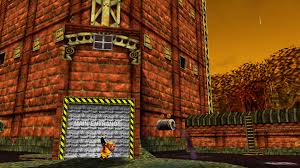
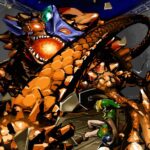
Our trope of drunken, evil clowns is back playing their wacky cabaret music in some back alley in order to complete the trilogy of decayed, grungy industrial complex levels in the Banjo series. The Banjo-Tooie answer to Clanker’s Cavern from the first entry (there is even a reference to it in a section called Clinker’s Cavern) is the culmination of the grim, polluted environment characteristic of Rare developed games—although the dirtiest place might actually be found in Conker’s Bad Fur day— that transports us by train to an actual nightmarish factory owned by Gruntilda, who more than a traditional fairy tale witch based around magic, is some kind of combination between that, a mad scientist and environment hazard ecocidal villain thanks to all of her various endeavors. The level features multiple levels and a maze like structure which is probably connected with and provides commodities to the route in Rusty Bucket Bay. No one knows exactly what Grunty’s monstrous factory produces but it seems to function as a power station, waste disposal plant, and storage depot that serves the powering needs of the ray equipped lair of the witch and her sisters who all live near it. As of today the entrepreneurship has failed all possible sanitary tests and does not comply with any regulations.
Musical Analysis
Perhaps the Banjo-Kazooiest track ever written, Grunty’s Industries has almost all of the necessary elements that identifies the sound of the series right from its very first seconds; only thing missing to be crowned with the title is a chord change from the I to bV. Yet there are plenty of tritone sonorities found in here since the Banjo-Tooie soundtrack is slightly darker, featuring more direct diminished chords and minor tonalities. But right from the very beginning almost al of the basic aspects of Banjo-Kazooie music are here: We still have a piece based around the C tonic and then going to multiple odd chord choices to which a melody is fitted by force, oom – pah like rhythms—although it feels more heavy, less frenetic here since it is played on each beat as opposed to using the off-beat and there is no swing— and reliance on the I to bVI chord change. We also have the cartoon orchestra with instruments transitioning between accompaniment and melodic roles; timbre wise there is the raspy, dirty baritone sax sound that is synonymous with the series alongside the marimba, theremin and a trombone that is used to its fullest with its most characteristic sound in mind as the basis of the melody. There is also the Kirkhope cadence right at the end of the intro.
Still, like any Banjo-Kazooie track there are plenty of curveballs in the harmony and melody department. For starters, the piece technically uses the melodic profile of the C minor scale but just for the sake of zaniness decides to retain a C major chord as the tonic even though the piece would be totally fine and more “proper”with Cm as the i chord. We can call this abomination Aeolian harmonic major, or just accept that Grant Kirkhope does whatever he wants and goes to any chord that sounds good, meaning quirky; the melodies follow the harmony wherever it arbitrarily decides to go.
Musically, the influences still belong to that lineage of the Clanker’s Cavern and its inside counterpart, which can be traced back to Weimar-era cabaret and dark jazz sound of classics such as the Threepenny Opera which were subsequently adopted by film composer Danny Elfman for the German expressionist projects of director Tim Burton and is today known as the dark cabaret style. It has that sassy, sinister, sleazy minor sound—made to sound more oddball here by making the C chord major, unlike the more traditional use of C minor in Clanker’s Cavern—that fits perfectly these decayed, rusty atmospheres. Structurally, it is also similar to Clanker’s Cavern in that it is one of the few Banjo themes that does not go up to a D Section, opting instead to repeat one of the previous sections with a different instrument playing the lead. It uses comparatively less instruments than other levels, with the Baritone Sax and Trombones carrying most of the sonic weight. Like other tracks in the series the theremin is not used as it is conventionally expected but as a synth pad playing chords, which is not how you are supposed or even possible to use it.
The intro section starts with the unmistakable sound of the baritone sax going from C major to C diminished (which can also crossdress as Ab7). It provides by itself both melodicism and harmony to the intro, which later will proceed to be relegated as the accompaniment of the main A Section. The full harmony would be something like:
Intro:
C – Cdim – Cdim / G – C – Cdim
C – Cdim – G – Ab – G – Ab – G – Ab
C – Cdim – Cdim / G – C – Cdim
C – Cdim – G7 – C – Db – G7
Remember the Cdim can be substituted for Ab7 (and from the bass in other arrangements of this cue we cam be sure that Ab7 is the actual intended chord for most of the cue). During this introduction section some drum hits accompany the lone saxophone and the clarinet also joins on beats 2 and four of each measure. It ends with the brusque Kirkhope cadence which is just going to the tritone chord of the dominant (I – bII – V – I) and a vaudeville walking bass line.
The main section of the piece makes use of the trombone glissandi to generate a catchy melody that adapts to the repetition of the Intro in the accompaniment. The melody is the one that shows us we are actually within a minor key, harmonic minor actually since the G is major, and not just the typical Ab chord borrowed from it. Although as said, it retains the C major chord for the harmony. The rapid vamp between G and Ab is colored with dominant sevenths during the A Section thanks to the clarinet support notes. It ends with a walking down chromatic bass line under a C chord, the Kirkhope cadence retiring in the meantime.
During B Section the theremin pad is added and the clarinet takes over melody duties. Things get more complicated here since the question melody uses both the notes of the Aeolian/Natural minor profile combined with the harmonic minor notes when the G chord is played; and also the answer phrase of the melody begins descending with the C minor notes but ends up tracing the C major notes—Because not even Grant Kirkhope is as crazy as to use C minor notes over a C major chord—This showcases what the composer has said about his process consisting of not thinking about rules but just using interesting chords and then let them dictate where the notes of the melody should go. Basically the melody follows the chords and the profile adopted is based around whichever chord is playing at the moment. The harmony for this section goes to the bVI, continuing its dance with the V. The chords wold be:
B Section
Ab – G – Ab – C
Ab – G – E – Bb – Db – G
It gets weirder as it goes along, traveling to E then to its tritone chord Bb and ending with the Kirkhope cadence, the melody just trying desperately to keep up with the oddball chord changes and pretty much adopting temporarily each profile from its parent chord.
Similar to Clanker’s Cavern it goes back to the main motif section here played with the trombone, just with one single repetition of the phrase and then to a coda ending with the G7 – C – G7 – C7 preparing the transition to the F minor tonality that will prevail during C Section (C7 here now functions as the dominant chord for the new key, not that you could call anything here a key since it is an hyperactive track that cannot stay put).
The harmony for this part starts normal enough based around a now standard F Aeolian/Minor profile with an actual i chord. The melodies now played first by the marimba and a second time by the clarinet as chordal melody that go up and down in scales arpeggiated to their respective chords just like the elevators on this large vertical level. It is the darker part and the only minor chord Grant puts into his whole composition based entirely around major chords. The full harmony is:
C Section
Fm – Db – Fm – Db – Fm – Db only one semitone of one note is required to move in this vamp
Bb – G – Bb – G – Bb – G
Bb – G – Fm – G –
Bb – G – Fm – G
The melody keeps adopting the profile of each chord. It is as lost as you will be on this dense factory, not falling into a simple key. It is a cartoony amalgamation of the F Aeolian/minor, G Ionian/Major and Bb Ionian/Major scales, fitting perfectly the kooky world that the bear and the bird inhabit alongside a colorful fauna. The melodic phrases are based around constantly repeating some motifs interjected with a long form scale like phrase during the Bb to G vamp.
The piece then moves on to another B Section but with the marimba replacing the clarinet as a lead instrument, similar to Clanker’s Cavern last section. After this we get one last A Section as opposed to the typical Banjo-Kazooie D Section. It ends with a vaudeville walking bass. Part of the intro is retained in the loop.
This better be a catchy tune since you will spend the next 8 hours of your life trapped on this dense fabric completely lost or getting a single jiggy (although technically the theme you most hear on this course is the inside arrangement of the factory, making it a better candidate for the main theme of the level). Grant Kirkhope has you covered with a theme that is as confused as its level and captures the quirky tone of the series . You probably can tell this is from a Banjo game from the first note.
All in all, the biggest influence on this era for Grant Kirkhope and other Rare games were the films scored by Danny Elfman, Just in Nightmare Before Christmas you can hear a lot of sounds similar to Banjo-Kazooie (and even a melody identical to a part of Conker’s Bad Fur Day infamous opera sequence. Just take a listen the credits to see a sample of the work.
Huge thanks to @JukeDenton for helping with all things Rare.

Help to keep the rites going around here by supporting the shrine:

Media Files, requests and support for more interactive content

Thou shall donate since this is a cult and you are now a sheep

Help staying awake analyzing game tracks and writing posts or else everything will end up being written by A.I
- Inside The Score – The Legend of Zeda: A Link to the Past – End Credits / Staff Roll
 The land rests As the last few minutes of this extensive journey that has now come to an end fly by, the nostalgia and reflective mood kicks in. Because such a massive enterprise as a Zelda game or a Lord of the Rings movie require multiple endings to convey everything… Read More »Inside The Score – The Legend of Zeda: A Link to the Past – End Credits / Staff Roll
 - Inside The Score – The Legend of Zelda: A Link to the Past – Ending / Epilogue ~ Beautiful HyruleFinal of the fantasy The Triforce has been touched. A wish has been granted. For the occasion, the newly undeceased king of Hyrule has commissioned a march in honor of the legendary hero to the Hylian Sousa, who might as well be composer Nobuo Uematsu since this piece is very… Read More »Inside The Score – The Legend of Zelda: A Link to the Past – Ending / Epilogue ~ Beautiful Hyrule
- Inside The Score – The Legend of Zelda: A Link to the Past – Triforce Chamber / Power of the GodsTake your boots off your feet And thus the Triforce spoke to men. And it became present in history. And you better treasure and contemplate this moment seldom witnessed in the course of the series. The elusive opportunity to interact and touch the most important artifact. You are now in… Read More »Inside The Score – The Legend of Zelda: A Link to the Past – Triforce Chamber / Power of the Gods
- Inside The Score – The Legend of Zelda: A Link to the Past – Ganon Battle / Prince of DarknessProgressive evil En Garde! And you better be prepared since you are about to duel the iconic enemy of the series at perhaps his canonically most powerful incarnation. Right after having touched the sacred Triforce which allowed him to conquer all of the Golden Land and whose evil and darkness… Read More »Inside The Score – The Legend of Zelda: A Link to the Past – Ganon Battle / Prince of Darkness
- Inside The Score – The Legend of Zelda: A Link to the Past – Boss Battle / Anger of the GuardiansQuick mayhem Ah, the simpler times when boss battles where not a multi epic orchestral suite but just an ostinato more basic that even what became the music for standard battle encounters out there. We are a long way from each boss having his own personalized track. And this early… Read More »Inside The Score – The Legend of Zelda: A Link to the Past – Boss Battle / Anger of the Guardians
- Inside The Score – The Legend of Zelda: A Link to the Past – Dark World Dungeon / Dungeon of ShadowsMemento mori We are getting closer to Ganondorf (or at least the wizard Agahnim who ultimately fulfills the same human side of evil role in this game) and that means getting closer to the profiles and motifs of his own theme song (which naturally was the theme of Agahnim at… Read More »Inside The Score – The Legend of Zelda: A Link to the Past – Dark World Dungeon / Dungeon of Shadows