The Sorceress’ Picnic
‘Spiral mountain and the opening might be the main themes
but Grunty’s Lair is where the true game begins
accustomed to this song you’ll be since it has the most repeats’
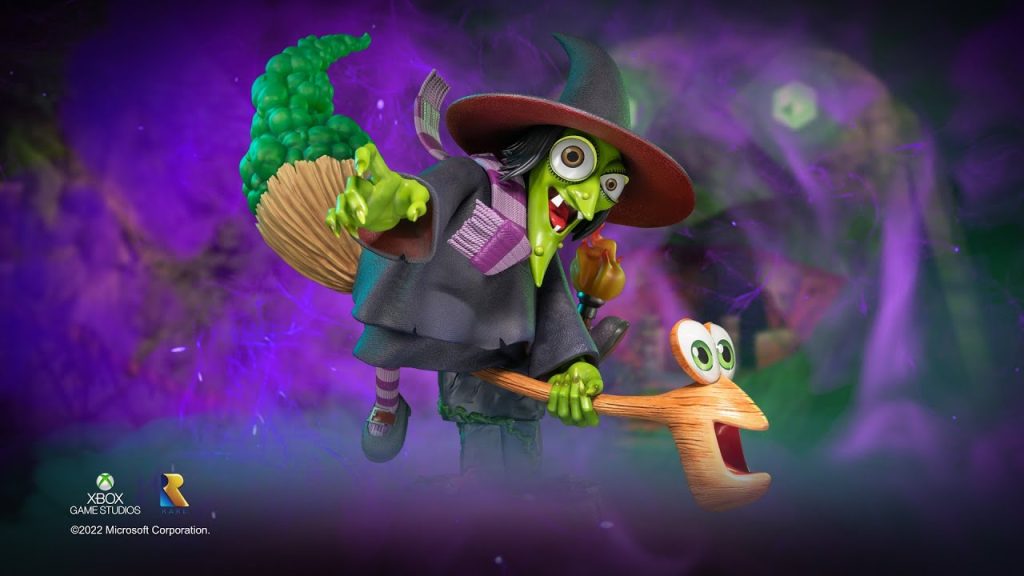
Anyway. Other tunes may be the main themes of the series as a whole but it is Gruntilda’s Lair the defining song and setting of this very first adventure of the bear and the bird. Teased in the introductory phases of the game with small melodic phrases sprinkled in relation to Grunty, it now sounds in all its glory and fully formed as Banjo tiptoes into the dangerous witch’s lair.
Gruntilda’s Lair will work as the hub world for this adventure. In the early days of gaming, levels were their own separate entities, completely disconnected from one another — beat one, and you go straight to the next, no intervening events or backtracking. Later, games added the idea of a “world map” as exemplified in Super Mario Bros 3 that connected the areas: you could now travel between worlds at will, perhaps unlocking shortcuts or alternate routes — but the map was a simplified area in and of itself, existing only to carry you from one location to the next. It became a place where small interactive things still happened but usually with a different gameplay. There was also the concept of the small scale overworld, popular in Eastern RPGs like Dragon Quest, where a traversable representation of a video game ‘overworld was abstracted and depicted at a much smaller scale than the other areas of the game.
This concept was fleshed out and improved with the invention of the hub level, made famous in Super Mario 64, in which the space between the levels became a sort of pseudolevel in and of itself, using the same engine as the rest of the game, with geography and secrets of its own. It is still essentially a gateway area, but more developed. Commonly, the hub level is the area where the plot is really happening — the stages are “side adventures” of sorts with almost no influence on the main story. The characters only need to go into the levels in order to collect the mcguffins necessary to proceed further into the hub level, where the big bad usually awaits. In Banjo-Kazooie one finds individual rooms which contain the entrances to each level, where the scenery in the room is similar to that of the level itself, as sort of a preview of what the level will be like. Similar to Mario 64, the worlds of Banjo-Kazooie will be scattered throughout Gruntilda’s Lair; but the lair goes beyond merely a sign or a photograph telling or showing travelers what to expect. The overall resting place of the portal looks like the endpoint in miniature. So a portal to the snowy level will be located in an icy chamber resembling a snowy mountain itself, or the portal to a mystical forest will be in an old tree in a small garden. Magical energy, or whatever is leaking through and reshaping the area. And, in typical Banjo-Kazooie fashion, along with the area the music follows suit and adapts the style and genres expected from these environments. Thus we will get a lot of variations on this track.
Musical Analysis
Structure: I – {PI – ABA’ – O}
Tempo: 97
Melodic and Harmonic Profiles: C Aeolian/Minor; Eb Ionian/Major; C Harmonic minor; C Mixolydian
This labyrinthine terminal is accompanied by the tune based around the melody of the slightly sinister children song called Teddy Bears’ Picnic. The bear connection and kooky rhythm made this melody fitting to the tone the game was going for, with its skipping pattern also characteristic of witchcraft in the popular consciousness thanks to the Paul Dukas composition ’The Sorceress’ Apprentice’; they all also share similarities in the use of instruments like skipping pizzicato strings to propel the rhythm.
If it wasn’t already drilled in, this tune will develop its main rhythmic motif in myriad ways, similar to Spiral Mountain; and like the mountain, it is composed of two main macro sections, making it its opposite. It is the other main level cue made of just two sections.
The piece starts with a one time intro made of cascading repetitions of Grunty motif (Dun dudududu Dun), giving it an effect of start and stop that gains intensity due to being repeated in higher and higher pitches, Although it has the same rhythm as in the verses, it manages to sound different thanks to the last note of the motif playing double duty as also the first note of each repetition. It then goes into what one could call the post intro, which is just a statement of the accompaniment before the melody kicks in. The intro is longer than usual and it has to pack a punch because of the fact the player will hear it each time they enter into a new room of the lair.
Like any good ol’ melody, Section A is composed of question-answer blocks clustered inside smaller question-answer blocks. This is the part taken straight from the Teddy Bears’ Picnic song. It follows its structure and melodic profile throughout the first two phrases, the first phrase based around a minor profile followed by the same phrase transposed a minor third to a major profile; this is known as tonal displacement, which is the technique of moving your motif to different notes within the appropriate scale while retaining the rhythm and contour of the phrase. This particular choice of notes from both songs are the responsible for the playfully sinister vibe since the transposition makes the first phrase minor and the second phrase major in the relative major scale to C minor (Eb major), which share the same notes on a piano. The melody goes:
a:
[ ( C Eb D EB D C – G Ab G ) – ( C Eb D EB D C – Bb ) ] —— [ ( Eb G F G F Eb – Bb C Bb ) – ( Eb G F G F Eb ) ]
Then, here is where Gruntilda and the Teddies part ways since Grant Kirkhope continues to play with the same motif transposed once again and goes back to minor profiles, while the bears, in an attempt to be more child friendly and happy, remain in the major profile with slightly altered question-answer blocks.
Previous iterations of the motif in the game tended more towards the harmonic minor profile. But on the standard version, Grant sticks with the natural minor since it is less threatening. For the b section (from A), first heard on the ‘Grunty Beauty Steal Machine’ cue, Kirkhope continues the motif starting from the F and alters the notes to create new question-answer blocks; he introduces the odd notes and chords outside the key that he is fond of and spice the melody like the Db and the A natural. The last iteration of the motif is the one beginning at Ab and ending with a coda that uses the harmonic minor note, B natural—on the requiem for Tooty cue, he uses the note C instead of B during this section’s coda.
After this, the composition repeats part b of the section A with the bassoon, introducing asymmetry into the structure of the song in order to offer variety. Normally it is expected a structure like {a b a b} but Grant extends the piece by repeating section b twice in a row. It then makes one last repetition of the block {a b}, this time with the low baritone sax providing new colors in the composition. So section A as a whole ends up with a substructure made of {a b b’ a b’}. The instruments playfully take turns to play like in a roundtable, as if they were just around the corner preparing for their turn; they begin playing their phrases even before the the previous instrument ends theirs. The bass line begins moving by the more villainous fourths but ends the section moving in fifths.
The harmony during this section A is
Cm – Bb – Eb
Fm – Cm – Db – G – Ab – Fm – Csus2 – G
The Kirkhopian tritone chord movement is again heard in the Db to G transition.
Like any good new’ B section, this one has to contrast by introducing new material, preferably with different motifs, harmonies and rhythms. This previously unheard section brightens up the piece by making use of the Mixolydian mode that changes the Cm into C major. The transition between the two sections is made smoother thanks to the baritone sax ending the previous section’s melody and now transitioning into the bass line while the marimba relieves the high strings. The new question motif is (DududuDun Duduun). Overall, it is shorter than section A since its question-answer format only has parallel to the {a} subsection from A.
While a triumphant start to the section, Grant immediately goes back to eerie profiles, first by playing the F# chord that sticks out seeing as how it is the tritone chord for C, the infamous bV chord and then going to the minor profiles. The harmony for this part goes:
C – Bb – C -Bb – F#
C – Bb – Fm – G – Ab
C – Bb – C -Bb – F#
C – Bb – G7 – Cm – F#
The last part is a reprise of section A with the gothic horror instruments: the theremin—used unconventionally as a chordal instrument— and the delicate Celesta. There is an alternative version that is heard on floor 4 and 6 that replaces the celesta with a small xylophone.
The outro ends up drilling the main motif by repeating it as a “question only” call and response between the instruments.
The iconic sax sound among others from the soundtrack comes from the sound module E-MU PROTEUS FX used back in the day.
As the bear and the bird navigate the perils and secrets of the lair, this tune will propel them and, alongside the echoing laugh of this witch, her leitmotif will remind them of their place, unlike in Peach’s Castle, where we don’t hear Bowser’s music. This is the villain’s lair.

Help to keep the rites going around here by supporting the shrine:

Media Files, requests and support for more interactive content

Thou shall donate since this is a cult and you are now a sheep

Help staying awake analyzing game tracks and writing posts or else everything will end up being written by A.I
- Inside The Score – The Legend of Zeda: A Link to the Past – End Credits / Staff Roll
 The land rests As the last few minutes of this extensive journey that has now come to an end fly by, the nostalgia and reflective mood kicks in. Because such a massive enterprise as a Zelda game or a Lord of the Rings movie require multiple endings to convey everything… Read More »Inside The Score – The Legend of Zeda: A Link to the Past – End Credits / Staff Roll
 - Inside The Score – The Legend of Zelda: A Link to the Past – Ending / Epilogue ~ Beautiful HyruleFinal of the fantasy The Triforce has been touched. A wish has been granted. For the occasion, the newly undeceased king of Hyrule has commissioned a march in honor of the legendary hero to the Hylian Sousa, who might as well be composer Nobuo Uematsu since this piece is very… Read More »Inside The Score – The Legend of Zelda: A Link to the Past – Ending / Epilogue ~ Beautiful Hyrule
- Inside The Score – The Legend of Zelda: A Link to the Past – Triforce Chamber / Power of the GodsTake your boots off your feet And thus the Triforce spoke to men. And it became present in history. And you better treasure and contemplate this moment seldom witnessed in the course of the series. The elusive opportunity to interact and touch the most important artifact. You are now in… Read More »Inside The Score – The Legend of Zelda: A Link to the Past – Triforce Chamber / Power of the Gods
- Inside The Score – The Legend of Zelda: A Link to the Past – Ganon Battle / Prince of DarknessProgressive evil En Garde! And you better be prepared since you are about to duel the iconic enemy of the series at perhaps his canonically most powerful incarnation. Right after having touched the sacred Triforce which allowed him to conquer all of the Golden Land and whose evil and darkness… Read More »Inside The Score – The Legend of Zelda: A Link to the Past – Ganon Battle / Prince of Darkness
- Inside The Score – The Legend of Zelda: A Link to the Past – Boss Battle / Anger of the GuardiansQuick mayhem Ah, the simpler times when boss battles where not a multi epic orchestral suite but just an ostinato more basic that even what became the music for standard battle encounters out there. We are a long way from each boss having his own personalized track. And this early… Read More »Inside The Score – The Legend of Zelda: A Link to the Past – Boss Battle / Anger of the Guardians
- Inside The Score – The Legend of Zelda: A Link to the Past – Dark World Dungeon / Dungeon of ShadowsMemento mori We are getting closer to Ganondorf (or at least the wizard Agahnim who ultimately fulfills the same human side of evil role in this game) and that means getting closer to the profiles and motifs of his own theme song (which naturally was the theme of Agahnim at… Read More »Inside The Score – The Legend of Zelda: A Link to the Past – Dark World Dungeon / Dungeon of Shadows