Zany Christmas spirit
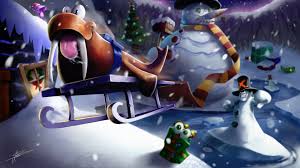
Ah, the obligatory ice level, i.e Christmas episode; or rather, the first from the trilogy of obligatory levels of which we are about to see Banjo-Kazooie’s take on them. And thankfully, even if Banjo is not a polar bear nobody will freeze to death. Inevitably, it is also the time of the year to celebrate Christmas, the most straightforward pairing to the ice level; analogous to what Egyptian themes are to desert levels and a Halloween dressing is to the spooky level, the snowy worlds are usually accompanied by the theme of perhaps the most popular celebration in the history of human culture, the annual worldwide festival commemorating the birth of Jesus Christ on earth. Who knows its origins in the wacky Banjoverse; but this is its Christmas special. As usual, Christmas elements find their way into works of fiction that are not supposed to be connected in any way to the real world; gift giving, lights decorating everywhere, evergreen conifers, winter, snowmen, Santa, and yes, jingles all the way are fair game. The real Christmas celebration itself has adopted multiple elements from various cultures across history, creating an amalgam of traditions that make it truly universal. It is observed primarily on December 25, exactly nine months after the annunciation of Jesus on March 25; it coincides with the date of the spring equinox, which other cultures celebrated in similar timeframes.
Alongside the Christmas motif we get the usual shenanigans of ice levels in video games; less friction, water so cold that causes damage, snowman enemies attacking with snowballs, walruses, among others. Since by then ice levels were already a staple of pretty much any video game with multiple environments, it is not surprising that Freezeezy Peak was among the earliest levels during the developments alongside the desert one and the spooky one. Its close cousin from Super Mario 64 would be the course Snowman’s Land which also features a giant snowman as its central landmark that grounds the level and allows players to not get lost. In Banjo-Kazooie the Christmas spirit begins right away at the entrance to the level, which is modeled after what is known as an Advent calendar, used to count the days in anticipation of Christmas day; they take the form of a large rectangular card with doors, one for each day of December leading up to and including Christmas Eve. Consecutive doors are opened every day and are distributed across the calendar in no particular order. The calendar doors open to reveal an image, a poem, a portion of a story (such as the story of the Nativity of Jesus), or a small gift, such as a toy or a chocolate item. This is just like the one the bear and the bird encounter which have some items inside.
As was the case for the other early development levels we find ourselves hearing a previous version of the music for this area. However, unlike the other levels, the original cue from Freezeezy Peak was not completely axed, retaining an entire section that Grant Kirkhope felt worked well and contrasted with the new material. Like the previous discarded tunes, the original is a more standard melodic ditty based on chill rhythms and unambiguous major tonalities. It was only after Mad Monster Mansion that Grant decided to feature tritone based harmonies and frantic unrelenting oom-pah rhythms inspired by scores from Danny Elfmann. Which means this track ended up closer in spirit to the song ‘What’s This’ from The Nightmare Before Christmas, whose orchestral sweep and celesta take over from the codification of epic orchestral Christmas music that took place when Russian composer Tchaikovsky decided to use a celesta for his Nutcracker ballet.
Here is the original Freezeezy Peak:
Unsurprisingly, it is also based around jingles as a foundation and the icy timbre of the celesta. It certainly sounds Christmasy and something you would hear while going shopping for the presents at the local mall.
There is an even earlier version that makes use of the horns playing chord melodies just like on the final track:
Musical Analysis
Structure: {PI – I – ABA’B’CB”D}
Tempo: 145
Melodic and Harmonic Profiles: C Ionian/Major; F# Ionian/Major; G Ionian/Major
The final version on the other hand goes all in with the oom-pah rhythms and a busier arrangement. The wintery feel lends itself to a more lush orchestration when compared to the music from the other main areas. Here, the cartoon orchestra is replaced by the more majestic combination of horns and strings, which are seldom used in the score, giving Freezeezy Peak instrumentation that contrasts with the rest of the levels. No marimbas here, which is a first for the world tunes.
The Drums are also completely absent on this track, replacing them with jingle bells….or not. In reality Grant used a tambourine as opposed to actual Christmas jingles; but the intended effect is exactly the same, to imitate the popular jingles you would hear on winter attached to the sleds as warning for the passersby since sleds produce almost no sound; with time they came to be associated with the sled of Santa Claus himself—a name that is born from trying to pronounce too fast the name of the real person that inspired the legend, St Nicholas—So now they are the main musical motif of Christmas (and snow levels).
Continuing with the trend of progressively more elaborate intros, Freezezy Peak presents us something akin to an overture, with melodic elements foreshadowing the main musical motifs we will encounter throughout the piece. The cue opens with exciting strings that signal the beginning of Christmas; we will encounter similar minor second based melodies featured as the answer phrases of the main section and as the basis for the last one. The horns then enter in the chord melody fashion they will retain throughout most of the piece. Their timbre is forcefull, gaining a raspy quality as if the musicians are playing with all their might. They themselves are foreshadowing the main question motif of the piece. During the intro the harmony goes from a C major chord to Am.
It is all very majestic and uplifting. Nonetheless, as is the standard procedure for Grant Kirkhope, this new revamped theme has to make use of the abrupt change to the tried and trusted F# sonority, the tritone chord of C. The main melody finds itself being played within the oom-pan rhythms, which in the Danny Elfman style ought to be played without a trace of swing; they need to be performed straight and fast—which some performers of the scores from the composer have found tricky to do— The melody consists of question phrases with longer notes and the answering phrases being the descendent minor second figures. During the second iteration of the answer the piece modulates once again, with the orchestra playing the same minor second figure a half step up in G.
The B section is the part taken from the original composition; this means that in line with the previous musical direction, it uses sane major chords as the basis for the harmony, returning to the only-white piano keys C major tonality. The melody is also question-answer based. The harmony consists of the basic IV – I – V7 movements giving us the sequence:
F – C – G7 – C – G7 – C7
F – C – G7
In the absence of the traditional drum kit, the orchestral treatment is enhanced by the timpani punctuating the transitions alongside the cymbals. We go back to a lighter Section A a half step down from the previous chord, now played with woodwinds.
C section is delayed in comparison with the previous level themes since we return back to the B section, giving the cue a verse-chorus feel. This new B section is basically straight from the original composition, using the subdued combination of the bassoon and the celesta which is the flagship melodic instrument of Christmas.
After that it seems as if the piece was returning to the overture but in reality is the more sublime C section—no frantic sections here—It begins similarly to the overture but then the piece uses a more solemn harmony on the answers, making use of maj7 in the interplay between the horns and the strings. The flute plays a response that consists on a quick reprise of the main question motif. It is the part that sounds the most like a classic Christmas carol. The chords can be though of as:
C – F – G7 -C
C – F6/9- C
After passing through good ol’ B section again, we then go to the last section, which uses the 50s chord progression C – Am – F – G7, right from the era where most Christmas pop standards are still stuck. The fast melody full of ornamental notes was already foreshadowed by the overture, making this a perfect candidate for becoming the connection with said overture, creating a smooth transition for the piece to loop naturally without losing step. No need to cut intros from the loop with this much smoothness.
Come closer to the Christmas tree and if it is lighted on you get to hear its bells joining the track. They are also omnipresent on the festivities; after all, the church across the world signaled special events like Christmas with their sound.
As a fun fact there is within the game files an underwater arrangement of the theme. However, there is no way to hear it during gameplay since there aren’t underwater sections that could use it.
Music is an inescapable part of the Christmas celebration, the pedigree has evolved into the hymns known as Christmas carols. The next piece would be the most suited candidate to fulfill this tradition.

Help to keep the rites going around here by supporting the shrine:

Media Files, requests and support for more interactive content

Thou shall donate since this is a cult and you are now a sheep

Help staying awake analyzing game tracks and writing posts or else everything will end up being written by A.I
- Inside The Score – The Legend of Zeda: A Link to the Past – End Credits / Staff Roll
 The land rests As the last few minutes of this extensive journey that has now come to an end fly by, the nostalgia and reflective mood kicks in. Because such a massive enterprise as a Zelda game or a Lord of the Rings movie require multiple endings to convey everything… Read More »Inside The Score – The Legend of Zeda: A Link to the Past – End Credits / Staff Roll
 - Inside The Score – The Legend of Zelda: A Link to the Past – Ending / Epilogue ~ Beautiful HyruleFinal of the fantasy The Triforce has been touched. A wish has been granted. For the occasion, the newly undeceased king of Hyrule has commissioned a march in honor of the legendary hero to the Hylian Sousa, who might as well be composer Nobuo Uematsu since this piece is very… Read More »Inside The Score – The Legend of Zelda: A Link to the Past – Ending / Epilogue ~ Beautiful Hyrule
- Inside The Score – The Legend of Zelda: A Link to the Past – Triforce Chamber / Power of the GodsTake your boots off your feet And thus the Triforce spoke to men. And it became present in history. And you better treasure and contemplate this moment seldom witnessed in the course of the series. The elusive opportunity to interact and touch the most important artifact. You are now in… Read More »Inside The Score – The Legend of Zelda: A Link to the Past – Triforce Chamber / Power of the Gods
- Inside The Score – The Legend of Zelda: A Link to the Past – Ganon Battle / Prince of DarknessProgressive evil En Garde! And you better be prepared since you are about to duel the iconic enemy of the series at perhaps his canonically most powerful incarnation. Right after having touched the sacred Triforce which allowed him to conquer all of the Golden Land and whose evil and darkness… Read More »Inside The Score – The Legend of Zelda: A Link to the Past – Ganon Battle / Prince of Darkness
- Inside The Score – The Legend of Zelda: A Link to the Past – Boss Battle / Anger of the GuardiansQuick mayhem Ah, the simpler times when boss battles where not a multi epic orchestral suite but just an ostinato more basic that even what became the music for standard battle encounters out there. We are a long way from each boss having his own personalized track. And this early… Read More »Inside The Score – The Legend of Zelda: A Link to the Past – Boss Battle / Anger of the Guardians
- Inside The Score – The Legend of Zelda: A Link to the Past – Dark World Dungeon / Dungeon of ShadowsMemento mori We are getting closer to Ganondorf (or at least the wizard Agahnim who ultimately fulfills the same human side of evil role in this game) and that means getting closer to the profiles and motifs of his own theme song (which naturally was the theme of Agahnim at… Read More »Inside The Score – The Legend of Zelda: A Link to the Past – Dark World Dungeon / Dungeon of Shadows