Industrial seamen
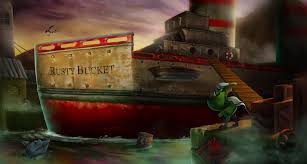
Welcome aboard the HMS Gruntilda, a place that confronts us directly with the consequences of taking industrial might to extremes that antagonize the environment. Because at the end of the day, Banjo-Kazooie is all just a big metaphor and message about becoming ecologically savvy after seeing the outcome relentless industrial consumption has on monosyllabic fauna….Or perhaps Rare just wanted to subvert your typical Gangplanck Galeon pirate ship level with their characteristic decayed factory land twist, another polluted wasteland, becoming the sequel to Clanker’s Cavern and prequel to Grunty Industries in the process— or Spiller’s Harbor from their forgotten Game Boy adventure. Since this is more of a Banjo-Kazooie specialty, the closest parallel to Mario 64 would be the part on Dire, Dire Docks when you visit the more abstract Bowser’s submarine. Here, just like in Clanker’s Cavern, the action centers around a main landmark floating in the middle of a puddle of contaminated water, the player able to explore its exterior, interior and surrounding port, never losing sight of where they are in the level with respect to the giant boat. That is 3D level design for ya
The game goes against its own pirate origin by opting instead for a modern cargo ship that gives players the opportunity to get the navy experience, traversing the different areas of the steamboat and not spending too much time underwater since it is polluted and oxygen is scarce. As its true name, the Rusty Bucket, implies, the ship looks decayed and in bad shape, just as expected from an evil witch who does not care about complying with maritime regulations. In contrast with other ship levels found in other games, which opt for the easy route of surrounding their ship with an infinite landscape of water creating the illusion of a very large world with less effort, the Rusty Bucket is currently stationed at port, the heroes able to explore it and find secrets in it. It is one of the most realistic levels found in the game—also the most challenging by many accounts.
Musical Analysis
Structure: { I – ABA’ – T – CC’- O }
Tempo: 120
Melodic and Harmonic Profiles: C Aeolian/Minor; C Harmonic minor; A Aeolian/Minor; A Harmonic minor; Db Aeolian/Minor; Db Harmonic minor; Db Dorian
What makes the music of the level special is that Grant Kirkhope somehow managed to get a catchy tune out of the functional considerations of creating a kinetic based melody, sounding factory-like and giving the sensation of active machinery and a coordinated workforce of sailors synchronizing their movements, going up and down stairs or moving steadily chains and pulleys to lift crates or platforms; music at the service of work as exemplified by work songs from all kinds of jobs that rely on repetitive tasks. There are also start n’ stop moments characteristic of industrial, assembly work, like timed responsibilities and shift changes managed through signals, which here are ingrained on the track as a natural part of the music; boat foghorns, alarms and whistles are part of the sonic landscape. It balances mechanistic considerations with melodic flourishes to create an original tune. This is all accomplished with typical resources like chromatic, stepwise movements going up and down; instrument paths mirroring each other, creating busier melodic lines just like the work environment of a cargo ship; and using a steady clock provided by the woodblocks. In doing so, the cue for Rusty Bucket Bay ends up as a worthy, albeit more depressing, competitor to the assembly line anthem in cartoons. Perhaps the most recognizable cartoon song of all time, ‘Powerhouse’, with both its A and B section, has seen use in plants, factories, or industrial-type situations, ever since composer Carl Stalling got his hands into the rights to the wacky, idiosyncratic music of Raymond Scott. It became synonymous with humorous Goldberg machine type of situations. Both tracks share some of the same techniques to accomplish this sense of repetitive mechanism-like movements, specially their reliance on chromatisms going up / down and ostinatos, like chains being pulled.
Notwithstanding, what makes this cue less zany and quirky but instead more epic and adventurous are its harmonic progressions, which are based on minor yet heroic profiles found in films of the swashbuckler genre or Westerns.
The piece goes back to the era of simpler intros from the beginning of the game, just an harmony establishing intro waiting for a melody to be rested upon it. The harmony in question is the same spicy dark cabaret one from Clanker’s Cavern, the one that uses the descending minor scale with the dominant chord in major form.
Cm – Bb – Ab – G
In this case the chords are implied since the trombone plays an octave based ostinato, likely because this simplicity will harmonically clash less with the chromatic melodies that follow. Just like for Clanker, this is a progression apt for decadent places like this old ship stationed in oily waters.The A section is the pulley based section, the marimba playing chromatically ascending and descending lines meant to depict cargo being lifted and then deposited by cranes and other devices. The Banjo-Kazooie tritone shtick still lives in the way that F# is a core note on this melody, strategically placed at the chord change; as long as core notes remain inside the scale the piece will sound melodic and musical no matter the chromaticism thrown at it.
The clock ticks alongside the relentless work of the sailors with double the tempo of how we count seconds, so it is indeed meant to convey time. Even though it is functional, its question-answer format unambiguously presents us a musical work as opposed to a sound design landscape, the answering phrases doing most of the melodic work. The section is marked and separated by the ship own signals composed of whistles and foghorns typical of synchronized cargo boats and industrial works; these stops are not only immersive but also help to separate sections, as if a new cargo just arrived or the workers need to change shift, or lunch time is about to begin—not that Grunty would offer lunch anyway. After the shift change the bassoon joins as if it was another piece of machinery working at the same time as the marimba, symmetrically mirroring the chromatic ascends with descends and vice versa; the core notes fall in octaves or unison or consonant intervals, salvaging the piece of unwanted dissonances.
Next section is the Mr. Vile section, played with more swashbuckler heroism; it is the first sign that this world shares more than just inedible water with Bubblegloop Swamp. It seems Grant had this trombone melody in mind when composing both of these trombone based tracks, which use the instrument’s slide to bend the pitches as the basis of the question phrases; both B sections of the tracks end with the same melodic cadence. As it is typical in the score, the piece goes to the IV chord to create contrast. Compared with the Mr Vile progressions which are major and endearing, the ones from Rusty Bucket are minor based, more solemn, the harmonic scale and ending the phrases on C major giving a more hopeful tone as opposed to straight up dread. The last question-answer pair ends with the Kirkhope cadence as is standard in Banjo Kazooie music, giving us the full progression:
F – E – Am – C
F – D – G – Db – G
The D major as the dominant of G preparing us to reach the C tonality once again by way of the Kirkhope cadence.
We get back to a revamped pulley section, the composer overhauling the instruments as per the shift change; now it is the turn for the baritone sax and clarinet to work while the marimba changes to become an accompaniment instrument. But, wait, the start n stop is longer, gears are shifting and Grant prepares us a key change a half step up just like on Clanker’s Cavern; however instead of reprising previous sections the piece arrives at the militaristic C section, a new melody that will return in full force for the final battle against Gruntilda. The progressions begins with the cabaret harmony a half step up before surprising with the appearance of the IV chord as opposed to the more standard iv, the last three chords together planting a Dorian seed into the proceedings and lifting the piece into more epic territory—which is perhaps the reason why this section is going to be used for the final battle atop a castle.
Dbm – B – A – G#
Dbm – B6 – E – F#
Another shift transition signaled by the boat sounds is in order before returning to the same section, this time with a countermelody played by the marimbas. The motif is recognizable since it is the same one from Bubblegloop Swamp, which was itself based around the B section of Spiral Mountain, this time played in the minor key, creating a self referential chain that glues the soundtrack and makes it feel as part of the same world whether consciously or unconsciously. The last trill of the marimba emphasizes the ‘Dorian note (in this case the Bb).
There is not really a D section. Instead, we get an explosive outro between the boat signals and a long pulley lifting and then dropping a crate from a 100 meter height, exemplified by the woodwinds doubling each other in their descent. One final foghorn sequence signals the end of the day, with a brand new sound, the most potent, ending the piece, as if the ship just arrived to its destination. Time to go home, shift has ended.
There is a part during gameplay when the player is required to sound diegetic whistles and horns on the boat. During this part, the track wisely removes its horn sounds and replaces them with a xylophone ticking as a clock in a quiz, apt for the mind that is consumed thinking and trying to remember a sequence; this in order to not confuse the diegetic sounds of the player with the semi diegetic ones from the track.
Rare might have opted to go against the pirate based influence of its original Project Dream, nonetheless we still find sailor music here thanks to the berthing facilities offered by the HMS Gruntilda. The insides of the ship that are conspiring to eliminate the bear and the bird.

Help to keep the rites going around here by supporting the shrine:

Media Files, requests and support for more interactive content

Thou shall donate since this is a cult and you are now a sheep

Help staying awake analyzing game tracks and writing posts or else everything will end up being written by A.I
- Inside The Score – The Legend of Zeda: A Link to the Past – End Credits / Staff Roll
 The land rests As the last few minutes of this extensive journey that has now come to an end fly by, the nostalgia and reflective mood kicks in. Because such a massive enterprise as a Zelda game or a Lord of the Rings movie require multiple endings to convey everything… Read More »Inside The Score – The Legend of Zeda: A Link to the Past – End Credits / Staff Roll
 - Inside The Score – The Legend of Zelda: A Link to the Past – Ending / Epilogue ~ Beautiful HyruleFinal of the fantasy The Triforce has been touched. A wish has been granted. For the occasion, the newly undeceased king of Hyrule has commissioned a march in honor of the legendary hero to the Hylian Sousa, who might as well be composer Nobuo Uematsu since this piece is very… Read More »Inside The Score – The Legend of Zelda: A Link to the Past – Ending / Epilogue ~ Beautiful Hyrule
- Inside The Score – The Legend of Zelda: A Link to the Past – Triforce Chamber / Power of the GodsTake your boots off your feet And thus the Triforce spoke to men. And it became present in history. And you better treasure and contemplate this moment seldom witnessed in the course of the series. The elusive opportunity to interact and touch the most important artifact. You are now in… Read More »Inside The Score – The Legend of Zelda: A Link to the Past – Triforce Chamber / Power of the Gods
- Inside The Score – The Legend of Zelda: A Link to the Past – Ganon Battle / Prince of DarknessProgressive evil En Garde! And you better be prepared since you are about to duel the iconic enemy of the series at perhaps his canonically most powerful incarnation. Right after having touched the sacred Triforce which allowed him to conquer all of the Golden Land and whose evil and darkness… Read More »Inside The Score – The Legend of Zelda: A Link to the Past – Ganon Battle / Prince of Darkness
- Inside The Score – The Legend of Zelda: A Link to the Past – Boss Battle / Anger of the GuardiansQuick mayhem Ah, the simpler times when boss battles where not a multi epic orchestral suite but just an ostinato more basic that even what became the music for standard battle encounters out there. We are a long way from each boss having his own personalized track. And this early… Read More »Inside The Score – The Legend of Zelda: A Link to the Past – Boss Battle / Anger of the Guardians
- Inside The Score – The Legend of Zelda: A Link to the Past – Dark World Dungeon / Dungeon of ShadowsMemento mori We are getting closer to Ganondorf (or at least the wizard Agahnim who ultimately fulfills the same human side of evil role in this game) and that means getting closer to the profiles and motifs of his own theme song (which naturally was the theme of Agahnim at… Read More »Inside The Score – The Legend of Zelda: A Link to the Past – Dark World Dungeon / Dungeon of Shadows