Reckless celebration
Do the Mumbo!
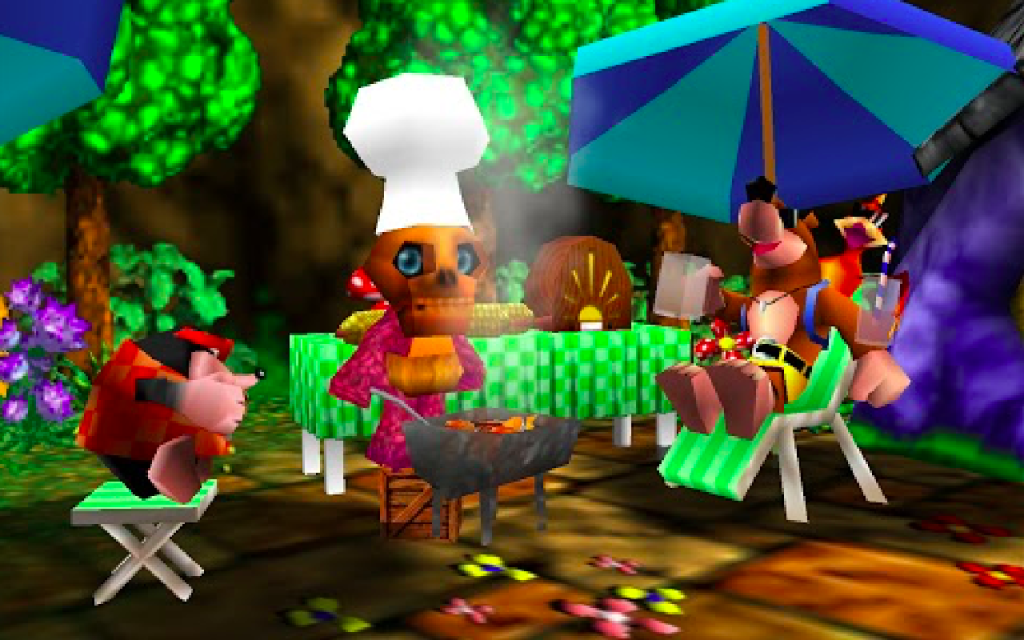
For his debut as a singer, which is a role he will fulfill even more broadly in the sequel, Mumbo (voiced by Grant Kirkhope himself) treats our heroes and their sensei to an enjoyable cookout party in honor of their deeds—except for Banjo’s own pet goldfish which is the one being cooked. In reality, the singing is still made out of the same chopped speech the character uses to speak—which can literally be characterized as mumbo jumbo—just used in a rhythmic fashion with the tune. Like any other party worth its salt this needs some thrilling dance music to go along with it, Mumbo going back to his roots by choosing the same boogie-woogie style that originally accompanied his level Mumbo’s Mountain alongside the bluesy feel of his own theme tune; the same boogie-woogie which immensely influenced styles such as the surf music that the track flirted with thanks to the palm muted clean electric guitar and the theremin roleplaying as a cool synth, fitting for Banjo too since his original clothing style was that of a surfer dude, which then later was mixed with a rural Appalachian personality (and haircut) thanks to being named after the flagship instrument of the region. The style as a precursor of Rock n Roll, is appropriate for the fun ambient of the gathering, which is sadly interrupted by the party popper common sense of Tooty.
The boogie-woogie uses blues based progressions with characteristic accompaniment figures such as the regular ascending bass pattern that incorporates in some fashion the interplay—mostly back and forth— between the perfect fifth and major sixth intervals, known specifically as a boogie, plus groovy chromatic steps. It is precisely this quality of persistently repeated rhythmic units known as a groove, which has its deepest origins in the trance like rituals of African tribes, what made the style irresistible for dancing and partying in juke joints across the United States, when the spirituals and work songs of African heritage collided with American folk and country from the Appalachians. The style is attested as early as the late 1800s, it was a quite distinctive sound that rang very strange back in those days, clashing with ears accustomed to the classical Western tradition, but it slowly became infectious for the American public, enjoying its heyday in the early ’40s.
Pine Top’s Boogie Woogie cemented the term as the moniker for the genre
So clearly, Mumbo Jumbo has a preference for the more modern coalescences of African music as opposed to his tribal counterparts from his village which would be more in line for such a shaman.
Musical Analysis
Structure: {I – ABA’- C} / Section 2
Tempo: 135 / 140
Melodic and Harmonic Profiles: F Ionian/Major; F Blues; F diminished
Besides the style thing, the barbeque music is a 12-bar blues arrangement based on F of the first song made exclusively for the game, the theme that ended up as Click Clock Wood, alongside other stylish blues licks. The melody is played with sliding ornamental notes and trills characteristic of the style by the organ, which has become an entirely new character after its days of being a mournful church organ. Some licks are so ubiquitous as to appear in many tunes, like for example the question-answer phrase above the V chord which just delineates the V7 chord, a phrase that Kirkhope also uses as the main motif for the ‘File Select’ cue of the game Donkey Kong 64. The blues progression is at its simplest form, without common devices such as “quick change”, turnarounds, or seventh chords, just the I – IV – V in the standard order (except for the organ which does use C7).
There is an intro and interludes which are where Mumbo interjects his famous Eekum Bokum familiar to the players who had to constantly collect his Mumbo skulls spread through the worlds of the game; the entire spelling somehow was born out of Grant recording the phrase “Come and have a go if you think you’re hard enough”, a famous English football chant, and then chopping it out and randomizing it to make it sound like a caveman; in the chromatic steps on this song you can hear the first half of the phrase.
Here we can hear the full composition whereas in the game the clarinet solo is rudely interrupted by Tooty reminding everyone that Gruntilda might possibly still posit a treat, you know, living like less than a block away from them; something not good for the sister’s PTSD. This triggers a disturbing scene where everyone screams, Kazooie hits Banjo on the head as usual due to laziness of finishing the quest and bottles falls down. It is accompanied by a common terror sting where the banjo and the other mallets sustain a Fdim7 that progressively gets higher, with changes following the scene edits that are accentuated by the orchestral percussion. For some reason Mumbo scream is just Gruntilda’s voice pitched down and two banjo voice clips play at the same time between his speech and an exasperated sound effect. Humorously, then Banjo runs back to the lair accompanied by the Turbo trainers cue even though they are not being used, just to convey the sense of urgency of having to go back to the castle; cub power activate. Because even Banjo-Kazooie would not dare to rob us of the solemn video game tradition of the final boss battle.

Help to keep the rites going around here by supporting the shrine:

Media Files, requests and support for more interactive content

Thou shall donate since this is a cult and you are now a sheep

Help staying awake analyzing game tracks and writing posts or else everything will end up being written by A.I
- Inside The Score – The Legend of Zeda: A Link to the Past – End Credits / Staff Roll
 The land rests As the last few minutes of this extensive journey that has now come to an end fly by, the nostalgia and reflective mood kicks in. Because such a massive enterprise as a Zelda game or a Lord of the Rings movie require multiple endings to convey everything… Read More »Inside The Score – The Legend of Zeda: A Link to the Past – End Credits / Staff Roll
 - Inside The Score – The Legend of Zelda: A Link to the Past – Ending / Epilogue ~ Beautiful HyruleFinal of the fantasy The Triforce has been touched. A wish has been granted. For the occasion, the newly undeceased king of Hyrule has commissioned a march in honor of the legendary hero to the Hylian Sousa, who might as well be composer Nobuo Uematsu since this piece is very… Read More »Inside The Score – The Legend of Zelda: A Link to the Past – Ending / Epilogue ~ Beautiful Hyrule
- Inside The Score – The Legend of Zelda: A Link to the Past – Triforce Chamber / Power of the GodsTake your boots off your feet And thus the Triforce spoke to men. And it became present in history. And you better treasure and contemplate this moment seldom witnessed in the course of the series. The elusive opportunity to interact and touch the most important artifact. You are now in… Read More »Inside The Score – The Legend of Zelda: A Link to the Past – Triforce Chamber / Power of the Gods
- Inside The Score – The Legend of Zelda: A Link to the Past – Ganon Battle / Prince of DarknessProgressive evil En Garde! And you better be prepared since you are about to duel the iconic enemy of the series at perhaps his canonically most powerful incarnation. Right after having touched the sacred Triforce which allowed him to conquer all of the Golden Land and whose evil and darkness… Read More »Inside The Score – The Legend of Zelda: A Link to the Past – Ganon Battle / Prince of Darkness
- Inside The Score – The Legend of Zelda: A Link to the Past – Boss Battle / Anger of the GuardiansQuick mayhem Ah, the simpler times when boss battles where not a multi epic orchestral suite but just an ostinato more basic that even what became the music for standard battle encounters out there. We are a long way from each boss having his own personalized track. And this early… Read More »Inside The Score – The Legend of Zelda: A Link to the Past – Boss Battle / Anger of the Guardians
- Inside The Score – The Legend of Zelda: A Link to the Past – Dark World Dungeon / Dungeon of ShadowsMemento mori We are getting closer to Ganondorf (or at least the wizard Agahnim who ultimately fulfills the same human side of evil role in this game) and that means getting closer to the profiles and motifs of his own theme song (which naturally was the theme of Agahnim at… Read More »Inside The Score – The Legend of Zelda: A Link to the Past – Dark World Dungeon / Dungeon of Shadows