Things just got serious
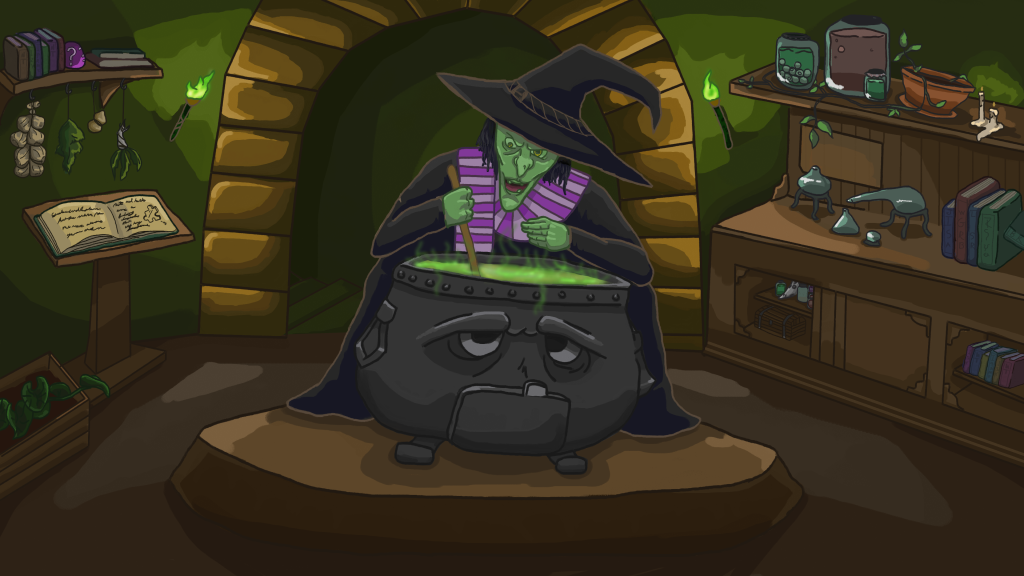
This is it. This is the moment when the game is telling us things are about to get real. You can smell the danger in the air, as if Gruntilda is hiding and an attack could come from any corner; she already lost her dream and we don’t really know the extent of her witchcraft. Doesn’t matter, you took away her victory, now she is done playing games with the bear and the bird. The cruelty of the game is also increased exponentially as we slowly realize the ending is not that close; the game requires of non-completionist players to get nearly one hundred percent of the jiggies and music notes in order to progress further, ensuring the player is truly prepared for the confrontation that is going to take place at the top of the castle. Grunty is indeed heavily guarded. One last effort is required. It is also good to finally be able to step into locations we had only seen through cutscenes throughout the adventure, making it all feel like a real place interconnected and a culmination.
Musical Analysis
Structure: {I – ABA’- C- B’} / Section 2
Tempo: 90 / 125
Melodic and Harmonic Profiles: C Harmonic minor; C Aeolian/Minor
The music also communicates this sense of dread and ominous danger in the air, striving to be right at the tipping point between consonance and dissonance, Any minor nudge and the piece would fall into dissonance, driving the point of just a general sense that something wrong is about to happen, not necessarily that is happening right now; the monster is not right in front of you, it is hiding, wounded, expecting for the opportunity to take you down. Throughout the piece we will hear some of the most strangest note combinations found in the harmony of the score, beginning with the two chord intro where Grant employs the sonority of the theremin to provide what is nicknamed the Hitchcook chord, due to its heavy use by Bernard Herrmann on the films of the director such as the seminal Psycho, which codified icy with this foreboding ambience (alongside the sheer terror of the strings in the shower scene). It Is this chord precisely what is being referred as right in the goldilocks zone between consonance and dissonance; not quite a minor chord but also not quite as horror inducing as, say, a diminished major seventh chord or diminished seventh one. Those are for when you are face to face with evil. This chord is for when evil is under you, breathing in the dark. The chord. a minor major seventh, does not contain the heavy dissonant interval of the augmented fourth (the tritone) but it does contain the one produced by the minor second, between the root and the seventh. This dissonance is augmented even further when clashing this chord with the underlying arpeggios played by the celesta, which is pretty much doing its own thing, accompanying with almost the same pattern as it did back in the cousin cue ‘Grunty Beauty Steal Machine’, albeit with some chords removed and some notes slightly modified.
All in all, the harmony of this unnerving intro produced by the individual interplay of the gothic celesta and theremin instruments would be something like the complex chord progression Cm maj7 / b13 – Bbm maj7 / b13. Since the celesta does not even bother to change the harmony when the theremin is playing the Bbm, it follows that the true chord would be the dissonant chimera composed of the mix between the Bbm maj7 / b13 of the theremin with the Cm b13 of the celesta, something like Bbm7 maj7 / 9 / 11 / b13 / 13. As we can see the theory can get even more disturbing than the music itself. In reality such a chord would be meaningless, since in this context the celesta is just providing an underlying color that is doing its own thing no matter if it clashes with the one played in the theremin; they are not really meant to be happy together, just against each other.
After this the piece plays the Gruntilda melody just like it did in the Grunty beauty steal machine cutscene, the notes losing all the bounciness and shuffle; some of the notes previously heard in the upbeats are now sounding in the downbeats. However, while on that cousin track the music sounded like a parody of b-horror and monster movies from back in the day, the theremin used in cliche fashion, here the strings contribute a more menacing sound that brings the track to more serious territory. As if Grunty stopped being a Halloween pastiche and is now a being truly in possession of dangerous witchcraft. This is not a just a new reorchestration with the same tempo of the Gruntilda’s Lair cue we have heard throughout the castle; the tone has truly changed now.
Unlike the steal machine track, the celesta maintains the Cm b6 arpeggio throughout the first bars of the A section. The high strings continue to imply the Hitchcook chords, The harmony during this section being something like:
Cm maj7 / b13 – Bdim7 / #5 / #9
Just a fancy way of saying Cm to B dim with odd minor second intervals added thanks to the celesta and string pad not bothering to harmonize with each other in pleasant ways.
Section B loses all of its playfulness on this version, sounding truly sad and decayed, the delicate strum like patterns of the celesta sounding like the abandoned gothic lair this has become. After that, the A section is reinforced with the instrument representative of Gruntilda, the bassoon. She is getting closer, her laugh is even getting higher in pitch.
Yet, in contrast with the beauty steal machine cue, here there is an extra section that does include the pseudo transposition of the motif to the happier Eb major profile, found in the version heard throughout the lair. Still, it remains twisted since the harmony goes back and forth between the chord and its diminished counter part, taking with itself what was the Eb major melody into the diminished territory thanks to the F#, which gives the sinister tone. The celesta also does not help to relieve the tension, since it plays in octaves slightly delayed, its plucks sounding like the clink of one of those cursed music boxes that feel just a bit off, a haunting tune that fills the air.
The full progression for this section being something like:
Cm – Cdim9 – Cm – Cdim9 – Cm – Cdim9 – Cm – Bb
Eb – Edim – Eb – Edim – Eb – Edim – Eb – G7
The happiness of the major chords never allowed to blossom. Something definitively is not quite right.
The haunting feeling is completely dispelled when the door to the the ceiling of the castle is finally open, playing a small taste of what it is to come, a bombastic and heavy brass fanfare sounding Grunty’s motif loudly and proudly, the strings warming up those ultra fast arpeggios for when the inevitable battle against the witch finally plays out. The fanfare quickly goes to a coda, giving the harmony Cm – G7 – Cm – Abm – Cm, preparing our ears for the brass spectacle and the opening Cm to Abm progression of the mighty orchestral suite that will accompany the epic battle between the bear, the bird and the witch, alongside some special guests.
Help to keep the rites going around here by supporting the shrine:

Media Files, requests and support for more interactive content

Thou shall donate since this is a cult and you are now a sheep

Help staying awake analyzing game tracks and writing posts or else everything will end up being written by A.I
- Inside The Score – The Legend of Zeda: A Link to the Past – End Credits / Staff Roll
 The land rests As the last few minutes of this extensive journey that has now come to an end fly by, the nostalgia and reflective mood kicks in. Because such a massive enterprise as a Zelda game or a Lord of the Rings movie require multiple endings to convey everything… Read More »Inside The Score – The Legend of Zeda: A Link to the Past – End Credits / Staff Roll
 - Inside The Score – The Legend of Zelda: A Link to the Past – Ending / Epilogue ~ Beautiful HyruleFinal of the fantasy The Triforce has been touched. A wish has been granted. For the occasion, the newly undeceased king of Hyrule has commissioned a march in honor of the legendary hero to the Hylian Sousa, who might as well be composer Nobuo Uematsu since this piece is very… Read More »Inside The Score – The Legend of Zelda: A Link to the Past – Ending / Epilogue ~ Beautiful Hyrule
- Inside The Score – The Legend of Zelda: A Link to the Past – Triforce Chamber / Power of the GodsTake your boots off your feet And thus the Triforce spoke to men. And it became present in history. And you better treasure and contemplate this moment seldom witnessed in the course of the series. The elusive opportunity to interact and touch the most important artifact. You are now in… Read More »Inside The Score – The Legend of Zelda: A Link to the Past – Triforce Chamber / Power of the Gods
- Inside The Score – The Legend of Zelda: A Link to the Past – Ganon Battle / Prince of DarknessProgressive evil En Garde! And you better be prepared since you are about to duel the iconic enemy of the series at perhaps his canonically most powerful incarnation. Right after having touched the sacred Triforce which allowed him to conquer all of the Golden Land and whose evil and darkness… Read More »Inside The Score – The Legend of Zelda: A Link to the Past – Ganon Battle / Prince of Darkness
- Inside The Score – The Legend of Zelda: A Link to the Past – Boss Battle / Anger of the GuardiansQuick mayhem Ah, the simpler times when boss battles where not a multi epic orchestral suite but just an ostinato more basic that even what became the music for standard battle encounters out there. We are a long way from each boss having his own personalized track. And this early… Read More »Inside The Score – The Legend of Zelda: A Link to the Past – Boss Battle / Anger of the Guardians
- Inside The Score – The Legend of Zelda: A Link to the Past – Dark World Dungeon / Dungeon of ShadowsMemento mori We are getting closer to Ganondorf (or at least the wizard Agahnim who ultimately fulfills the same human side of evil role in this game) and that means getting closer to the profiles and motifs of his own theme song (which naturally was the theme of Agahnim at… Read More »Inside The Score – The Legend of Zelda: A Link to the Past – Dark World Dungeon / Dungeon of Shadows