Over the top
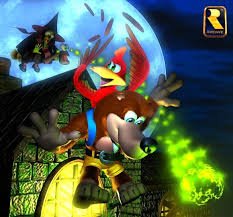
Look how far the Teddy Bears’ Picnic has come; from quirky children’s song to becoming the cornerstone of a multi-part bombastic orchestral suite for the mighty final boss of a game. And there is no question that Gruntilda is indeed a formidable opponent, stationed and ready to fight at the top of her tower like many other villains who are fond of the adrenaline rush produced by heights. This witch is not in need of any fancy transformations or making herself giant, it is just her and her broom toe to toe against the adversaries she delighted in psychologically torturing throughout the game. This is a villain with very good aim, a villain who could even erase your save file if you misbehaved, so caution is advised.
The music reflects hits and spells thrown from side to side and Grant Kirkhope also throws himself completely at it, going over the top and making the track as epic and dramatic as humanly possible on a N64 soundfont; no attempt is made at humour or oddball writing. This is unapologetically serious and powerful through and through, with the might and grandeur of romantic scoring, something that Grant considers characterizes most of his boss battle themes. A he points out, since this was the proper first boss theme people would hear from him, he pretty much throw everything he’s got at it, giving Grunty a sense of danger way beyond her usual playfulness. The game took as seriously its final boss battle as Super Mario 64. Percussionist had never had to work this hard before.
Like other epic sounding tracks from the scores of the composer its origins reside in the work and tone of the previous scrapped material known as Project Dream, a pirate themed fantasy adventure that would have allowed for more majestic soundtrack composing than the more cartoon based mascot platformer that we ended up with. Even so, some of its influences managed to pour through to Banjo-Kazooie, specially after the musical direction pretty much changed mid-game, giving the bear and the bird a very particular zany style. A bulk of the ‘Final Battle’ cue is directly taken from a boss theme that was already composed for Project Dream; it would seem that, having the track laying around, Grant decided to use its tone and parts of it for Gruntilda, and then what remained was connecting it with Banjo-Kazooie exclusive motifs. In this case, we have of course Gruntilda’s motif; Mad Monster Mansion harmonic progression, a.k.a the track that gave most of the identity to the score; the nautical, heroic part of Rusty Bucket Bay and the main theme of the series. It was just a matter of connecting all these parts and then add some blows back and forth in musical form to wind it all.
The heavy and dramatic brass-based romantic sound in Rareware games first appeared on the soundtrack for the game Donkey Kong Country 2, with composer David Wise feeling the darker tone of the project when compared to the first would benefit from the potent and mighty sounds of Russian composers such as Sergei Prokofiev and Tchaikovsky, specially in matters related to the villainous Kremlings. Since Project Dream continued the pirate theme and originally had David Wise on board alongside Grant Kirkhope perhaps this stylistic choice was carried to it and might have encouraged some thematic overlap with dramatic and powerful moments in the Banjo series.
A few tracks from DIddy Kong’s Quest carry with them part of the DNA of the Kirkhopian dark style, specially those related to the dark atmosphere inhabited by the pirate Kremlings. Recreating this soundtrack for the Game Boy was also the very first assignment of Grant at the company.
These dramatic and awe-inspiring qualities of the Soviets’ music make it a suitable choice for portraying the grandeur and danger associated with either pirates or boss battles. After all, the powerful and often bombastic nature of Russian music like Prokofiev’s works lends itself exceptionally well to build atmosphere and heighten experiences with its inherent theatricality and grandeur, allowed by the implementation of the brand new, expanded spectrum of romantic orchestras and modality centering on minor profiles. Pieces such as Prokofiev’s Dance of the Knights or Musorgsky’s coronation scene from his opera Boris Godunov convey part of the style. Banjo-Kazooie just takes it up a notch with insanely fast tempos which would prove very difficult to play for real life orchestras.
Same for the ultra fast string arpeggios combined with slow, heavy brass and enhancing percussion:
It also doesn’t hurt that with the trumpet being his main instrument Grant Kirkhope certainly knows his way around exciting brass sections.
Musical Analysis
Structure: Section 0 / Section 1 / Section 2 / Section 3 / Section 4 / Section 5 / Section 6 / Section 7 / Section 8 / Section 9 / Section 10 / Section 11
Tempo: 180
Melodic and Harmonic Profiles: C Harmonic minor; C Aeolian/Minor; C Dorian; Eb Harmonic minor; F Aeolian/Minor; Ab Harmonic minor; Bb Aeolian/Minor; Eb Aeolian/Minor; A Ionian/Major; B Ionian/Major; E Aeolian/Minor; F Octatonic; C Altered Dorian; Ab Ionian/Major; F Ionian/Major; D Harmonic minor; D Aeolian/Minor; Db Harmonic minor
The final battle from Banjo-Kazooie is kickstarted with the very last version of the Grunty’s Theme, a tune which has accompanied us throughout the game in multiple arrangements. This time it is sounding weightier and tenser; It is the only rearrangement that incorporates the cascading on top of each other motif pre-intro of the standard Lair theme (the other rearrangements begin from the accompaniment establishing intro that loops). This is the Gruntilda’s Lair section, played fast and with string arpeggio accompaniment that betray the metal influences of Grant Kirkhope, also an accomplished guitar player himself, due to the chords being sounded closer to a guitar technique known as sweep picking than something a violinist could achieve easily. On a guitar the technique is realized by playing single notes on consecutive strings with a ‘sweeping’ motion of the pick, using the fretting hand to produce arpeggiated chords that are fast and fluid in sound. It sounds epic, appropriate for a fight on top of a castle or a ship traversing in the middle of a storm; it is a two-octave sweep that plays most of the chords in root position—the Bb as a transition chord and G are the only ones inverted. It also includes the more majestic coda Gsus4 to G which is absent in the original versions. This is Paganini levels of violin playing and contributes to the chaos of th moment.
Instead of the accompaniment establishing intro of the Gruntilda’s Lair theme, here we get a snippet of the Mad Monster Mansion harmony as heard on the prologue when Grunty shows up to kidnap Tooty; it is a small and quick foreshadowing of the later full blown Mad Monster Mansion section, just a quick tease of the i to bVi harmony. The low end is played in monolithic fifths as it is standard to ground the harmony.
After passing the Gruntilda melody through three different instruments that we are used to from the cartoon orchestra, next in line is the Rusty Bucket Bay section, based on the C section of that theme due to its use of the Andalusian progression and Shantey like Dorian profile produced by the F chord, which give a sense of high stakes and heroic end of times. The percussion gets heavier and more unrelenting. In contrast with the original Rusty Bucket Bay melody, this has a coda more appropriate for the situation, the piece reiterating the Gsus4 to G cadence which is more majestic than just going to the G point blank; this cadence is used throughout the cue even for sections whose original source did not include that suspended version of G.
Then we get the payoff of the foreshadowing of both the prologue and the intro of the piece by letting the full progression of Mad Monster Mansion play out, the brass section getting progressively higher by stacking octaves on top of each other for each iteration of the progression which is repeated three complete times before allowing itself to go to the coda.
Banjo and Kazooie are in a predicament so it is no wonder that their main theme is featured distorted and frantic, in a minor key due to the bleakness of the situation. The C harmony is changed to a C minor and the G of the banjo melody is flattened, the harmony diabolically going from Cm to Ab7. This is the moment when the piece starts to toy with the idea of opposite hits, as if each fighter is allowed to throw a punch back and forth. First the banjo sound, then an immediate interjection of Grunty, represented by the rapid reiteration of the Mad Monster progression, the key changing to match the higher stakes and create the sense of exponential nervousness; it is a leap of one and a half step, first from Cm to Ebm, then from Ebm to Fm when it is the turn of Banjo and Kazooie to hit back—or more likely, their small opportunity to run away from Gruntilda—since this call and response might have been inspired by the Chase cue from Project Dream, which also contrasted two themes, one for the good guys and one for the bad guys, played against each other. Lastly we get from Fm to Abm before transitioning into the calm before the storm section.
This new section is the one entirely taken from the ‘Boss’ cue found in Project Dream. It is a small breath of fresh air after the bombast and frenetic tension we have been subjugated to. Because if you want an impact sometimes first going quiet is the most effective strategy, allowing for a crescendo towards the final clash of powers. The octaves are played by the low strings implying the descending harmony: C – Bbm – Ab -F#, then the same but based around Ebm. It reaches the climax as if Gruntilda was just charging a magic spell and just threw it at you, the tempo matches the speed of some of her in-game attacks, working specially well for the flying segment of this multi part boss fight. During this section, the idea of left to right hits becomes more prevalent, the orchestra accentuating each hit with percussion. The harmony is based around the I to bVI chord movement, which is made with economical voice leading. It also changes keys, first based around the pair A – F and then a whole step up, B – G. Chaos and persecution ensues.
Things are not looking good for the heroes as the subsequent section devolves into a fast flurry of descending patterns that are a signal for trouble. This is now new material written exclusively for this battle. The marimba fulfilling the role of a player trying desperately to run away and the brass personifying the witch throwing spells that hit at certain intervals. The descending scales are based around E minor profiles, then an ascending major chord (Bb) thrown at the end for those small moments of courage. After that we get the most dissonant crescendo, as if Gruntilda’s powers are getting more and more overwhelming. Diminished chords that progressively get higher are sustained alongside dissonant fast descending scales played by the strings. The scales and percussion begin by emphasizing each measure and then double this emphasis as the anticipation reaches a climax. The progression could be F dim – Ab dim – B dim or could be though of as just a long unnerving Fdim7.
After the bear and the bird survive that attack there is another deflating section full of malice and danger in the air. This evilness is transmitted through a modified version of the minor scale (one with a flat third and sharp fourth on the first tetrachord) on the head with a minor tetrachord on the tail; it allows for the use of Cm alongside D. Adding the notes of the clarinet, which has the more melodic role alongside the low strings during this mostly harmony based part, the progression would take the form of something like
Cm – D – Eb6 – D7
Cm -D – Cm – D
A similar progression and idea to the Song of Storms from the Zelda series.
The player is back to the fold and another series of back and forth signaled by the changing of chords, frenetic key changes and percussion follows. The Banjo-Kazooie tritone is in full form here due to the rapid change first between Ab to D and then F to B. After the flute recharges the energy, during the very last clash, Gruntilda, the bear and the bird are now exhausted, so the blows become slower and heavier, Still, the idea of hits from side to side remains.This time we only have Cm against Ab, meaning the piece is ready to go back to the beginning of the loop in C minor; the Ab now being major points to a ray of hope for the player that this battle might end. But no, neither Grant nor Gruntilda can let it go, adding an additional exciting section reprising the Gruntilda’s Lair part, this time transposed a whole step up to D minor before abruptly returning to C minor by way of a coda that moves the last dominant chord stepwise in chromatic steps towards the G.
The final Battle both musically and conceptually is full of pyrotechnics and unrelenting driving force, elements that generate excitement and a sense of forward momentum, Grant Kirkhope is not shying away from putting his frenetic cinematic scoring prowess to the test and giving a track unlike any other in the soundtrack yet still retaining its motifs and instrumentation. This was a clash between two forces. However, it is the intervention of a third mythical power the one who will decide the outcome.
As a fun fact and showing he means business with the metal influences of this track, Grant participated in a rearrangement of this final battle cue shredding in an electric guitar, which was a present from Eddie Van Halen himself, and filmed at his house for the Youtube channel FamilyJules:

Help to keep the rites going around here by supporting the shrine:

Media Files, requests and support for more interactive content

Thou shall donate since this is a cult and you are now a sheep

Help staying awake analyzing game tracks and writing posts or else everything will end up being written by A.I
- Inside The Score – The Legend of Zeda: A Link to the Past – End Credits / Staff Roll
 The land rests As the last few minutes of this extensive journey that has now come to an end fly by, the nostalgia and reflective mood kicks in. Because such a massive enterprise as a Zelda game or a Lord of the Rings movie require multiple endings to convey everything… Read More »Inside The Score – The Legend of Zeda: A Link to the Past – End Credits / Staff Roll
 - Inside The Score – The Legend of Zelda: A Link to the Past – Ending / Epilogue ~ Beautiful HyruleFinal of the fantasy The Triforce has been touched. A wish has been granted. For the occasion, the newly undeceased king of Hyrule has commissioned a march in honor of the legendary hero to the Hylian Sousa, who might as well be composer Nobuo Uematsu since this piece is very… Read More »Inside The Score – The Legend of Zelda: A Link to the Past – Ending / Epilogue ~ Beautiful Hyrule
- Inside The Score – The Legend of Zelda: A Link to the Past – Triforce Chamber / Power of the GodsTake your boots off your feet And thus the Triforce spoke to men. And it became present in history. And you better treasure and contemplate this moment seldom witnessed in the course of the series. The elusive opportunity to interact and touch the most important artifact. You are now in… Read More »Inside The Score – The Legend of Zelda: A Link to the Past – Triforce Chamber / Power of the Gods
- Inside The Score – The Legend of Zelda: A Link to the Past – Ganon Battle / Prince of DarknessProgressive evil En Garde! And you better be prepared since you are about to duel the iconic enemy of the series at perhaps his canonically most powerful incarnation. Right after having touched the sacred Triforce which allowed him to conquer all of the Golden Land and whose evil and darkness… Read More »Inside The Score – The Legend of Zelda: A Link to the Past – Ganon Battle / Prince of Darkness
- Inside The Score – The Legend of Zelda: A Link to the Past – Boss Battle / Anger of the GuardiansQuick mayhem Ah, the simpler times when boss battles where not a multi epic orchestral suite but just an ostinato more basic that even what became the music for standard battle encounters out there. We are a long way from each boss having his own personalized track. And this early… Read More »Inside The Score – The Legend of Zelda: A Link to the Past – Boss Battle / Anger of the Guardians
- Inside The Score – The Legend of Zelda: A Link to the Past – Dark World Dungeon / Dungeon of ShadowsMemento mori We are getting closer to Ganondorf (or at least the wizard Agahnim who ultimately fulfills the same human side of evil role in this game) and that means getting closer to the profiles and motifs of his own theme song (which naturally was the theme of Agahnim at… Read More »Inside The Score – The Legend of Zelda: A Link to the Past – Dark World Dungeon / Dungeon of Shadows