Hasta la vista, bruja
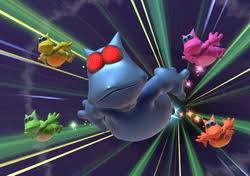
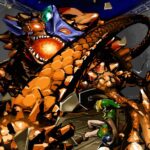
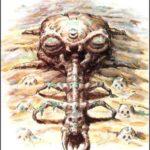
The mighty Jinjonator of legend, an Eldritch abomination from ancient tales passed down all across Jinjo Village. Previously though as just a myth. Amidst the battle against the witch the bear and the bird become one of the few sentient creatures to lay eyes upon it. It is this deity of the jinjos the one who literally charges into Gruntilda and knocks her off from the top of her tower; because just like villains are fond of rooftop battles, they usually find their demise by falling into the void. Banjo-Kazooie is actually one of the few that depicts the impact on the ground, with a rock falling on top of the witch just like it did for the evil queen in the Snow White animated film. Notwithstanding, it appears that Grunty has achieved immortality at some point and trapping her under a heavy stone was the only way to stop her.
Unsurprisingly, this godly jinjo design as its name implies is inspired by the film Terminator, about an unstoppable killing machine set to accomplish one and only one goal. The character is also parodied in Banjo-Tooie and Conker’s Bad Fur Day, so someone at Rare is really fond of the series. The jinjonator receives the energy from all the jinjos that suffered at the hands of Gruntilda and proceeds to give a few deserved blows to the witch, throwing itself into the enemy accompanied with sound effects straight from sci-fi UFOs and WWI diving planes. Each blow musicalized with dramatic stings.
Musical Analysis
Structure: Section 1 / Section 2 / Section 3 / Section 4 / Section 5 / Section 6
Tempo: 100 [95] (Section 1, 2, 4); Accelerando 95-195 (Section 3); 170 (Section 5); 105 (Secion 6)
Melodic and Harmonic Profiles: C Whole tone; A Whole tone; C Altered Dorian; C Chromatic; C Lydian
The cues pretty much follow the kinetic action we see on screen, the orchestra punctuating each hit with stirring orchestral fortissimos. Grant Kirkhope feels it is overtly dramatic but would not have it any other way. The Jinjonator presence and apparition is conveyed with the uncanny augmented triads, perfect for ambiguous characters with incomprehensible powers or enigmatic motivations; does it really want to help Banjo and Kazooie, or does it just want to be free to seek revenge? Doesn’t matter, its inscrutable and ancient power is still needed. The augmented chords are in a tonal limbo, not feeling completely scary, nor sad, nor triumphant, just powerful and worthy of fearful respect; we are dealing with powers unknown and beyond our control. Move any single note from an augmented triad a semitone up, you get a minor chord, move it a semitone down, you get a major chord. They are right in the middle between the two emotions. There are also only so many augmented chords you can form with the twelve pitches available, many of them in fact are constructed with the exact same notes, just in different inversions (C+, E+ and Ab+ are just differentiated by which note is the root position). They are the harmonic partner sensation to what the whole tone scale is in melodic form, what the whole tone scale is to melodic profiles, the augmented chords are to whole tone profiles; an unending sensation of never finding resolution since the stabilizing fifths are replaced by augmented ones, which are themselves a major third apart from the third of the chord, feeling as if the notes are just jumping in major thirds across the board without really deciding which major chord they want to bring into being (C goes to E pretending to be a C major chord, but then the E goes to Ab, which are the two main notes of E major, but then Ab goes to C…and so on). In fact the JInjonator appearance uses all the notes of the chromatic scale just by limiting itself to using augmented chords, Traveling from C aug to B aug:
C+ – Ab+- D+ – Bb+
A+ – F+ – G+ – B+
Each pair of chords uses the same notes, just in different inversions.
The appearance of the JInjonator statue has a slightly faster tempo than the same cue when he is released from its gargoylic prison. Just a tiny score modification of 5 BPM to get the tune to fit with each visual scene.
When the Jinonator begins to absorb the energy, dreams and wishes of his suffering people are witnessed. The cue follows the action by using ascending chords in line with the level of power and awe. The progression is close to the calm section from the ‘Final Battle’ cue. Cm – D – Eb – F – Gb. From C to its tritone chord in major form. Ambiguity is still part of the situation. The tunes retain the instruments and bombastic romantic style from the Final Battle track, providing continuity and maintaining the mood of the different happenings.
A dizzying whirlwind of chromatic notes is employed to follow the movements of the Jinjonator in circles through the air, which also becomes faster as it takes momentum. Then the sudden blow pierces with dramatic stings, only leaving the suspense of ultra low strings between each hit, Which are composed of orchestral hits made with the major chord starting on Gb—also the ending chord of the anticipation power charge—but retaining the low pedal note C and also adding it as a tritone note to the major chord in order to keep the suspense alive and uncanny sonority, not allowing these major chords to feel entirely triumphant. Each subsequent hit raises each chord by a semitone and takes progressively less time between each hit, paralleling the action on screen; it feels as if each blow hits harder. The very last one, the one that finally breaks Grunty’s spirit and defeats her, takes a longer time to strike and is the most dramatic of the bunch, sustained the longest and hitting the hardest. The low strings accompany the aftermath of the conflict.
As for when Gruntilda falls down, the music continues its kinetic aspirations by using the standard cartoon device of descending scales to signify the progressively lower level the character falling is currently at, similar to a Looney Tunes short. The scales are commanded to fit the length of the scene and how long the character falls. The impact of the rock breaking the unending descending scale is punctuated by the same very last of the hit chords, Eb. The timpani then transitions us into the coda, a reprise of the prologue’s mysterious theme that serves as a neat bookend to the entire fable, connecting the beginning with the end as a full package.
Tooty must surely be pleased this time. The bear and the bird are in need of a well deserved generic cartoon vacation now. Beach episode is upon us.
Help to keep the rites going around here by supporting the shrine:

Media Files, requests and support for more interactive content

Thou shall donate since this is a cult and you are now a sheep

Help staying awake analyzing game tracks and writing posts or else everything will end up being written by A.I
- Inside The Score – The Legend of Zeda: A Link to the Past – End Credits / Staff Roll
 The land rests As the last few minutes of this extensive journey that has now come to an end fly by, the nostalgia and reflective mood kicks in. Because such a massive enterprise as a Zelda game or a Lord of the Rings movie require multiple endings to convey everything… Read More »Inside The Score – The Legend of Zeda: A Link to the Past – End Credits / Staff Roll
 - Inside The Score – The Legend of Zelda: A Link to the Past – Ending / Epilogue ~ Beautiful HyruleFinal of the fantasy The Triforce has been touched. A wish has been granted. For the occasion, the newly undeceased king of Hyrule has commissioned a march in honor of the legendary hero to the Hylian Sousa, who might as well be composer Nobuo Uematsu since this piece is very… Read More »Inside The Score – The Legend of Zelda: A Link to the Past – Ending / Epilogue ~ Beautiful Hyrule
- Inside The Score – The Legend of Zelda: A Link to the Past – Triforce Chamber / Power of the GodsTake your boots off your feet And thus the Triforce spoke to men. And it became present in history. And you better treasure and contemplate this moment seldom witnessed in the course of the series. The elusive opportunity to interact and touch the most important artifact. You are now in… Read More »Inside The Score – The Legend of Zelda: A Link to the Past – Triforce Chamber / Power of the Gods
- Inside The Score – The Legend of Zelda: A Link to the Past – Ganon Battle / Prince of DarknessProgressive evil En Garde! And you better be prepared since you are about to duel the iconic enemy of the series at perhaps his canonically most powerful incarnation. Right after having touched the sacred Triforce which allowed him to conquer all of the Golden Land and whose evil and darkness… Read More »Inside The Score – The Legend of Zelda: A Link to the Past – Ganon Battle / Prince of Darkness
- Inside The Score – The Legend of Zelda: A Link to the Past – Boss Battle / Anger of the GuardiansQuick mayhem Ah, the simpler times when boss battles where not a multi epic orchestral suite but just an ostinato more basic that even what became the music for standard battle encounters out there. We are a long way from each boss having his own personalized track. And this early… Read More »Inside The Score – The Legend of Zelda: A Link to the Past – Boss Battle / Anger of the Guardians
- Inside The Score – The Legend of Zelda: A Link to the Past – Dark World Dungeon / Dungeon of ShadowsMemento mori We are getting closer to Ganondorf (or at least the wizard Agahnim who ultimately fulfills the same human side of evil role in this game) and that means getting closer to the profiles and motifs of his own theme song (which naturally was the theme of Agahnim at… Read More »Inside The Score – The Legend of Zelda: A Link to the Past – Dark World Dungeon / Dungeon of Shadows