A saloon of memories
The foundational myths of the Mario series ought to be explored next. Throughout these next few days we will take a look at some tracks from the three games that cemented the worldbuilding of the series as the wacky Mushroom Kingdom comes to life on the 16-bit SNES. More colorful and with new sounds, we will try to compare and contrast the original NES tracks with their Super Nintendo counterparts to see how composer Soyo Oka, entrusted with the project under the supervision of original composer Koji Kondo, arranges the classic set of pieces. Coming right after her work on Super Mario Kart, Soyo also composed some original tracks to complement the worlds.
The game is still the standard bar for remakes that go beyond the call of duty by providing not only four but sometimes five absolute classic games for the prize of one; a bargain indeed of those seldom coming from Nintendo. The original games also received a considerable makeover in both visuals and sound for the 16-bit era, something we will never see again due to the difficulty of updating an entire series and the diminishing returns of new graphics. That being said, they pretty much used Super Mario World as a template for them all to just follow. Now, going from 8-bit chiptunes to the new era not only requires simple rearrangements but to actually select for the first time the proper orchestration for these classic themes, meaning we will get closer to their intended genre which was difficult to convey with the limited timber of electronic waves.
This also marks The Lost Levels‘ first release outside Japan; it was not released on the NES in Western territories because Nintendo deemed it too difficult at the time (they were right). The result is the convoluted story of Super Mario Bros. 2.
Music Analysis
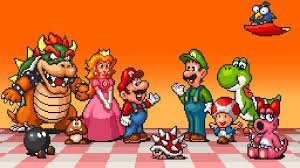
This one is the literal opening of the curtain where the essence of Mario had to be captured, a catchy yet nostalgic tune that reminds players of the adventures they probably had. Curiously, with the honky tonk piano (an upright piano which has some detuned strings due to use and poor maintenance) and the playing style, the track would feel more at home in Super Mario Bros. 2, the Mario game that was not originally a Mario game and whose convoluted story we should explore someday. In any case, even though that game had an Arabic theme, the music was very ragtime and fairground based, as if it could be played by a calliope or an organ. It gave that game a vaudeville tone of classic early animation. The reason is because the original game, Doki Doki Panic—Doki Doki always means panic—was a promotional effort for an actual fair in Japan. Many classic Mario elements pretty much found their way into the series via a marketing gimmick, like the Shy Guys with their fair masks. On the other hand, Super Mario World also has some saloon music with honky tonk piano. Here the idea is also to convey a sense of a group of old friends reunited at an old time bar, with the sound effects suggesting conversation and a party at a saloon.
So it fits the actual Title Screen of the game since it looks like our characters are at a party in a saloon where someone is at the poorly tended piano. Plus Birdo is here and that Aladdin bird instead of better known characters, making the connection directly to the second entry.
The piece still manages to sound a little cute with a classic Ionian/Major progression, 3/4 time signature and mellow sounds, most which come from Super Mario World. Our characters were probably actually dancing to the tune before the lights went on.
Composer Soyo Oka would leave the company in the mid nineties to pursue freelance projects.
We will continue to archive some music here. This one is a deconstruction with the actual samples that were originally used. If you have any insights or memories about the tracks please share since they help for the full musical analysis. More essays to come. And as an introduction to Mario and its music you can read some of the posts here dealing with composer Koji Kondo influences, the history of Mario as a character and his iconic main theme here: https://videogamemusicshrine.com/super-mario-64/

Help to keep the rites going around here by supporting the shrine:

Media Files, requests and support for more interactive content

Thou shall donate since this is a cult and you are now a sheep

Help staying awake analyzing game tracks and writing posts or else everything will end up being written by A.I
- Inside The Score – The Legend of Zeda: A Link to the Past – End Credits / Staff Roll
 The land rests As the last few minutes of this extensive journey that has now come to an end fly by, the nostalgia and reflective mood kicks in. Because such a massive enterprise as a Zelda game or a Lord of the Rings movie require multiple endings to convey everything… Read More »Inside The Score – The Legend of Zeda: A Link to the Past – End Credits / Staff Roll
 - Inside The Score – The Legend of Zelda: A Link to the Past – Ending / Epilogue ~ Beautiful HyruleFinal of the fantasy The Triforce has been touched. A wish has been granted. For the occasion, the newly undeceased king of Hyrule has commissioned a march in honor of the legendary hero to the Hylian Sousa, who might as well be composer Nobuo Uematsu since this piece is very… Read More »Inside The Score – The Legend of Zelda: A Link to the Past – Ending / Epilogue ~ Beautiful Hyrule
- Inside The Score – The Legend of Zelda: A Link to the Past – Triforce Chamber / Power of the GodsTake your boots off your feet And thus the Triforce spoke to men. And it became present in history. And you better treasure and contemplate this moment seldom witnessed in the course of the series. The elusive opportunity to interact and touch the most important artifact. You are now in… Read More »Inside The Score – The Legend of Zelda: A Link to the Past – Triforce Chamber / Power of the Gods
- Inside The Score – The Legend of Zelda: A Link to the Past – Ganon Battle / Prince of DarknessProgressive evil En Garde! And you better be prepared since you are about to duel the iconic enemy of the series at perhaps his canonically most powerful incarnation. Right after having touched the sacred Triforce which allowed him to conquer all of the Golden Land and whose evil and darkness… Read More »Inside The Score – The Legend of Zelda: A Link to the Past – Ganon Battle / Prince of Darkness
- Inside The Score – The Legend of Zelda: A Link to the Past – Boss Battle / Anger of the GuardiansQuick mayhem Ah, the simpler times when boss battles where not a multi epic orchestral suite but just an ostinato more basic that even what became the music for standard battle encounters out there. We are a long way from each boss having his own personalized track. And this early… Read More »Inside The Score – The Legend of Zelda: A Link to the Past – Boss Battle / Anger of the Guardians
- Inside The Score – The Legend of Zelda: A Link to the Past – Dark World Dungeon / Dungeon of ShadowsMemento mori We are getting closer to Ganondorf (or at least the wizard Agahnim who ultimately fulfills the same human side of evil role in this game) and that means getting closer to the profiles and motifs of his own theme song (which naturally was the theme of Agahnim at… Read More »Inside The Score – The Legend of Zelda: A Link to the Past – Dark World Dungeon / Dungeon of Shadows