Abandoning the traditional Zelda main theme in favor of a collage of dynamic themes encompassing the history of the series
Actually, I arranged songs from all the Zeldas up to now in the score to Hyrule Field. It looks like not many people have recognized them! In fact, there were even people on staff who didn’t notice!
Koji Kondo
Indeed none had….till now…..maybe?
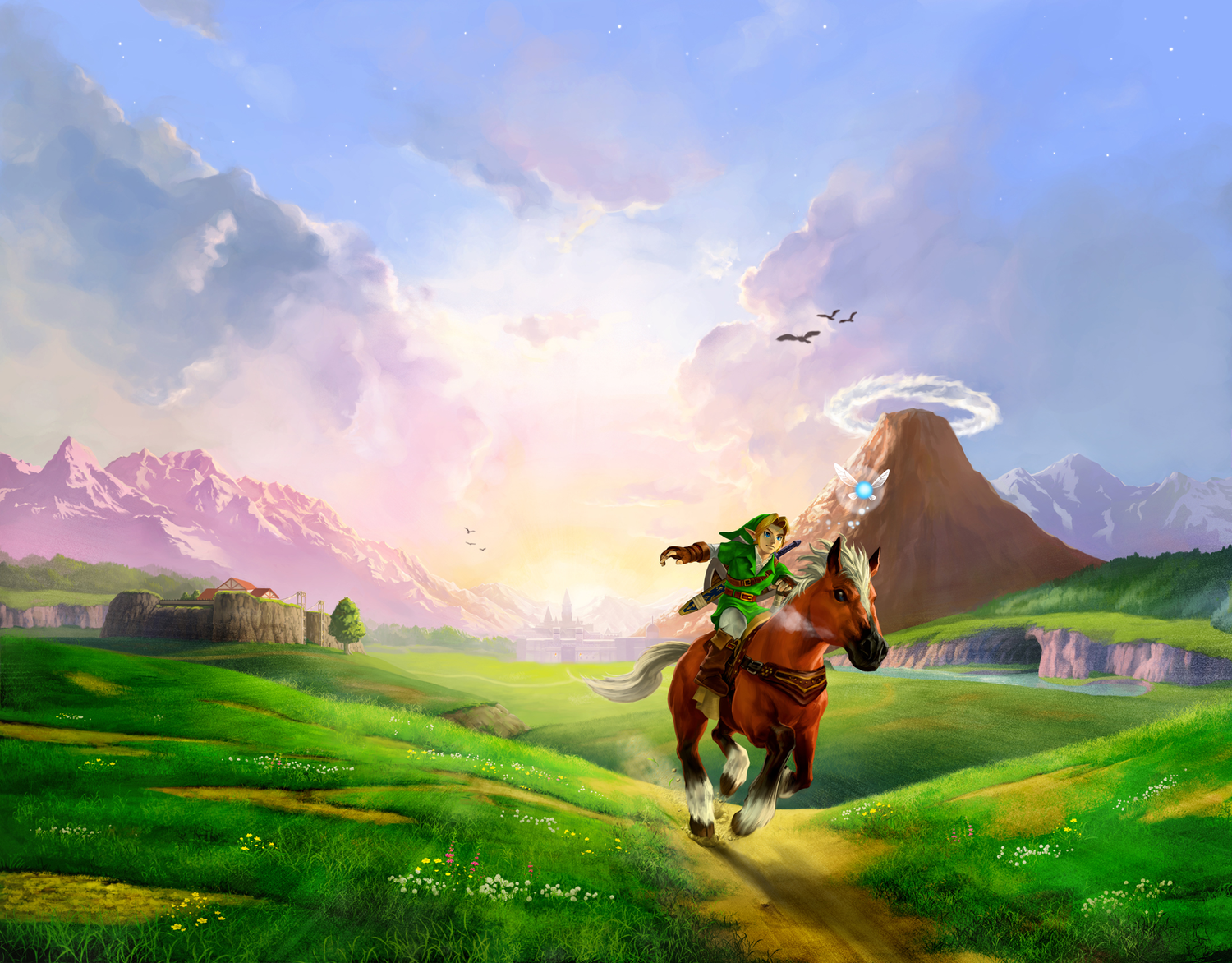
Yes, yes, we all know how we felt the first time when we stepped into the overworld of Ocarina of Time; it was huge, it was liberating and all the usual cliches that have been stated since 1998. In fact, it was specifically designed with horse riding in mind, hence why there were less trees and structures than initially planned. But let’s instead focus on one of the most underrated aspects at the time and even today: the interactive, dynamic score that accompanies the player throughout various regions and magically reacts to the action, allowing the player to conduct his or her own orchestra and avoiding the repetition over and over of a musical cue like was the standard of the time.
The theme for Hyrule Field and other familiar open regions across the kingdom is not actually a theme; that is, it’s not meant to be heard as a song, its full purpose can only be grasped during a gameplay session. It is really a collection of 8-bar snippets of music that the game system plays depending on the action on screen and the state of the avatar Link. This is video game music at its most pure and distilled state, a medium exclusive technique. It was something that was quite ambitious and revolutionary for its time—even future installments in the Zelda series shied away at attempting to do something of this scope.
The overworld is divided in three types of music depending on the action on screen:
- The Adventure Sections
- The Danger Sections
- The Rest Sections
Basically, the adventure sections will play whenever you run around the field, the danger sections when a monster is near and the rest sections when Link stands still. Additionally, the piece has two different intros, depending on how Link receives a transition between night and day (if you spend the night at Hyrule Field, you will hear the morning cue at sunrise, if you just enter Hyrule Field at day from somewhere else then the faster intro plays)
Hyrule Field theme is what most would point as being the most Zeldaesque, or put it another way, the spiritual successor to the iconic main theme of the series, absent for the most part from Ocarina of Time due to the sheer size of the world requiring a longer and different approach—And maybe because using it a third time after reusing it in A Link to the Past would be unprecedented; like what other series has reused an overworld even once? Not even Mario (ok, unless you count Super Mario Bros: The Lost Levels)
So what are the ingredients of the Zeldaesque music? They would be:
- Modal Mixture. Principally between the Ionian/Major mode, the Aeolian Dominant Mode, the Mixolydian mode and the different flavors of Phrygian modes. In short, just throw in a lot of modes, making sure to mix major and minor sonorities. As an example listen to James Horner’s theme song for the film The Mask of Zorro to hear how the Aeolian Dominant scale gives that Spanish Zelda sound
- Deep Purple (the Zelda Andalusian Cadence) A previously discussed, Koji Kondo was inspired by their song April and its use of the Andalusian cadence in the making of the first The Legend of Zelda for the NES; more Spanish flavor. The traditional Andalusian cadence uses the first chord in its minor form, in order to fully transform it into the more adventouresome Zelda version you need to just play that first chord in its major form, a major tonic Andalusian cadence, you could say; its formula is [I – bVII – bVI – V]
- The Swashbuckler Film Genre. Popularized during the 30s in Hollywood, this genre and its main exponent, composer Erich Wolfgang Korngold codified what we think of as Hollywood mainstream adventure music; from John Williams’ Star Wars score to Hans Zimmer’s Pirates of the Caribbean. The most influential score of this genre is the one for the movie The Adventures of Robin Hood (1938). The Zelda main overworld theme takes some of its flavor including its main percussion rhythm from these styles, an intermittent, driving military rhythm.
And if you still doubt the Spanish influence on the Zelda score just remember that Kondo initially planned to use the music of Maurice Ravel’s Bolero (a mostly Spanish dance) for the title theme and opening crawl of the entire series (they could not use it due to copyright). It is possible that the snare rhythm of the piece may be the one that influenced the rhythm of the Zelda theme, or that the Zelda rhythm and Spanish chords pointed Koji Kondo towards this classical piece. As a side note, there is a common misconception going around that the main theme of The Legend of Zelda was written in a single night after the developers discovered that the Bolero piece was not in the public domain. In truth, the piece in question was the Title Theme and to replace it Kondo just had to re-arrange the Overworld music which was already written.
These ingredients together in different amounts are what makes the music of Zelda have that sometimes sinister edge that prevents the music from sounding overtly happy and childish.
That being said the overworld from Ocarina of Time is decidedly more happy and triumphant than the series’ main theme. This is precisely because the adventure and rest sections are meant to contrast with the danger sections which is where most of the dissonance will go. It mostly focuses on the Mixolydian profile for most of the adventure sections, just like the Kokiri Forest cue going back and forth between I to bVII; Link is a child after all and this Hyrule is full of wonder and just the second main location a player might encounter. The further you get from the good people, the further you will get from these profiles. A lot of Nintendo series main themes are fond of using the Mixolydian mode to denote ‘adventure’ or ‘heroism’ and this set of mini songs of Hyrule Field have a strong resemblance to the Pokemon main theme:
As stated above, Kondo himself has said on interviews that the cue was inspired from the previous Zelda games to that point. So we will have to stretch to try and find if there are hidden motifs or pieces from previous Zelda games. So are there really hidden motifs and songs from the Zelda history? They are, and very hidden; or at least many recognizable motifs. So pay attention to try to hear them or maybe discover new ones.
Music Analysis
As can be seen, the entire orchestra is brought up to contribute to the overworld theme, the most heard cues during gameplay.
Structure: Section 0 / Section 1 / Section 2 / Section 3 / Section 4 / Section 5 / Section 6 / Section 7 / Section 8 / Section 9 / Section 10 / Section 11
Time Signature: 4/4
Tempo: 150
Melodic and Harmonic Profiles: G Mixolydian; G Ionian/Major; G Aeolian/Minor; Chromatic (Section 3)
There are several compositional considerations that have to be done with a dynamic/interactive score such as the one used for Hyrule Field. One would be how long each section should be and how it should relate to the others. Each section has 8 bars worth of music. Another consideration is the harmony underlying the piece and how if could maintain cohesiveness even when the sections play in a random way. Koji Kondo makes sure that each section connects in a harmonically pleasant way—ending most sections on either F or D chord, creating satisfying cadences— and maintains a consistent driving beat throughout all cues. Since Link will spend most of his time in the “adventure mode”, the adventure sections are the most numerous, having 11 different possibilities plus the intro.
Section 0 / Intro
As stated previously, when Link enters the Hyrule Field zones during the day, the one beat intro that opens the curtain with chromatic notes plays as opposed to the sunrise intro. The snare provides the rhythmic drive and the pizzicato strings the main harmonic support for the rest of the piece. It is a straightforward introduction to the piece with the exciting arpeggio at the beginning. The cue stays for the most part on a G Chord, with the other notes implying C/G and F/G chords, the G5 chord maintained as a pedal that is seasoned with the flavour of the upper notes. This changes for the last part where it changes key to the parallel Aeolian/Minor profile with descending chords (F and Eb); that is, an echo of the classic Zelda Cadence (the major-Andalusian Cadence [ I – bVII – bVI] ). it is interesting to note that the support for most of the sections rest on the two-note pizzicato strings—playing mostly perfect fifths, so you can see that this interval really is the most naked accompaniment and the minimum structure, as discussed in previous posts.
Section 1
Possibly based around some motifs from The Legend of Zelda: A Link to the Past – Dark World Theme / Section A, The Legend of Zelda – Overworld Theme and Zelda II: The Adventure of Link chords
The happy cousin of the dark overworld theme from A Link to the Past. Pay attention to how that theme’s ending phrases are the same rhythm as in this: the two sixteenth notes plus long note; their melodic contours are also similar. The opening has to be none other than the Zelda main theme interval, the perfect fourth and back to the root. The Mixolydian chord progression that consists in going back and forth between the I and the bVII, G and F here, goes back to Zelda II overworld and title theme. Same goes for the scale that descends from F (F E D C). The most likely inspiration for this part was the score from Zelda II: The Adventure of Link, the often neglected Zelda that was not even composed by Koji Kondo—How much of a black sheep can you be?
Section 2
Based around motifs from The Legend of Zelda Main Theme, the Recorder Cue and Zelda II Overworld rhythm and chord progression.
Listen closely and you will hear an exact excerpt of the recorder melody hidden in the melodic phrases of Section 2, the Mitsuda chromatic lick that connects mystically a minor third interval via their chromatic notes. The melody continues to be based around the Zelda perfect fourth interval and back, possibly with the quarter note rhythm reminiscent of the Zeda II overworld cue. The progression continues to be based around the G to F vamp
Section 3
Based around motifs from The Legend of Zelda Main Theme
Here the piece gets slightly darker as it introduces chords other than the G and F. The main melody interval is now a major sixth. There are reminders of the triumphant scale of the main theme of the series that goes (G A B C D) but omitting the A note. That unmistakable Andalusian descent is finally able to thrive but there is a catch since it keeps going down and the fifth degree chord is now minor for a brief moment. Link is getting away from home and we start to hear more chords outside the key, mixing in more borrowed chords and throwing in the first minor chord. The progression goes:
G – F – G – F
Eb – Dm – Cb – Dsus4 – D.
It ends on the dominant of the G Ionian/Major profile pointing that the piece has transitioned from the G Mixolydian profile to the major one thanks to the emphasis in the F# note. The last four chords are based around chromatic movements in the root note.
Section 4
Based around motifs from Zelda II: The Adventure of Link – Overworld Theme / Section C
The strings seem to mimic the ultra fast arpeggio found in that previous game but in a slower fashion. The piece calms down, as if a little breeze is blowing at you. The cue changes into a more pastoral, typical major chord progression, except for the borrowed III chord from the G harmonic major profile:
G – C – G – C – B – Em – Am – D
This is the section for when birds fly beside you while you are on your horse galloping beside a river.
Section 5
Based around motifs from The Legend of Zelda: Hyrule Fantasy – Overworld Theme (Main Theme) / Section A
Finally, we hear a clear nod to the series’ iconic main theme. A fleeting moment that will be all you get from the original overworld tune. As a reminder of the original theme it is fitting that it has the most nostalgic harmony, with the classic and romantic chord change between the IV to its minor form iv. The full progression would be:
G – F – C – Cm – G – Am – Dsus4 – D
Section 6
Based around motifs from The Legend of Zelda: Hyrule Fantasy – Main Theme – Game Over Theme
Quarter notes and a similar melodic contour make the theme reminiscent of the original Game Over cue. The calm continues and this serves as a B Section of the piece where it goes to the fourth chord and there is now a vamp between C and D. This Section is a close partner of Section 2, just more pensive and focusing on the Ionian/Major profile of G by using extensively the F# note. The Zelda interval comes back, the descending perfect fourth and back is now started on the C as opposed to G. The full progression is now completely Ionian:
C – D/C – C – D/C – Bm – Em – Am – Dsus4 – D
The cadence from Section 4 is repeated, the vi – ii – V
Section 7
Possibly based around motifs from The Legend of Zelda: A Link to the Past – Hyrule Castle Theme / Section A and B
This section is very similar to the previous one, with the piccolo answering the calls with a trill and the harmony remaining the same. The melody repeats the same rhythm four times, the last two iterations each starting a whole step higher. It does not seem to have similarities to other overworld themes, the closest would be the Hyrule Castle theme in the way that both themes start with a descending interval that is then repeated in a higher register and that on the B Section you get that climax coda climbing a melody by whole tones to create tension.
Section 8
Based around motifs from The Legend of Zelda: A Link to the Past – Hyrule Castle Theme / Section D
Same rhythm, same brassness. Dotted quarter note, two sixteenths and two eights. The Mixolydian vamp returns but this time beginning in F.
F/G – G
Section 9
Possibly based around motifs from The Legend of Zelda: Hyrule Fantasy – Main Theme and The Legend of Zelda: A Link to the Past – Death Mountain Theme / Section A
The militaristic feel is augmented and both themes emphasize the brass section of the orchestra. Their rhythm accents are kind of similar, with focus on the two sixteenths and an eight figure. It is the rhythm of the intro from the original overworld theme. The chords are at their most alien, going:
G – Bb – Db – E
The harmony is moving by a minor third each time, accumulating tension. It ends up having as a coda the head of Section 2 that does the Mixolydian vamp, creating a hybrid part. As if the track just stabilized itself after exploring outside of the beaten path, just like Link does in Hyrule. (also because it needs to connect seamlessly with any other section so Kondo did not bother to think of a different ending here)
Section 10
Possibly based around motifs from The Legend of Zelda: A Link to the Past – Being a Bunny Theme / Section A
Staccato rhythms and a similar end to the melodic phrases in the two compositions. There is emphasis in syncopation and, also, there is an special focus on suspended chords. Instrumentation progressively becomes more numerous, with more notes joining in. The Phrygian flavoir begins to appear courtesy of the Ab. Both rhythm and harmony are allowed to be outlandish except at the very ends since they need to be connected with any other section smoothly. Here the harmony becomes:
Ab – Bb – Ab – Bb
Csus4 – Dsus4 – Csus4 – Dsus4
Fsus4 – Gsus4 – Fsus4 – Gsus4 –
G
The part ends as if nothing happened with once again the Mitsuda lick, this time a shorter iteration, making the entire piece cohesive and connecting it with the Title Theme and the original Recorder instrument which is the predecessor to the more versatile Ocarina of Time
Section 11
Intro Reprised— without the horns or the harp arpeggios
As can be seen, Kondo manages to hide the themes by focusing on just small motifs to create a foundation and then add new melodic ideas. Do you hear any other possible themes or motifs referenced here? Please let me know.
Let’s see what about the danger sections.
You want battle music? Just do what every composer does and copy the stylistic signatures of Gustav Holst’s planets suit. ‘Mars, Bringer Of War’ codified the militant, orchestral pounding that is signature of battle music in movies and scores like Star Wars and even Mario music, deployed to great effect by the Star Fox team, who served as guinea pigs for orchestral scores and battle music on the Nintendo 64.
A series of rapid-fire staccato notes followed by more spaced notes that are blasted out, usually by the horns, and dissonant intervals that add to the chaos. The result is a very martial and distinctive tempo.
For the danger cues, played when an enemy is near Link, Kondo mixes variations of the Zelda series main theme motifs with this tradition.
Structure: Section 0 / Section 1 / Section 2 / Section 3 / Section 4
Time Signature: 4/4
Tempo: 150
Melodic and Harmonic Profiles: G Mixolydian; Ational; Chromatic; Whole-Tone; G Phrygian
Section 0
Starts with the Zelda series main theme but distorts it at the end with parallel minor and augmented chords played staccato. Instrument volume is turned up. By starting in the same way to Section 5 from the Hyrule Field adventure sections, the transition between adventure and danger music is smooth.
Section 1
Now we see the percussion section changing its rhythm pattern while continuing the militaristic feel. Use of the perfect fourth interval characteristic of the Zelda main theme and metamorphosing it into the dreaded tritone. It ends with parallel staccato dominant chords. For most of the danger cues the monolithic G5 will stay as the foundation.
Section 2
A different motif also taken from the series’ main theme, Emphasis on brass and introduction of the marimba to the cue in a rhythmically displaced way playing triplets, giving for a brief time the sensation of a 6/4 time signature. This rhythmic displacement is characteristic of battle and boss music in video games. The ending of this section finds the accompaniment getting to a climax by climbing by half steps from G to A.
Section 3
More bastardized versions of the Zelda main theme played mainly by brass with harp and strings playing a dissonant ostinato based around a whole-tone scale. The accompaniment plays the more sinister Phrygian profile by going back and forth between G5 and Ab5. There is a clever displacement of the expected rhythm in the chord changes since right at the beginning of the second bar the chord changes to the Ab, displacing the rhythm and making your brain think that the rhythm is disrupted—you expect the pattern to begin always with the G chord, yet having the Ab right at the beginning of the bar is meant to feel awkward.
Section 4
Alternate version of Section 3 that the system can play when danger sections are active.
Next, we have the rest sections; those beautifully pensive versions that the players hear whenever they stop still and enjoy the scenery.
Time to relax and watch as the sunset dawns upon the kingdom of Hyrule. The tempo slows down, the level is turned down and the woodwinds take center stage while the percussion goes away, leaving the rhythm section to the harp.
These sets of beautiful 8-bar melodies are based on the adventure sections
So grab a copy of Ocarina of Time and enjoy conducting the orchestra by moving, or stopping Link around Hyrule Field and other central regions
Structure: Section 0 / Section 1 / Section 2 / Section 3
Time Signature: 4/4 Tempo: 150 ritardando to 138 (Section 0); 137 (Section 1); 138
Melodic and Harmonic Profiles: G Ionian/Major; G Mixolydian; G Aeolian/Minor
Section 0 / Intro
Pensive version of Section 6 from the adventure sections with a more melancholic coda.
Section 1
Pensive version of Section 2 from the adventure sections replacing the `Mitsuda lick of the recorder with an alternate version that descends a perfect fourth via the diatonic notes. Although it uses the romantic chord progression from Section 5 of the Adventure cues:
G – F – C – Cm – G – Am – Dsus4 – D
Section 2
Pensive version of Section 7 with a little it of Section 6 too from the adventure sections with a different, more emotional coda. First introduction to the score of the pitch bend technique on the high strings.
Section 3
And it ceases it all with the rendition of the Zelda series’ main theme, the pensive version of Section 5 in full from the adventure sections.
We only have left to analyze one little iconic ditty that nonetheless complicates things a bit due to how it had to deal with two remarkable constraints.
Structure: Section 0 / Section 1
Time Signature: 4/4 Tempo: 100; 80 (last chord)
Melodic and Harmonic Profiles: G Mixolydian; G Ionian/Major; G Aeolian/Minor
The sound of morning right here. It perfectly captures the ambience intended by the developers, that dynamic level of fog that the Nintendo 64 maximized at the beginning of a transition between night and day, all coming together to make the world really feel alive.
We finally arrive at the first song based around one of the ocarina melodies we learn throughout the game, the Sun’s Song—also, the most likely for players to miss the connection due to how short it is and how fast it pays compared to its ocarina counterpart. We can track how a motif evolves with these ocarina songs: first it’s the question phrase the player has to input, then the answer that the ocarina automatically plays, and then the full song that will be somewhere in the game for the first six songs.
As has been stated somewhere before, Kondo only had 5 notes to choose for the question motif—to make it easier for players to memorize the songs— Five powerful notes carefully chosen to maximize melodic and harmonic possibilities: D F A B D. In these five notes, we could say, are hidden three or four different profiles to craft different emotions from the melodies (mostly D Dorian, D Aeolian/Minor, F Lydian, D Ionian/Major and the pentatonic Yo Scale).
That being said, it appears that the Sun’s Song is an anomaly within the ocarina melodies, and the only song that seemed to be affected by the limitations imposed on Kondo. The question motif is composed of the three notes: A F and upper D. We can disregard for now the F note since it is just an ornamental note, a grace note. We start to see what Kondo was going for: the perfect fourth characteristic of the Zelda series’ main theme. The answer melody confirms this, as it does the same answer found in the Zelda series’ main theme—a run through five Ionian/Major scale notes: C D E F G— in essence, the idea was to recall the opening of the Zelda series’ theme and arrive at the G note which is the tonic of Hyrule Field theme.
But the problem is that the ocarina does not have the note G as part of its five note selection. So, in order to connect the Sun’s Song to the Hyrule Field theme, the composition had to jump abruptly from an intended D Ionian/Major profile to a C Ionian/Major (which is parallel to the G Mixolydian profile). This gives the complete ocarina melody a weird, fragmented and unique feel that maybe was for the best.
Even some Youtube versions of this theme get the opening notes wrong:
It is opting for a major sound instead of minor for the opening notes. In short, in a perfect world where the ocarina melody could exist completely isolated and did not need to limit itself to that particular set of notes, the Sun’s Song would sound like this: A-F#-Upper D and then the rising answer would be D E F# G A, completing the opening of the Zelda series’ theme. But then, you would not find such a happy melody inside a tomb, would you?
The Sun’s Song by itself sounds so alien because in its short duration it packs two different profiles—one that initially appears minor transitioning into one major, which may not even be related to the first one! (we would need more notes to confirm if the question motif is in D Aeolian/Minor or D Dorian) The result is that it is the least singable of all the ocarina melodies, but it makes a lot of sense narratively in-universe since it was composed as a research to make the sun rise, and the melody does exactly that, rising through the scale; invoking the sun (or the moon)
Furthermore, the fact that the ocarina plays the song so slowly does not help to smooth the transition between scales. The piccolo, on the other hand, plays the opening to the sunrise so fast that the F note is registered as the intended grace note. Having established the G tonality, it’s smooth sailing from there. The sunrise theme starts with descending chords and the G as a pedal point that suspend you in the air, the piccolo gets to fulfill its purpose as an imitation of birds singing in the morning and the main melody teases the series’ main theme, ending with a perfect cadence that sets the stage for the blast of music that is to come and a new day. The harmony can be interpreted as the descending
G – Fº – Em – Ebaug – Dsus4 – D
Ending on the dominant just for the triumphant arrival of the G Mixolydian progression.
Hyrule Field is a complex mix of pieces that keeps giving surprises, even today; more than twenty years after the original release of the game. It can be considered the most pure form of video game music and shows that the game really was ahead of its time.

Help to keep the rites going around here by supporting the shrine:

Media Files, requests and support for more interactive content

Thou shall donate since this is a cult and you are now a sheep

Help staying awake analyzing game tracks and writing posts or else everything will end up being written by A.I
- Inside The Score – The Legend of Zeda: A Link to the Past – End Credits / Staff Roll
 The land rests As the last few minutes of this extensive journey that has now come to an end fly by, the nostalgia and reflective mood kicks in. Because such a massive enterprise as a Zelda game or a Lord of the Rings movie require multiple endings to convey everything that the adventure represented. You… Read More »Inside The Score – The Legend of Zeda: A Link to the Past – End Credits / Staff Roll
 - Inside The Score – The Legend of Zelda: A Link to the Past – Ending / Epilogue ~ Beautiful HyruleFinal of the fantasy The Triforce has been touched. A wish has been granted. For the occasion, the newly undeceased king of Hyrule has commissioned a march in honor of the legendary hero to the Hylian Sousa, who might as well be composer Nobuo Uematsu since this piece is very similar to the main theme… Read More »Inside The Score – The Legend of Zelda: A Link to the Past – Ending / Epilogue ~ Beautiful Hyrule
- Inside The Score – The Legend of Zelda: A Link to the Past – Triforce Chamber / Power of the GodsTake your boots off your feet And thus the Triforce spoke to men. And it became present in history. And you better treasure and contemplate this moment seldom witnessed in the course of the series. The elusive opportunity to interact and touch the most important artifact. You are now in the presence of something truly… Read More »Inside The Score – The Legend of Zelda: A Link to the Past – Triforce Chamber / Power of the Gods
- Inside The Score – The Legend of Zelda: A Link to the Past – Ganon Battle / Prince of DarknessProgressive evil En Garde! And you better be prepared since you are about to duel the iconic enemy of the series at perhaps his canonically most powerful incarnation. Right after having touched the sacred Triforce which allowed him to conquer all of the Golden Land and whose evil and darkness are pouring out into Hyrule.… Read More »Inside The Score – The Legend of Zelda: A Link to the Past – Ganon Battle / Prince of Darkness
- Inside The Score – The Legend of Zelda: A Link to the Past – Boss Battle / Anger of the GuardiansQuick mayhem Ah, the simpler times when boss battles where not a multi epic orchestral suite but just an ostinato more basic that even what became the music for standard battle encounters out there. We are a long way from each boss having his own personalized track. And this early boss battle cue is one… Read More »Inside The Score – The Legend of Zelda: A Link to the Past – Boss Battle / Anger of the Guardians
- Inside The Score – The Legend of Zelda: A Link to the Past – Dark World Dungeon / Dungeon of ShadowsMemento mori We are getting closer to Ganondorf (or at least the wizard Agahnim who ultimately fulfills the same human side of evil role in this game) and that means getting closer to the profiles and motifs of his own theme song (which naturally was the theme of Agahnim at this point) on this dungeon… Read More »Inside The Score – The Legend of Zelda: A Link to the Past – Dark World Dungeon / Dungeon of Shadows