Medieval fiesta
Hah!
How thoughtful for a game about time travel of having the foresight to throw a fair honoring its original player base.
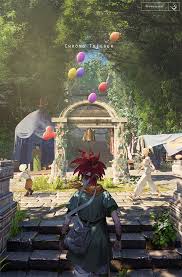
It is a fair that sets the mood for the adventure to come, the calm before the storm that just introduces you to the vibe of characters and the environment they find themselves in. Because even though we will end up getting to a future full of robots and a past brimming with dinosaurs and the like, the main vibe and design spirit is fundamentally that of a medieval fantasy full of swords and magic. And nothing brings to mind this spirit quite like a castle town full of life, merchants and music where an unique renaissance festival takes place; the setting with a bohemian lifestyle that will always attract rich princesses wanting to experience what is it like to blend in with the commoners by going incognito. This is exactly how Crono ends up bumping into the kingdom of Guardia royalty and kickstars the adventure.
The music, which is presumably diegetic, with a group of people coming together bringing the instruments from their homes to sing and dance around the plaza, and chanting hah! in sync with the clank of their huge beer bottles, instantly puts yourself in the medieval mood by using a mixture of folk instruments and older late middle ages/renaissance staples sounds such as the clavichord.
Unexpectedly it also relies heavily on modal mixture, with the church modes that immediately sound like an ancient British folk tune such as the Mixolydian profile that helps to color what otherwise would be a standard D major key piece.
The cue begins right away combining the Mixolydian and Ionian profiles which will be the basis of the entire composition; this means that since they differ in only one note we will see both the C and C♯ featured. So we will find here either A major or A minor chords that are born from this. The bass line is playing the usual perfect fifth intervals colored with the major second interval characteristic of the Mitsuda approach. The first chord progression would be D – C – G – A, the first two chords establishing the Mixolydian profile and the A from the Ionian/Major team.
Then onto a post-intro where all the instruments and main backing track forms sustaining the D harmony and the main vamp which will sound modal and thus medieval to any player, the D to Am (the G note in the harmony makes it an Am7). The tambourine and ostinatos had already established a ternary meter but there is some kind of interesting polyrhythm going on with the congas since they have a pattern in 4/4:
So there are many ways that the piece can be counted such as a fast 3/4, slow 6/8 and even normal 4/4. Since everyone is dancing here the safe bet is in compund time signature.
The bass now plays only perfect fifths and the melody prominently features the Mixolydian note C natural; also known as the note that does the heavy lifting in making this a true medieval fair. Still, the cue uses the rather modern sound of the accordion which gives it a more original sound; it could be imitating the bagpipes of some Scottish jig though. Alongside it another musician with a flute joins in repeating the melody.
The next section cements that this is meant to be diegetic by adding the handclaps of the same crowd that shouts in replacement of the percussion section. This calmer section features melodic and harmonic interplay of the accordion and clavichord. The instruments, even the bass, find some spaces to throw in some licks. The vamp is now from G to A major which means the composition is now flirting more with the D Ionian/Major profile. Yet the coda to the section brings back the Mixolydian feeling with its proud Cmaj7 chord. The full harmony would be:
G – A – G – A
G – D – A
G – A – G – A
G – D – Cmaj7 – Aadd9
Next section gets even more sparse—there is not even a hah! that marks the transition—with just the flute and clavs filling all of the space with even some little counterpoint and an ascending chromatic progression. The ascending chromatic notes in the bass voice of the keyboard produce new chords via inversions introducing the spicy E major that is outside the D key since it has the tritone note Ab. So the full harmony would be D – G – E – A. It sounds less cutesy than the standard I – IV – ii – V progression used in nursery rhymes and pop standards. The melodic phrase repeats exactly the same and for the last part all the instruments return minus the daf percussion which is the maraca sounding frame drum you can play by rubbing your palm against it. This last section is a callback to the intro, beginning its melody in the same way and with the same instrument over the similar bass accompaniment that just sustains the D chord until it arrives at the same C – G – A cadence to join the loop points smoothly. The flute becomes savage during this part playing some jungle patterns. The accordion also gets in one last flourish before the cue loops.
And so the player, Crono and Princess Nadia get acquainted with themselves and the world that will be at stake. We are about to experience why this festival exists in the first place.

Help to keep the rites going around here by supporting the shrine:

Media Files, requests and support for more interactive content

Thou shall donate since this is a cult and you are now a sheep

Help staying awake analyzing game tracks and writing posts or else everything will end up being written by A.I
- Inside The Score – The Legend of Zeda: A Link to the Past – End Credits / Staff Roll
 The land rests As the last few minutes of this extensive journey that has now come to an end fly by, the nostalgia and reflective mood kicks in. Because such a massive enterprise as a Zelda game or a Lord of the Rings movie require multiple endings to convey everything… Read More »Inside The Score – The Legend of Zeda: A Link to the Past – End Credits / Staff Roll
 - Inside The Score – The Legend of Zelda: A Link to the Past – Ending / Epilogue ~ Beautiful HyruleFinal of the fantasy The Triforce has been touched. A wish has been granted. For the occasion, the newly undeceased king of Hyrule has commissioned a march in honor of the legendary hero to the Hylian Sousa, who might as well be composer Nobuo Uematsu since this piece is very… Read More »Inside The Score – The Legend of Zelda: A Link to the Past – Ending / Epilogue ~ Beautiful Hyrule
- Inside The Score – The Legend of Zelda: A Link to the Past – Triforce Chamber / Power of the GodsTake your boots off your feet And thus the Triforce spoke to men. And it became present in history. And you better treasure and contemplate this moment seldom witnessed in the course of the series. The elusive opportunity to interact and touch the most important artifact. You are now in… Read More »Inside The Score – The Legend of Zelda: A Link to the Past – Triforce Chamber / Power of the Gods
- Inside The Score – The Legend of Zelda: A Link to the Past – Ganon Battle / Prince of DarknessProgressive evil En Garde! And you better be prepared since you are about to duel the iconic enemy of the series at perhaps his canonically most powerful incarnation. Right after having touched the sacred Triforce which allowed him to conquer all of the Golden Land and whose evil and darkness… Read More »Inside The Score – The Legend of Zelda: A Link to the Past – Ganon Battle / Prince of Darkness
- Inside The Score – The Legend of Zelda: A Link to the Past – Boss Battle / Anger of the GuardiansQuick mayhem Ah, the simpler times when boss battles where not a multi epic orchestral suite but just an ostinato more basic that even what became the music for standard battle encounters out there. We are a long way from each boss having his own personalized track. And this early… Read More »Inside The Score – The Legend of Zelda: A Link to the Past – Boss Battle / Anger of the Guardians
- Inside The Score – The Legend of Zelda: A Link to the Past – Dark World Dungeon / Dungeon of ShadowsMemento mori We are getting closer to Ganondorf (or at least the wizard Agahnim who ultimately fulfills the same human side of evil role in this game) and that means getting closer to the profiles and motifs of his own theme song (which naturally was the theme of Agahnim at… Read More »Inside The Score – The Legend of Zelda: A Link to the Past – Dark World Dungeon / Dungeon of Shadows