Huge blade runner
“Beyond the edge of reality, lies a story of ultimate conquest. A story of war, and friendship. A story of a love that could never be, and a hatred that always was. And now, the most anticipated epic adventure of the year… will never come to a theater near you!”
But nevertheless, the cinematic aspirations of the seventh entry in the Final Fantasy series are made clear right off the bat with the overture that used all the resources of the PlayStation and the possibilities allowed by 3D graphics to realize the epic dreams that were always present from the very first entry: tell and all encompassing story of grand proportions that matches the feeling of a movie but with the length of a novel; something video games can do since they are not limited by the three hour length of matinee features. Add interactivity to the mix and you have one of the most difficult media projects to pull off.
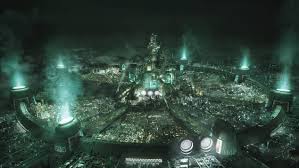
And the cinematic sensation on full display in this opening is no accident; there are homages to important works in the genre to which this work of fiction now belongs. Since the sixth entry, the series was slowly transitioning into the steampunk genre, abandoning the more traditional medieval fantasy setting characteristic of JRPG games that descended from tabletop games like Dungeons and Dragons. No, that was too limiting for a series that wanted to go all places from both a spatial and narrative standpoint. So here they take the full plunge into the steampunk/cyberpunk atmosphere and that means taking influence from one of the landmarks of the genre, the Ridley Scott directed film Blade Runner (1982). The intro aims to showcase its setting; the iconic metropolis of Midgar where knights in horses are replaced by rebels in bikes and trains (our protagonist still has a big ol’ sword though), a bustling city controlled by a mega corporation that is sucking nature’s life out of the world—nature naturally represented by the color green—and converting everything to industrial metal and steel.
It starts as your prototypical scenario of a ragtag group of rebels against an evil corporation that is loved by dystopian writers. But here it grows much larger, following threads of relationships between characters and sowing encompassing narrative arcs. It puts forward a common Japanese theme of environmentalism against technology and a more universal one about class conflict. Originally it was even planned for the setting to take place in none other than New York but ultimately it was decided to stick with a fictitious setting. In any case it plays with the common held belief that everything wrong with the world turns out to be the fault of nasty corrupt corporate executives and their nasty, greedy megacorporations. On a societal and technological level, the game would fall into the industrial or post-industrial science fiction setting where class divide are prevalent.
Just like the bleak world of Blade Runner and in cyberpunk fashion, in Midgar we apparently get 24 hour nights, neon lights everywhere and a palpable air of decay and depression. For some reason even though these cities are so advanced the lighting is somehow never adequate, all for the coolness factor. The city is full of dark star scrapers (symbolizing class oppression), neon signs (symbolizing MegaCorp domination) and other signs of a future gone wrong. If there are hours of daylight, it will probably consist of rain and thunderstorms. Sunrises usually mean the story is ending. Sonicwise, Uematsu has also the responsibility of bringing us outside of the fantasy medieval setting and into the Blade Runner world; this all exemplified in the opening of the game.
As the film experience it pretends to deliver, it knows that an opening has to catch the attention immediately, be memorable and establish the mood and setting of Midgar, just leaving enough air of mystery in order to continue the story. And like some works of fiction, it brings us right into the middle of the action to get to an exciting start, which is the titular Bombing Mission here. Because whenever you begin a story in the “middle”you then have freedom to move and explore it backwards or forwards, sometimes allowing for richer narratives. So remember to never begin a story at the beginning.
The composer himself on the other half did start the scoring process at the very beginning, with the very first scenes. Opening – Bombing Mission” was the first song Uematsu was asked to compose for Final Fantasy VII. The game’s director, Yoshinori Kitase, showed the opening cinematic to Uematsu and told him to start with that scene. It ended up becoming the main motif of the Final Fantasy VII subseries. Nobuo uses various of the elements and techniques that composer Vangelis applied to create the iconic landscape of Blade Runner, such as an assortment of synthesizers used with an orchestral language; still, Uematsu retains proper orchestral instruments, creating an eclectic mix of the past and future, quite like Final Fantasy.
Musical Analysis
When a player jumpstarts the adventure he is received with the view of the stars, a view into outer space and not some medieval castle. The cue there which is not on the soundtrack since it is apparently taken as a sound effect is just an evolving synth sound where choirs are buried deep in the mix and you cannot quite make it what they are saying; as if they were some kinds of souls trapped in a limbo; the sounds mimic the opening of Blade Runner which also starts with undefined synthesizer sounds slowly morphing in the low end. The scene is extended for an uncomfortable long time to make you dizzy and confused. Until a face appears in the frame with the green of her eyes reflecting back the green sparks of the life force that are now in place of the stars. Both which represent the nature slowly drying out; she also carries flowers so this girl is practically the embodiment of mother nature, the only traces of life and humanity in this neon world. The scene is similar to the eye in the opening of Blade Runner reflecting back the lights of the city. Here Uematsu starts employing the cinematic language of suspense, the sustained string note and then an ambiguous motif played by the icy timbre of the celesta combined with synthesized strings, implying this girl is not where she is supposed to be and might be being followed. The composer uses both the major and minor tetrachord tail of the E scale to create this sense of ambiguity; the question phrase played in major tetrachord while the answer is in the minor. When the girl is walking, the steam world begins to be revealed as the synthesizer noise sounding like a snare being brushed starts to play to foreshadow the sound of the train; this synth noise sound is also used in Blade Runner. And like in Blade Runner we are about to be treated to a panoramic view of the entire city, populated by tall buildings that shoot energy to the air.
The piece begins to grow towards its climax showing that this is no orchestral cue by pounding industrial sounds by combining huge bass drums with even bigger Taiko drums; because Uematsu does not shy away from big so that is why he manages to bring all the big drums including the Oriental Taiko with the western Timpani and also the bass drum. Synthesized brass sounds characteristic of Blade Runner reinforce the string sounds with more E notes. Slowly, more notes join in to form a series of sustained chords; first only the E notes then its perfect fifth, then forming more despairing minor chords: Emadd9 and finally E6sus2 for full ambiguity. Just a little before the climax, when the extent of the futuristic, industrial complex is shown, some glitchy, cybernetic noises also characteristic of the Vangelis Blade Runner score, the cyber in cyberpunk, and a friction drum sound one after the other (for some reason this friction drum sound is not heard on other versions).
The timpani rolls signify the triumphant climax to coincide with the logo appearance, sounding the crash cymbal and snare rolls as it is standard procedure on the excitement industry; all the pomposity that you can muster. It is the Final Fantasy VII fanfare and even though Blade Runner never goes for this exciting moment we still get its most iconic sound which is the sequencer synth playing relentlessly. Both pieces then go for a bit of an oasis in pure major profile, the instruments here playing a full E major chord. It morphs towards more epic scales with the Db major chord, a I to VI, where in functional harmony the VI is expected to be minor; it is pure science fiction harmony. That is as high as the track will get since it will now go down to more somber tones to reflect the state of the world. It ends in the downer Am chord, the iv, like a minor plagal cadence that never resolves since it is up to the player to resolve and that is what the next track is for. Because it seems Final Fantasy likes to open in pairs since for the sixth entry we also had two cues stitched together. The melodies follow the underlying chord profiles.
And that is it for the opening piece which is connected to the next one, Bombing Mission via a new synth noise sound that carries over to represent the train that has been appearing in our screen and that will pump us throughout the action packed overture. The theme, which also will be used in other parts of the game, is a standard battle theme full of fast rhythms, propulsive percussion with marching snare punctuated with timpani and cymbals, ostinatos that are then transposed, lots of chromatic notes and aggressive bursts from the orchestral instruments. The low end composed of the piano reinforced with a bass synth will be in charge of the dissonant ostinato in triplets that are more chaotic than duplet rhythmic profiles. The piano riff starts in D and later it is transposed to start a perfect fourth higher in G; it is a way to increase tension via a higher register, as if time is ticking faster. The militaristic snare plays a dynamic pattern that emphasizes each beat and every second bar destabilizes the rhythm. Another industrial sound includes the grinding on metal as if doors are being open forcefully or trains are pulling emergency breaks. The various characters begin to appear on screen and are punctuated by timpani hits, but it is the level of spikiness in the hair plus the cool moves plus the fact he is the new guy what clues us into who is our main character.
Cloud appearance on the action is punctuated in even bigger fashion with the orchestral hits. The rest of the orchestral instruments made of the entire brass section play various battle cries and the woodwinds sound the various alarms. Descending chromatic notes tell us that we are meant to be in a high stress situation. When you lest realize you are already in control of your actions, the very first time being in actual battle. This makes this cue a cinematic, a location and gameplay battle cue at the same time.
The loop start is right where the piece is transposed to G, with brass synth sounds playing long, dissonant melodies using the minor profile of G but also focusing on its tritone note Db. Each section could be distinguished by each time the piece transposes. Flute alarms transition into the D minor profile. The language of the piece is not triumphant, it just strives to make you feel the stress of this hard task. For the next section, the ostinatos go away for a moment of caution where Uematsu plays rhythmically with the noise sounds and the Blade Runner sequencer comes back. Before you know it, an even more alarming ostinato returns in the D Aeolian/Minor profile but with the starting point on a higher note giving it a different flavour to the previous ostinato. Strings join in to augment the ostinato. After this, the piano gets to play just a single bass D note while the horns play a slightly more heroic chordal melody where the high notes of the inverted chords play descending chromatic lines. It goes Dm – Bb – C – B.
The second ostinato returns and on top of it trumpets and other brass instruments play battle fanfares. The tuba responds with a battle cry of its own which we can visualize as the response from the enemy, especially since by using B natural they appear to belong to the different A Aeolian/Minor key. In any case this tells us we are in the middle of a war and everything is on the line. The flutes play more low morale sounds that drive the point of the bad situation. Later, the horn melody section returns but other instruments join in staccato rhythms on the tonic to add more intensity this second time around.
The last section which sounds more regal, sinister and powerful is closer to the A Aeolian/Minor profile and it is the most representative of the evil empire you are trying to take down due to the amount of descending chromaticism. Could the party of heroes be able to surmount this task? You will need to turn the page of this interactive novel. The loop point is reached by way of a chromatic ascent at the very last minute which puts us back into the D based loop.
All things considered we know that, just like Cloud, Final Fantasy knows how to make an entrance with this memorable intro that was probably enough to hook players and throw them tight into this industrial castle, a brand new direction for the series. The remake retains these two cues but adding multiple flourishes since it is even more cinematic; the Sephiroth theme is even featured prominently in combination with these. There is a reason why Midgar is the most iconic location in the entire Final Fantasy series. The music tells us its people meant business and are determined to go all in to change the status quo.

Help to keep the rites going around here by supporting the shrine:

Media Files, requests and support for more interactive content

Thou shall donate since this is a cult and you are now a sheep

Help staying awake analyzing game tracks and writing posts or else everything will end up being written by A.I
- Inside The Score – The Legend of Zeda: A Link to the Past – End Credits / Staff Roll
 The land rests As the last few minutes of this extensive journey that has now come to an end fly by, the nostalgia and reflective mood kicks in. Because such a massive enterprise as a Zelda game or a Lord of the Rings movie require multiple endings to convey everything… Read More »Inside The Score – The Legend of Zeda: A Link to the Past – End Credits / Staff Roll
 - Inside The Score – The Legend of Zelda: A Link to the Past – Ending / Epilogue ~ Beautiful HyruleFinal of the fantasy The Triforce has been touched. A wish has been granted. For the occasion, the newly undeceased king of Hyrule has commissioned a march in honor of the legendary hero to the Hylian Sousa, who might as well be composer Nobuo Uematsu since this piece is very… Read More »Inside The Score – The Legend of Zelda: A Link to the Past – Ending / Epilogue ~ Beautiful Hyrule
- Inside The Score – The Legend of Zelda: A Link to the Past – Triforce Chamber / Power of the GodsTake your boots off your feet And thus the Triforce spoke to men. And it became present in history. And you better treasure and contemplate this moment seldom witnessed in the course of the series. The elusive opportunity to interact and touch the most important artifact. You are now in… Read More »Inside The Score – The Legend of Zelda: A Link to the Past – Triforce Chamber / Power of the Gods
- Inside The Score – The Legend of Zelda: A Link to the Past – Ganon Battle / Prince of DarknessProgressive evil En Garde! And you better be prepared since you are about to duel the iconic enemy of the series at perhaps his canonically most powerful incarnation. Right after having touched the sacred Triforce which allowed him to conquer all of the Golden Land and whose evil and darkness… Read More »Inside The Score – The Legend of Zelda: A Link to the Past – Ganon Battle / Prince of Darkness
- Inside The Score – The Legend of Zelda: A Link to the Past – Boss Battle / Anger of the GuardiansQuick mayhem Ah, the simpler times when boss battles where not a multi epic orchestral suite but just an ostinato more basic that even what became the music for standard battle encounters out there. We are a long way from each boss having his own personalized track. And this early… Read More »Inside The Score – The Legend of Zelda: A Link to the Past – Boss Battle / Anger of the Guardians
- Inside The Score – The Legend of Zelda: A Link to the Past – Dark World Dungeon / Dungeon of ShadowsMemento mori We are getting closer to Ganondorf (or at least the wizard Agahnim who ultimately fulfills the same human side of evil role in this game) and that means getting closer to the profiles and motifs of his own theme song (which naturally was the theme of Agahnim at… Read More »Inside The Score – The Legend of Zelda: A Link to the Past – Dark World Dungeon / Dungeon of Shadows