Jet forward
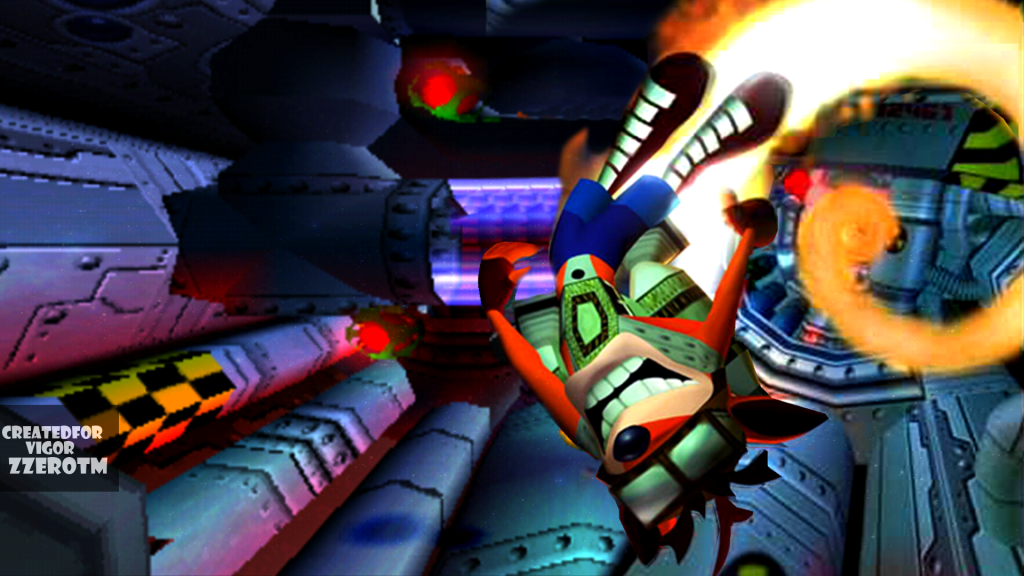
The bandicoot went into the final frontier of space years before Mario did—that is, only if we count out the idiosyncratic star world or Rainbow Road—And even if he pretty much lifted his brand new move-set from Super Mario 64, the jet pack levels are a significant change of pace from the platforming; it is unlike any other gameplay type in the game, paving the way for the alternative type of levels we will find on the sequel, like the underwater ones or racing with the bike.
The music is also very different from your typical Crash Bandicoot fare, ditching the cool marimba riffs in favor of a multi suite space opera that uplifts the experienced action and lifts its sound from ubiquitous sci-fi tropes, albeit while still retaining some bluesier and cartoon influences.
From the title screen we could already see and hear the change in tone in comparison with the first game, leaning more into the technological/industrial side of the equation in favor of the Indiana Jones temples sparser jungle beats. The Crash Bandicoot main theme is rearranged with more synthesizer and electronic tones, reflecting the technologically drenched ambients we will encounter; there is more oomph to the sound. For the Rock It cue returning composer Josh Mancell even decided to create the most complex track for the series, arranging it with multiple sections and creating a long buildup meant to reflect the wonder of trying to slowly acclimatize with the new jetpack controls which are a big overhaul for players out of nowhere; and then it morphs into a rocking drum fill filled composition kicking in, presumably, when you have dominion over zero gravity space movement.
Musical Analysis
Unsurprisingly, the theremin, or a synth that closely matches its wobbly radio sound, is one of the lead instruments featured prominently as the representative of the sci-fi movie tradition that began way back in the Bernard Herrman score for ‘The Day the Earth Stood Still‘ from the 1950s which used the instrument effectively to convey the otherworldly feeling of space, UFOs and aliens; the instrument just has that flying saucer sound. Even today, the instrument seems from the future and what an outer space civilization would conceive since it is an electronic device with an antenna that you don’t even need to touch in order to provide musical sounds that are characterized by a smooth portamento across a pitch range and sounds like a radio transmission from another planet. It is difficult to use nowadays in an effective non-cliche manner but that is not a preoccupation for a cartoon character like Crash; in fact, it is the incentive. Including this instrument on any soundtrack has become common shorthand for the presence of the paranormal, such as aliens or ghosts, generally with the implication that the subject matter is not going to be treated very seriously. Perfect for the Aussie marsupial first foray into space.
The original track meant to accompany the space levels in Crash Bandicoot 2 was also going for a more frightening sci-fi sound that payed homage to these famous scores, like the use of a waltz to parody in comedic fashion the use of the Johann Strauss II’s waltz “The Blue Danube on the 2001: A Space Odyssey film and then a dissonant sounding action orchestral cue as opposed to the uplifting one of the final version.
The revamped track that ended up on the final product retains the ideas of making it the longest Crash tune to date, buildup and using the non-Crash orchestral language straight from space operas like Star Wars and 2001: A Space Odyssey, themselves born out of the tradition from Gustav Hoist’s The Planets.
The theme opens up with the also cliche harp glissando that brings us up in the air, weightlessly floating like a dream. Never mind not with the typical whole tone scale but with the more Crash Bandicoot appropriate notes of the E blues scale forming an E7 chord. Josh Mancell did not forget about his blues influences even if he was going for an epic arrangement, the harmony using all dominant seventh chords while the lead theremin plays around with the E minor pentatonic scale and the blue note D#. The strings and pizzicato samples, which on the PlayStation console sound much better than what the N64 cartridges could contain, play in a contrary, symmetric wavelike pattern also meant to give that weightless floating sensation. They play the dominant seventh chords but don’t forget about sounding sci-fi and mysterious enough by also adding some extended notes on their arpeggios (mostly the b5 which is the tritone, the b9 and the 11).
The progression is not a blues progression but the full of wonder, going up E7 – G7 – A7 – B7 all connected with the wavelike voice leading. The chords begin changing every four bars, then every two, then every bar. You are getting the hang of the jetpack controls slowly. Space themes often opt to use such chords separated by large distances on the circle of fifths which is like the family tree of music showing how related or unrelated chords are. So we get an I to bIII which is a classic that is also the basis of the sci-fi Metroid theme. “One small step for the piano, one giant leap for the circle of fifths” (the I to bVI is still the king of space though). The violins do some counterpoint here.
But then the intro keeps going and building up with flutes entering the mix with staccato articulations just like on the violins, both instruments sounding like a short burst of notes. The flutes are not on the same page as the theremin, refusing to use the minor blues scale but instead the Mixolydian profile from each underlying chord. The glockenspiel is also somewhere there adding the sparkle of the stars to the accompaniments. The other members of the woodwind family are also slowly introduced cooking a tapestry of melodic counterpoint; both the oboe and flute end with an echoing morse code signal into outer space. Unlike the theremin, the woodwinds are playing major profiles with the major chords; they are the non-blues quota. There is also a synthesizer pad where the notes are sampled in reversed form, meaning the sustain comes first and then the attack; this also is often used to create an otherworldly or ghostly feel since it is a totally unnatural sound. The drums are raring to go, with Josh Mancell, being himself a drummer, preparing to show off his programming chops and learned vocabulary on the instrument.
Is the Intro still going? Yes it is. There is a third Intro section where the theremin plays some Western-like phrase straight from a Ennio Morricone film—just replace the theremin with a similar sounding whistle—which in context with the harmony would be using the tail tetrachord of the Mixolydian profile.
The tempo accelerates to the climax of the piece where an assured violin melody captures your newfound ease of the use of the jetpack, having fun crashing boxes in anti gravity space. The rhythm section consisting of drums and bass enters in full force completing the ‘Rock It’ name double meaning. The bass maintains the bluesy spirit of the dominant seventh while the theremin now plays the remainder of the minor notes to complete the minor profiles; natural and melodic minor. The woodwinds keep on with their counterpoint role, creating a complex and layered track that fills any possible space. The harmony would be E7 – G – A – B. This is the Section 1.
Second section of the main track would be when the flute plays the action packed pedal arpeggio that starts on A and is then transposed to B while the bass plays single lines.
The harmony implied for this part might be
Em – Am7 – F#m7 – Bm7 if we consider the notes from the reversed synth pad.
The cymbal crescendo brings with it yet another section where the pizzicatos introduce some chromatic runs and the underlying harmony changes implying something like Bm – Em – F# – D with the bass playing more passing notes. After this, the track goes onto the baroque inspired melody—also similar to the Iron Maiden song ‘Fear of the Dark’—on the strings, playing a figure over the E minor chord and then transposing it in similar fashion to play in harmony with the D major. This piece truly has all bases covered.
The main string phrase returns presumably restarting the loop but nah, the thing keeps going onto more frantic sections since you are now going through more difficult parts of the level; notes begin to whirlwind at faster, steady subdivisions and the woodwind arpeggios get zanier. Flutes and oboes go up while the clarinet plays the contrary pattern moving down. The piece is now on a Dm profile base, transposed a tone down. The dynamic drum playing marks the call and response times between the calm theremin and the crazy woodwinds. There aren’t enough notes to infer an harmony but having in mind the transposition that comes next some chords that could work for this section would be Dm – C – E – D. The Figure is then presented on the G profile with the bass going for the Gm – F – C – D. This time the last two chords go one step up in order to complete the phrase.
Then onto an interlude where the harp returns to play some more uplifting glissandos over a Gm chord that go into the stratosphere. This time the harp plays a minor hexatonic scale that ignores the Eb of the G Aeolian/Minor profile and the woodwinds respond. The oboe and tremolo string play when the piece transposes yet again to the Am chord. The timpani, used as ornamentation on the beginning, contribute power to the bass line here.
The call and response section is played again but this time the strings are the ones doing the fast runs, replacing the woodwinds.
There are a couple of last sections for a whooping 12 different sections depending on how you count This is truly Looney Tunes in space. The last two are the outros meant to connect the loop back to the exciting full tempo track. This is the one Crash Bandicoot song where the intro is never to be heard again. The harmony goes for the space E – G – E – Bm and then the standard E7 – G – A – B from the main motif. The violins play some foreshadowing of the main melody.
A brand new piece was needed for a brand new gameplay mode that the developers felt could be too difficult for players to master. This resulted in a track that sounds nothing like the others from the Crash Bandicoot series, fitting since the levels were nothing like the typical Crash Bandicoot levels. Even so, the composer seemed to have fun with it and go wild with multiple sections that capture the storytelling of a player navigating the different sections of the level, from learning the controls to excitingly exercise dominion of the jetpacks, to frantically trying to evade the different hazards presented.
As always, Josh Mancell has uploaded the pre-console version showing how the original mix sounded before being fitted to the console:
Help to keep the rites going around here by supporting the shrine:

Media Files, requests and support for more interactive content

Thou shall donate since this is a cult and you are now a sheep

Help staying awake analyzing game tracks and writing posts or else everything will end up being written by A.I
- Inside The Score – The Legend of Zeda: A Link to the Past – End Credits / Staff Roll
 The land rests As the last few minutes of this extensive journey that has now come to an end fly by, the nostalgia and reflective mood kicks in. Because such a massive enterprise as a Zelda game or a Lord of the Rings movie require multiple endings to convey everything… Read More »Inside The Score – The Legend of Zeda: A Link to the Past – End Credits / Staff Roll
 - Inside The Score – The Legend of Zelda: A Link to the Past – Ending / Epilogue ~ Beautiful HyruleFinal of the fantasy The Triforce has been touched. A wish has been granted. For the occasion, the newly undeceased king of Hyrule has commissioned a march in honor of the legendary hero to the Hylian Sousa, who might as well be composer Nobuo Uematsu since this piece is very… Read More »Inside The Score – The Legend of Zelda: A Link to the Past – Ending / Epilogue ~ Beautiful Hyrule
- Inside The Score – The Legend of Zelda: A Link to the Past – Triforce Chamber / Power of the GodsTake your boots off your feet And thus the Triforce spoke to men. And it became present in history. And you better treasure and contemplate this moment seldom witnessed in the course of the series. The elusive opportunity to interact and touch the most important artifact. You are now in… Read More »Inside The Score – The Legend of Zelda: A Link to the Past – Triforce Chamber / Power of the Gods
- Inside The Score – The Legend of Zelda: A Link to the Past – Ganon Battle / Prince of DarknessProgressive evil En Garde! And you better be prepared since you are about to duel the iconic enemy of the series at perhaps his canonically most powerful incarnation. Right after having touched the sacred Triforce which allowed him to conquer all of the Golden Land and whose evil and darkness… Read More »Inside The Score – The Legend of Zelda: A Link to the Past – Ganon Battle / Prince of Darkness
- Inside The Score – The Legend of Zelda: A Link to the Past – Boss Battle / Anger of the GuardiansQuick mayhem Ah, the simpler times when boss battles where not a multi epic orchestral suite but just an ostinato more basic that even what became the music for standard battle encounters out there. We are a long way from each boss having his own personalized track. And this early… Read More »Inside The Score – The Legend of Zelda: A Link to the Past – Boss Battle / Anger of the Guardians
- Inside The Score – The Legend of Zelda: A Link to the Past – Dark World Dungeon / Dungeon of ShadowsMemento mori We are getting closer to Ganondorf (or at least the wizard Agahnim who ultimately fulfills the same human side of evil role in this game) and that means getting closer to the profiles and motifs of his own theme song (which naturally was the theme of Agahnim at… Read More »Inside The Score – The Legend of Zelda: A Link to the Past – Dark World Dungeon / Dungeon of Shadows