The heroic Item Get cue
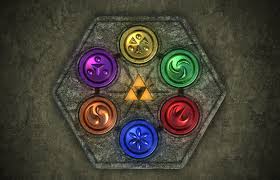
The companion piece to the Spiritual Stone cue which will accompany us for the adult dungeons is this one that follows the cinematic of the medallions descending from the sky into the hands of the hero; the first one is on the house.
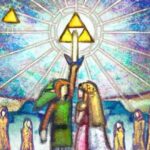
After a short explanation of the current situation by the sage Rauru and the shock of seeing Link as an adult for the very first time, we are presented with the first of six medallions that will become symbols of success for the duration of the adult portion of the game. The first one is given as a token for reaching this milestone and it comes alongside the last of the recurrent acquisition fanfares.
They symbolize the connection with the seven sages which are not the conventional old men in robes like before but actual fleshed out characters (and the majority actually being young women) that we interact with in some capacity as a child. Since this seems to be a realm outside time and space, and based on some events seen in game we can infer that these sages are no longer bless us with their presence.
Musical Analysis
Structure: Section 1
Time Signature: 4/4
Tempo: 75 (ritardando to 50)
Melodic and Harmonic Profiles: G Mixolydian; G Aeolian/Minor
This one is more fanfarey than the longer and more mystic Spiritual Stone cue, focusing on brass and a less angular harmony. As it is standard fare for fanfares, the main melody of the cue tends to ascend to a climax, but in similar fashion to the cue of the Master Sword, the piece has a descending bass contrasting with the melody and generating extended harmony with sevenths and ninths.
As usual the glockenspiel does rapid arpeggios to create expectation and a sense of winning a prize. Meanwhile, the descending chords of the piece point to the major Andalusian cadence which is none other than one of the most recognizable motifs in The Legend of Zelda music, the Zelda Cadence [I – bVII – bVI]—you technically need the V at the end—yet it surprises by going an extra whole step down, which extends the cadence, ending it on C instead of the normal cadence which would end on a D chord; maybe it is because of the fact that it has to adapt to the duration of the little medallion cutscene. In the same way, the glockenspiel is doing the Mario Cadence [bVI – bVII – I], the opposite of the Zelda Cadence thus fusing the two most important Kondo harmony progressions into one due to the contrary motion of the voices.
The chords can be simplified to G – F – Eb – Db – C (The Zelda cadence would be G – F- Eb – D). With the melody notes and the glockenspiel arpeggio you would get some maj7/9 harmonies.
Koji Kondo could probably have gotten away with using a single cue for both the spiritual stones and the medallions but he went the extra mile and conjured a second track that further establishes that the state of affairs has changed.
Soon, Link will find the results of being absent from Hyrule for seven years, but before that, he will encounter a very special ally that will help him for the remainder of the adventure; as well as being his new music teacher.

Help to keep the rites going around here by supporting the shrine:

Media Files, requests and support for more interactive content

Thou shall donate since this is a cult and you are now a sheep

Help staying awake analyzing game tracks and writing posts or else everything will end up being written by A.I
- Inside The Score – The Legend of Zeda: A Link to the Past – End Credits / Staff Roll
 The land rests As the last few minutes of this extensive journey that has now come to an end fly by, the nostalgia and reflective mood kicks in. Because such a massive enterprise as a Zelda game or a Lord of the Rings movie require multiple endings to convey everything… Read More »Inside The Score – The Legend of Zeda: A Link to the Past – End Credits / Staff Roll
 - Inside The Score – The Legend of Zelda: A Link to the Past – Ending / Epilogue ~ Beautiful HyruleFinal of the fantasy The Triforce has been touched. A wish has been granted. For the occasion, the newly undeceased king of Hyrule has commissioned a march in honor of the legendary hero to the Hylian Sousa, who might as well be composer Nobuo Uematsu since this piece is very… Read More »Inside The Score – The Legend of Zelda: A Link to the Past – Ending / Epilogue ~ Beautiful Hyrule
- Inside The Score – The Legend of Zelda: A Link to the Past – Triforce Chamber / Power of the GodsTake your boots off your feet And thus the Triforce spoke to men. And it became present in history. And you better treasure and contemplate this moment seldom witnessed in the course of the series. The elusive opportunity to interact and touch the most important artifact. You are now in… Read More »Inside The Score – The Legend of Zelda: A Link to the Past – Triforce Chamber / Power of the Gods
- Inside The Score – The Legend of Zelda: A Link to the Past – Ganon Battle / Prince of DarknessProgressive evil En Garde! And you better be prepared since you are about to duel the iconic enemy of the series at perhaps his canonically most powerful incarnation. Right after having touched the sacred Triforce which allowed him to conquer all of the Golden Land and whose evil and darkness… Read More »Inside The Score – The Legend of Zelda: A Link to the Past – Ganon Battle / Prince of Darkness
- Inside The Score – The Legend of Zelda: A Link to the Past – Boss Battle / Anger of the GuardiansQuick mayhem Ah, the simpler times when boss battles where not a multi epic orchestral suite but just an ostinato more basic that even what became the music for standard battle encounters out there. We are a long way from each boss having his own personalized track. And this early… Read More »Inside The Score – The Legend of Zelda: A Link to the Past – Boss Battle / Anger of the Guardians
- Inside The Score – The Legend of Zelda: A Link to the Past – Dark World Dungeon / Dungeon of ShadowsMemento mori We are getting closer to Ganondorf (or at least the wizard Agahnim who ultimately fulfills the same human side of evil role in this game) and that means getting closer to the profiles and motifs of his own theme song (which naturally was the theme of Agahnim at… Read More »Inside The Score – The Legend of Zelda: A Link to the Past – Dark World Dungeon / Dungeon of Shadows