A portal into another dimension
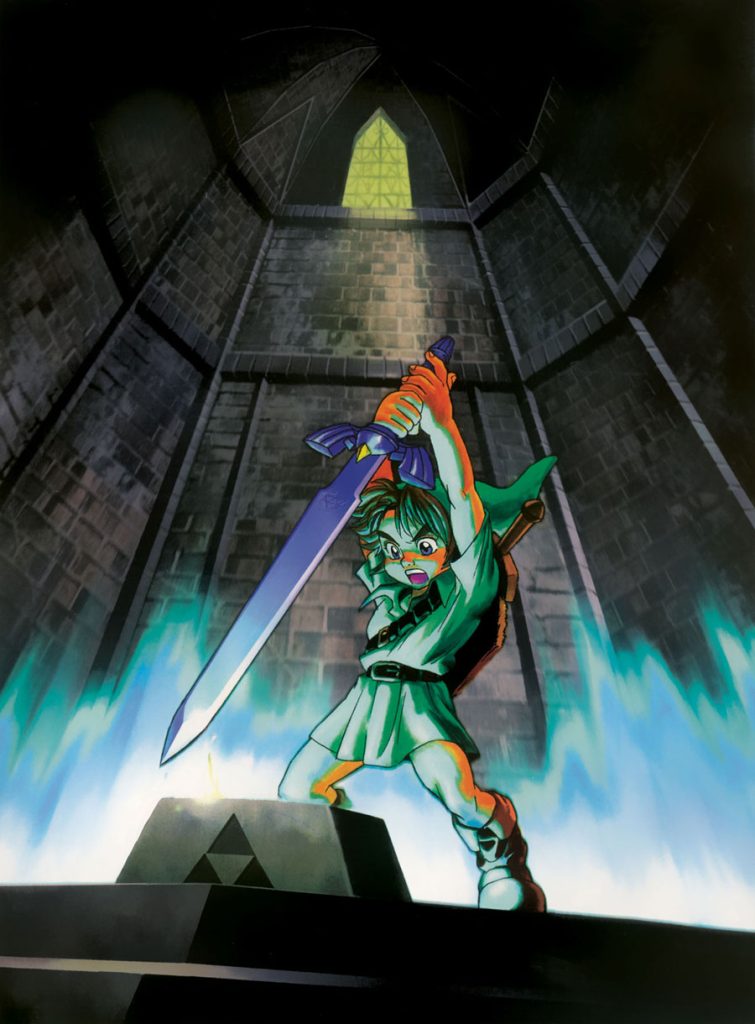
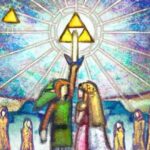
The sword in the stone. How much more European medievalism can you get? Straight from Arthurian legends about another mythical sword we see our hero grow in front of our own eyes physically and symbolically the moment he is able to pull the most iconic weapon in the Zelda series; this of course merits its own cue. Now we are about to see why this church has the right to be called the Temple of Time. Having this pedestal—which probably has a huge timeshifting stone underneath as per the modern lore—that transports Link to a kind of spiritual realm where some souls and goddesses await, a realm beyond time that brings back the goddesses’ choir.
This is the ultimate Item get cue offered in the Zelda series,appearing first on A Link to the Past and then arranged each time the hero gets his sword that often signals the midpoint of the quests. It is also not only an item get theme but technically a small cutscene cue which has to follow the action on screen; the anticipation of Link getting the sword, his magical properties and the travel into another dimension that happens in sequence.
The Blade of Evil’s Bane forged by an ancient hero in the distant past with the flames from a goddess itself is as legendary as the Triforce. And it is also the key to unlock it. It is a rite of passage for all Zelda players and here the motif of growing up with it is literally applied.
Musical Analysis: The Master Sword
Structure: Section 1 / Section 2
Time Signature: 2/4
Tempo: 98
Melodic and Harmonic Profiles: C Aeolian/Minor C Chromatic
There are two parts to this, the anticipation full of wonder, and the magic operating and surrounding you, showing that this legendary sword is indeed very special.
Finally, the moment the real adventure begins, everything before this was just two children playing the hero role by trying yo prevent a threat. After Link gets his hands on the legendary Master Sword, the equivalent item on this world to the Excalibur from Arthurian legend, the threat becomes a reality and now the world is truly in danger. This track has become the anthem that rewards players that get far enough in the game to manage to reach this mythical blade.
With a similar treatment to other success fanfares from the game, this cue ascends higher and higher; starting with the beautiful major 7th chord in scale form and then making a chromatic ascent of four major chords. But there is a catch, it can’t be a fully triumphant moment because there is a lot of uncertainty in the air, this sensation is present courtesy of the glockenspiel playing a suspended ostinato and a contrasting bass line that descends while the chords go up. This can be clearly seen in the visualization for the horn notes. Therefore, the notes are creating all kinds of wacky chords that the composer probably wasn’t thinking about; what matters here are the opposite melodic lines.This results in a climax where the G notes on the bass clash with the F# notes on the chords, finishing with an unresolved dissonance. It somehow manages to sound appropriate as both an acquisition cue and a portal traversal cue.
Section 2 is the one with this four ascending chromatic harmony, the bases being Ab – A – Bb – B. Section 1 scale implies an Abmaj7 chord. The piece is the spiritual successor of the ‘Item Get’ cue—which also uses chromatically ascending major chords—played with more grandiosity and mystery to signify the importance of this new item.
Musical Analysis: Chamber of the Sages / Sacred Realm
Structure: Section 0 / Section 1
Time Signature: 4/4
Tempo: 60
Melodic and Harmonic Profiles: C Whole Tone
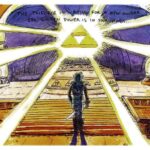
We reach that other plane of existence known as the Sacred Realm. Everything that is happening is confusing. The visuals show that this is indeed an ethereal place; full of divinity and timelessness. Truly a place outside space and time. Possibly a spiritual plane of existence where Link’s soul gains enlightenment.
In the ancient legends, as told by the Great Deku Tree and the Princess, it is said that here dwells the artifact known as the Triforce. However, by the actions of Link and Zelda, the Triforce has been put in danger, broken in three parts which might have caused space and time to break in three; and now Link, an older and wiser man, must face responsibility by fulfilling his destiny as the Hero of Time.
Link will return to this location each time he awakens one of the game sages. The cue is a reprise of the music we hear when characters talk abut the Triforce or the golden goddesses. But this time, the track is not designed for a cutscene; it has to loop smoothly.
Once again it uses the whole tone scale to convey the sense that time stands still and that this realm does not belong in the world of mortals; it’s almost impossible to catch when the piece ends and when a new loop of the music begins. It seems like the song goes on forever thanks to the scale it uses and the lack of cadences.
The choirs that stand in for the goddesses return with a new melody on top of the same accompaniment from the previous track. So it is not the same as the Legend of Hyrule cue, jut reminiscent enough to make the spiritual/mythical world more cohesive.
After seven long years, the spirit of the hero is ready to finish the quest. In order to complete it, he will need to acquire the six medallions handed by the sages.

Help to keep the rites going around here by supporting the shrine:

Media Files, requests and support for more interactive content

Thou shall donate since this is a cult and you are now a sheep

Help staying awake analyzing game tracks and writing posts or else everything will end up being written by A.I
- Inside The Score – The Legend of Zeda: A Link to the Past – End Credits / Staff Roll
 The land rests As the last few minutes of this extensive journey that has now come to an end fly by, the nostalgia and reflective mood kicks in. Because such a massive enterprise as a Zelda game or a Lord of the Rings movie require multiple endings to convey everything… Read More »Inside The Score – The Legend of Zeda: A Link to the Past – End Credits / Staff Roll
 - Inside The Score – The Legend of Zelda: A Link to the Past – Ending / Epilogue ~ Beautiful HyruleFinal of the fantasy The Triforce has been touched. A wish has been granted. For the occasion, the newly undeceased king of Hyrule has commissioned a march in honor of the legendary hero to the Hylian Sousa, who might as well be composer Nobuo Uematsu since this piece is very… Read More »Inside The Score – The Legend of Zelda: A Link to the Past – Ending / Epilogue ~ Beautiful Hyrule
- Inside The Score – The Legend of Zelda: A Link to the Past – Triforce Chamber / Power of the GodsTake your boots off your feet And thus the Triforce spoke to men. And it became present in history. And you better treasure and contemplate this moment seldom witnessed in the course of the series. The elusive opportunity to interact and touch the most important artifact. You are now in… Read More »Inside The Score – The Legend of Zelda: A Link to the Past – Triforce Chamber / Power of the Gods
- Inside The Score – The Legend of Zelda: A Link to the Past – Ganon Battle / Prince of DarknessProgressive evil En Garde! And you better be prepared since you are about to duel the iconic enemy of the series at perhaps his canonically most powerful incarnation. Right after having touched the sacred Triforce which allowed him to conquer all of the Golden Land and whose evil and darkness… Read More »Inside The Score – The Legend of Zelda: A Link to the Past – Ganon Battle / Prince of Darkness
- Inside The Score – The Legend of Zelda: A Link to the Past – Boss Battle / Anger of the GuardiansQuick mayhem Ah, the simpler times when boss battles where not a multi epic orchestral suite but just an ostinato more basic that even what became the music for standard battle encounters out there. We are a long way from each boss having his own personalized track. And this early… Read More »Inside The Score – The Legend of Zelda: A Link to the Past – Boss Battle / Anger of the Guardians
- Inside The Score – The Legend of Zelda: A Link to the Past – Dark World Dungeon / Dungeon of ShadowsMemento mori We are getting closer to Ganondorf (or at least the wizard Agahnim who ultimately fulfills the same human side of evil role in this game) and that means getting closer to the profiles and motifs of his own theme song (which naturally was the theme of Agahnim at… Read More »Inside The Score – The Legend of Zelda: A Link to the Past – Dark World Dungeon / Dungeon of Shadows