The human side of evil
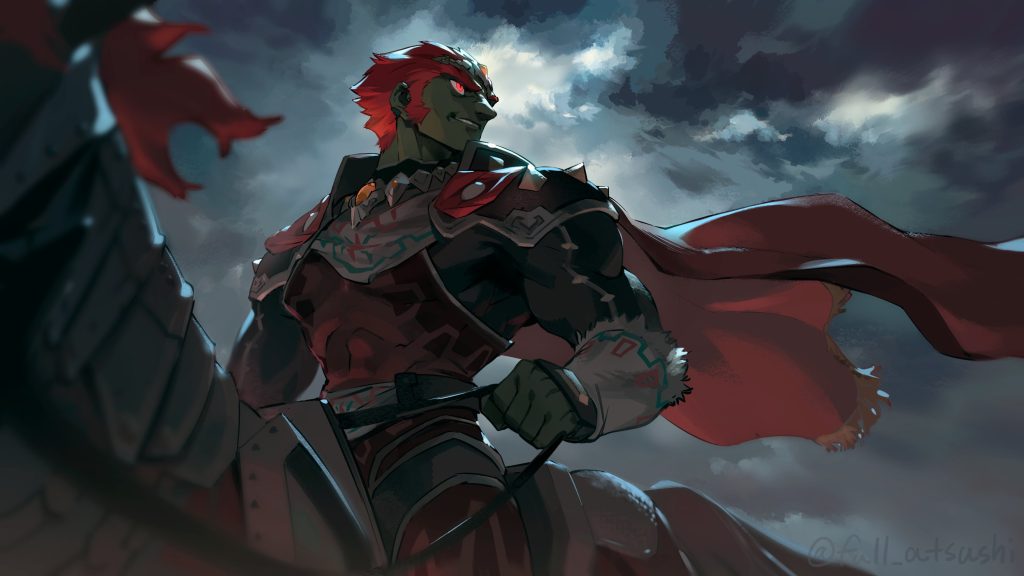
The man who came from the desert. For the benefit of Ocarina of Time’s sense of realism we don’t get a pig anymore as the base villain. Exploring the legendary tale of an evil human thief with a German sounding name as told in A Link to the Past was the goal of this new story. The man who eventually became Ganon. As seen here it was not only some guy who lead a group of bandits but there is an entire culture attached to him, giving the main villain of the series a fleshed out background as he is the powerful caliphate of the Gerudo tribe who make the only male born every hundred years their chief and furthermore he is raised by two suspicious witches in the arts of black magic. Yep, this sounds more interesting than a pig who abducts princesses for the sake of power even if it is this what he is ultimately destined to seek for eternity. He is also quite the musician just like his eternal counterparts Zelda and Link and this theme seems to exist in-universe; so powerful a villain he is that he wrote his own theme song.
He is also more developed in the fact that we encounter him various times throughout the adventure and not only as the placeholder final boss in the game. He even interacts with LInk. Yet, with the short but impactful moments what has now been repurposed as his theme is what speaks for himself the most.
Still, it only plays at the halfway point of the quest, signaling the end of the first act. The first direct confrontation with the main villain of the game. Finally, the nightmare that opened the game becomes a reality—Does this mean this Link has premonitions too, like the princess?— The scene of Link arriving to Hyrule Castle Town, seeing it surrounded by an unsettling mist adds to the tone of this encounter. The player must have come countless of times here but something has definitively changed. You have not thwarted the villain’s plan by collecting the spiritual stones; the game is only about to begin.
The sound design, appropriate use of silence to give gravitas and the inspired decision of the developers to not resort to pre-rendered cutscenes and instead limit themselves to manipulate the camera inside the game helped to not break the immersion between gameplay and cinematics.This short cutscene makes clear not only the threat that Ganondorf represents to Hyrule or how powerless is Link against this foe, but also the courage of the hero.
Musical Analysis
Structure: Section 1 / Section 2
Time Signature: 4/4
Tempo: 120 (accelerando to 135 in Section 2)
Melodic and Harmonic Profiles: Bb Diminished, Bb Chromatic
An staple of evilness in video game music, analogous to the imperial march from Star Wars, Zelda players will recognize immediately the cue that plays right after the leitmotif for the Gerudo king. A brooding, ascending sequence of chromatic perfect fourths plus a tail that accelerates the pace of the chords.
Appearing for the first time in A Link to the Past, this theme is used to symbolize the human form of evil. Being applied initially for the servant/alter ego of the beast Ganon. This is no battle music, it just indicates that something is in the air that should not be.
What else can you ask for in a villain theme? perfect fourths, which are adequate for a more sophisticated, less primal kind of malevolence than the demonic tritone (the exact same notes that make up the perfect fourth that opens the Zelda series’ main theme also open this piece: Bb and F); very low ostinatos played by double basses play the ground harmony that when it comes to basses is often made of perfect fifths since it is the interval that is easier to digest for the ears at that range, that is other than the octave; The first part is just a pedal C5 chord. There is also dissonant harmony and chromaticism, as opposed to more balanced note leaps; and an accelerando that instills the sense of urgency and danger present for the Section 2 of this short cue.
And it is the harmony in Section 2, the one that forms parallel minor chords, that which provides a sense of hopelessness. It is certainly less melodramatic than the Ganondorf Appears leitmotif which is straight from horror tropes. This is a more kind of subtly evil that makes you not want to flee but to give up. The full statement of this theme will be heard at the climax of the game played by Ganondorf himself.
Don’t expect this classic motif to abandon the Zelda series anytime soon. With this piece the princess, the hero and the villain, the Triforce holders, find their music identity, an identity that will accompany them possibly for the rest of the franchise run.
Help to keep the rites going around here by supporting the shrine:

Media Files, requests and support for more interactive content

Thou shall donate since this is a cult and you are now a sheep

Help staying awake analyzing game tracks and writing posts or else everything will end up being written by A.I
- Inside The Score – The Legend of Zeda: A Link to the Past – End Credits / Staff Roll
 The land rests As the last few minutes of this extensive journey that has now come to an end fly by, the nostalgia and reflective mood kicks in. Because such a massive enterprise as a Zelda game or a Lord of the Rings movie require multiple endings to convey everything… Read More »Inside The Score – The Legend of Zeda: A Link to the Past – End Credits / Staff Roll
 - Inside The Score – The Legend of Zelda: A Link to the Past – Ending / Epilogue ~ Beautiful HyruleFinal of the fantasy The Triforce has been touched. A wish has been granted. For the occasion, the newly undeceased king of Hyrule has commissioned a march in honor of the legendary hero to the Hylian Sousa, who might as well be composer Nobuo Uematsu since this piece is very… Read More »Inside The Score – The Legend of Zelda: A Link to the Past – Ending / Epilogue ~ Beautiful Hyrule
- Inside The Score – The Legend of Zelda: A Link to the Past – Triforce Chamber / Power of the GodsTake your boots off your feet And thus the Triforce spoke to men. And it became present in history. And you better treasure and contemplate this moment seldom witnessed in the course of the series. The elusive opportunity to interact and touch the most important artifact. You are now in… Read More »Inside The Score – The Legend of Zelda: A Link to the Past – Triforce Chamber / Power of the Gods
- Inside The Score – The Legend of Zelda: A Link to the Past – Ganon Battle / Prince of DarknessProgressive evil En Garde! And you better be prepared since you are about to duel the iconic enemy of the series at perhaps his canonically most powerful incarnation. Right after having touched the sacred Triforce which allowed him to conquer all of the Golden Land and whose evil and darkness… Read More »Inside The Score – The Legend of Zelda: A Link to the Past – Ganon Battle / Prince of Darkness
- Inside The Score – The Legend of Zelda: A Link to the Past – Boss Battle / Anger of the GuardiansQuick mayhem Ah, the simpler times when boss battles where not a multi epic orchestral suite but just an ostinato more basic that even what became the music for standard battle encounters out there. We are a long way from each boss having his own personalized track. And this early… Read More »Inside The Score – The Legend of Zelda: A Link to the Past – Boss Battle / Anger of the Guardians
- Inside The Score – The Legend of Zelda: A Link to the Past – Dark World Dungeon / Dungeon of ShadowsMemento mori We are getting closer to Ganondorf (or at least the wizard Agahnim who ultimately fulfills the same human side of evil role in this game) and that means getting closer to the profiles and motifs of his own theme song (which naturally was the theme of Agahnim at… Read More »Inside The Score – The Legend of Zelda: A Link to the Past – Dark World Dungeon / Dungeon of Shadows