The culmination of the organic dungeons

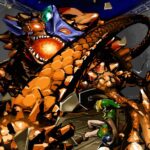
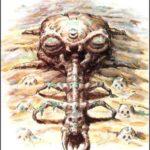
First there was inside a giant tree as the less visceral botanical counterpart, then carved into a mountain and within the giant skeleton of an Emperor Dodongo. From the same creators of these keyless dungeons we get the natural conclusion to the organic set of dungeons that accompany the child era; They are the culminations of their respective tribes’ elemental motif. So be prepared to suspend disbelief and come to terms that a relatively small whale on the outside has within himself a puzzle driven dungeon with equivalent elements for doors, buttons, lifts and any other complete disregard for anatomy. All in the service of one characteristic trope in media: being swallowed whole by a whale or an equivalent gargantuan monster and live to cause shenanigans inside. This is our womb level, time to get nasty.
Ocarina of Time stretched the idea of what a dungeon in Zelda could be; before Ocarina, the dungeons in Zelda were exactly that: Caves, ancient man-made structures and underground buildings. This 3D adventure showed that dungeons could be basically…anything. Nothing would be too absurd or outlandish anymore after having literal puzzles and enemies inside a whale. From then on, dungeons would appear on the sky, on another dimension, on mansions, boats or technology infused facilities.
Stories of whales or other aquatic creatures swallowing humans are recurring features in the mythologies of many cultures since they are the biggest creature we still have around; they don’t chew, they don’t rip the body, they just swallow the victim whole in one or two gulps— Scarily, it can actually happen in real life, but they are mostly accidents where whales were trying to eat something else, and large prey such as humans are expelled almost immediately.
Lord Jabu-Jabu takes the organic component to extreme lengths. The combination of the breathing visuals, claustrophobic setting and music that mimics sounds that are characteristic of living organisms creates the coarse atmosphere that would make the Metroid series proud because of how it straddles the line between sound effects and music. Like the other patron deity, the Great Deku Tree, this fish has been cursed with a parasite that needs to be removed.
Musical Analysis
Structure: Section 1
Time Signature: 4/4
Tempo: 76
Melodic and Harmonic Profiles: D Octatonic, D Diminished
As with the previous dungeons, Kondo uses few “instruments” to create the ambience of this fish deity. There is only one traditionally pitched instrument and this is the only dungeon track from the child portion of the game that has a drum beat; but not any beat, remember that this is a full red blooded mammal, which means that the cajon is the representation of the heartbeat of a beast that is currently alive—and not feeling very well since it has all those monster inside— The growling noises we hear are pretty much self explanatory, complementing the unsavory imagery with the sonic space Link is currently hearing coming from the stomach of the animal. The constant, pulsating ambience track supplements the claustrophobic sensation of this dungeon.
The use of this specific, eerie synth pad—a synth which would go on to be promoted to a major role on Majora’s Mask, owing to the special connection it shares with one of the game’s main inspirations— seems to parallel the use of its counterpart pad for the Zora’s Domain, cementing the connection of this place with the Zora and the princess Ruto; possibly implying that the ethereal mermaid choir from before has been corrupted inside the Lord Jabu-Jabu—it also could have sprouted from the electricity the dungeon is based around and the ties this element has to modern sounds.
This string pad is playing one-measure chords in a parallel motion that are reaching for a resolution that never seems to come; they move mostly in chromatic fashion. At first glance, it could be said that the chords are playing dominant seventh chords, however, from a musical intention point of view, it is better to classify the chords with the unconventional Sus2 (b5) suffix, seeing how the tritone is their main emphasis—in fact, the spirit of the piece would basically be unchanged if we remove the major second from the chord, its only function being softening the harmony and making it more mysterious than diabolical. The volume of all the instruments is undulating, creating a pulsating sonic landscape akin to the breathing sounds found on the scores of the Metroid series. Yet it is still significantly more musical than the previous dungeon tracks mainly due to its constant rhythm.
Samples used on this track:
Cajon = Trip Hopping; from the ‘Spectrasonics Distorted Reality’ library:
Underwater Pressure = Cricket Choir; from the ‘Spectrasonics Distorted Reality’ library:
Growl = Breaths/moans/screams – Crunch Roar; from the ‘A Poke in the Ear with a Sharp Stick II’ library:
Ethereal Strings = JX Lo Strings Right; from the Digidesign SampleCell Factory Library or basically any emulation of the iconic Roland D-50 string pad.
Help to keep the rites going around here by supporting the shrine:

Media Files, requests and support for more interactive content

Thou shall donate since this is a cult and you are now a sheep

Help staying awake analyzing game tracks and writing posts or else everything will end up being written by A.I
- Inside The Score – The Legend of Zeda: A Link to the Past – End Credits / Staff Roll
 The land rests As the last few minutes of this extensive journey that has now come to an end fly by, the nostalgia and reflective mood kicks in. Because such a massive enterprise as a Zelda game or a Lord of the Rings movie require multiple endings to convey everything… Read More »Inside The Score – The Legend of Zeda: A Link to the Past – End Credits / Staff Roll
 - Inside The Score – The Legend of Zelda: A Link to the Past – Ending / Epilogue ~ Beautiful HyruleFinal of the fantasy The Triforce has been touched. A wish has been granted. For the occasion, the newly undeceased king of Hyrule has commissioned a march in honor of the legendary hero to the Hylian Sousa, who might as well be composer Nobuo Uematsu since this piece is very… Read More »Inside The Score – The Legend of Zelda: A Link to the Past – Ending / Epilogue ~ Beautiful Hyrule
- Inside The Score – The Legend of Zelda: A Link to the Past – Triforce Chamber / Power of the GodsTake your boots off your feet And thus the Triforce spoke to men. And it became present in history. And you better treasure and contemplate this moment seldom witnessed in the course of the series. The elusive opportunity to interact and touch the most important artifact. You are now in… Read More »Inside The Score – The Legend of Zelda: A Link to the Past – Triforce Chamber / Power of the Gods
- Inside The Score – The Legend of Zelda: A Link to the Past – Ganon Battle / Prince of DarknessProgressive evil En Garde! And you better be prepared since you are about to duel the iconic enemy of the series at perhaps his canonically most powerful incarnation. Right after having touched the sacred Triforce which allowed him to conquer all of the Golden Land and whose evil and darkness… Read More »Inside The Score – The Legend of Zelda: A Link to the Past – Ganon Battle / Prince of Darkness
- Inside The Score – The Legend of Zelda: A Link to the Past – Boss Battle / Anger of the GuardiansQuick mayhem Ah, the simpler times when boss battles where not a multi epic orchestral suite but just an ostinato more basic that even what became the music for standard battle encounters out there. We are a long way from each boss having his own personalized track. And this early… Read More »Inside The Score – The Legend of Zelda: A Link to the Past – Boss Battle / Anger of the Guardians
- Inside The Score – The Legend of Zelda: A Link to the Past – Dark World Dungeon / Dungeon of ShadowsMemento mori We are getting closer to Ganondorf (or at least the wizard Agahnim who ultimately fulfills the same human side of evil role in this game) and that means getting closer to the profiles and motifs of his own theme song (which naturally was the theme of Agahnim at… Read More »Inside The Score – The Legend of Zelda: A Link to the Past – Dark World Dungeon / Dungeon of Shadows